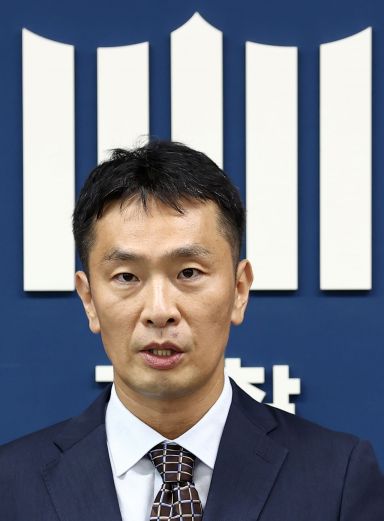
 On the 1st, at the Seoul High Prosecutors' Office press room, Deputy Chief Prosecutor Lee Bok-hyun of the Economic Crime Division at the Seoul Central District Prosecutors' Office announced the investigation results of the "Samsung Group Illegal Merger and Accounting Fraud Case." / Photo by Moon Ho-nam munonam@
[Asia Economy Reporter Ji Yeon-jin] With the appointment of a former prosecutor as the first Financial Supervisory Service (FSS) chief under the Yoon Seok-yeol administration, expectations and concerns are mixed within and outside the financial sector. While there is optimism that the FSS’s core functions could be strengthened through organic cooperation with the prosecution in addressing unfair practices such as price manipulation and financial crimes, there are also worries that a sanction-focused financial supervision approach could increase market volatility.
According to the financial investment industry on the 8th, the newly appointed FSS chief, Lee Bok-hyun, who took office the day before, is a Seoul National University economics graduate and a prominent economic and financial investigator within the prosecution, having passed both the certified public accountant and judicial exams simultaneously. He led the investigation into the Samsung Biologics (Samba) accounting fraud case, indicting Samsung Electronics Vice Chairman Lee Jae-yong without detention in connection with the Samsung Group’s illegal merger and accounting fraud allegations. He also investigated Hyundai Motor’s slush fund and the undervalued sale of Korea Exchange Bank to Lone Star, earning the nickname “Reaper of the Business World.”
In recent years, cases such as the Lime Asset Management scandal, private equity fund incidents, unfair practices in the capital market, and financial crimes have become increasingly sophisticated and often require legal interpretation. Given the series of related lawsuits, there is hope that a former prosecutor leading the FSS could invigorate supervisory work. An FSS official stated, “Although this is the first time a former prosecutor has been appointed as chief, if illegal activities are detected during FSS supervision, it can immediately lead to prosecution, which could speed up the handling of cases.”
In his inaugural speech the day before, Chief Lee emphasized a strict stance against market disruption activities. At his first meeting with reporters after taking office, he said regarding the Lime and Optimus scandals, “We understand that all individual private equity fund cases have been concluded and are already behind us,” but added, “We will thoroughly check through our system to see if there is anything that needs to be reviewed.”
The Lime scandal erupted in July 2019 when Lime Asset Management was suspected of manipulating returns through irregular trading of convertible bonds (CBs) of KOSDAQ companies, causing the stock prices of companies held in Lime-managed funds to plummet and triggering a suspension of redemptions. The Optimus scandal involved Optimus Asset Management collecting over 1 trillion won from investors through fund subscription solicitations last year, deceiving investors, and investing in bonds of insolvent companies, resulting in massive losses.
Particularly, the Discovery Fund was sold between 2017 and April 2019 through commercial banks such as Industrial Bank of Korea and Hana Bank, as well as securities firms. However, due to incomplete sales and poor management by the fund manager, redemptions were suspended, causing significant losses to individual and corporate investors. The police launched an investigation in July last year. Discovery Fund Asset Management CEO Jang Ha-won is the younger brother of Ambassador Jang Ha-sung to China, who is also reported to have invested about 600 million won in the Discovery Fund.
Chief Lee’s remarks indicate that while the FSS has completed inspections and sanctions related to these fund scandals, it intends to look further into any additional issues. This is interpreted as a commitment to comprehensively review private equity fund problems that occurred under the previous administration.
However, some express concern that under Chief Lee’s leadership, financial supervision might lean heavily toward sanctions, resembling prosecution investigations or indictments. In response, Lee said, “Given the nature of the financial industry, regulations cannot be completely eliminated. The question is how to rationalize and make them predictable. The FSS aims to improve its relationship with supervised institutions from the perspective of providing financial supervisory services so that consumers experience less inconvenience.”
Born in 1972, Lee is the youngest FSS chief to date. Currently, even deputy governors and bureau chiefs at the FSS were all born in the 1960s. Since the current administration’s launch, prosecutors have occupied key positions, sparking controversy over “prosecutorial bias” appointments. If internal conflicts arise alongside the FSS’s core duties of market supervision and financial consumer protection, it could become a burden at the government level. The People’s Solidarity for Participatory Democracy commented the day before, “Although Lee Bok-hyun, the nominated FSS chief, is an expert in investigating financial crimes, he is a former prosecutor with no expertise or experience in financial policy or consumer protection. We cannot help but worry that there will be significant gaps in financial policy supervision and consumer protection.”
© The Asia Business Daily(www.asiae.co.kr). All rights reserved.
![Clutching a Stolen Dior Bag, Saying "I Hate Being Poor but Real"... The Grotesque Con of a "Human Knockoff" [Slate]](https://cwcontent.asiae.co.kr/asiaresize/183/2026021902243444107_1771435474.jpg)
















