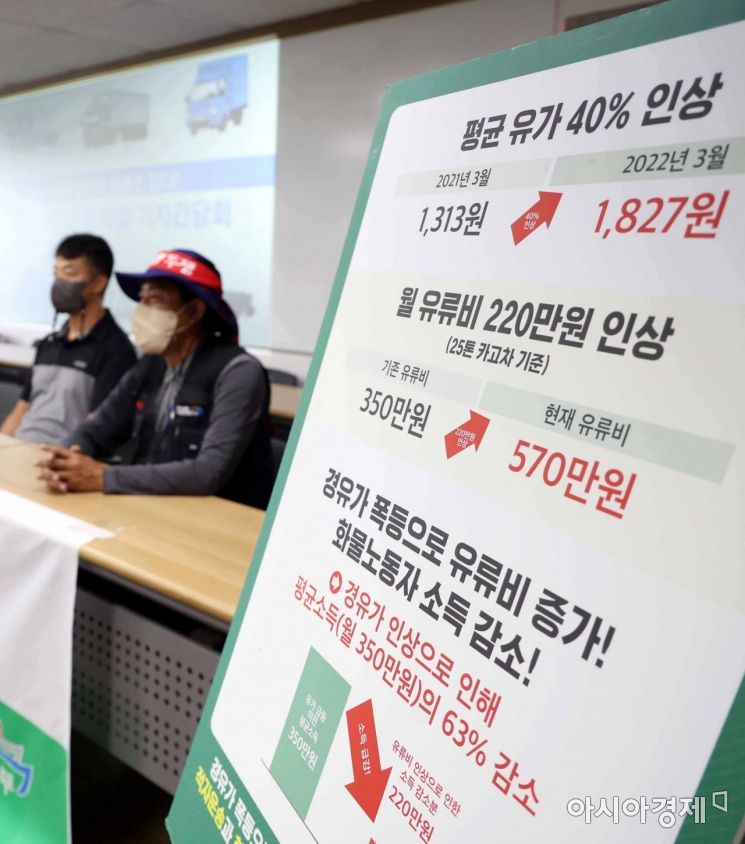
 On the 8th, a press conference for the "No Sunset for Public Safety! Cargo Solidarity General Strike" was held at the Korean Confederation of Trade Unions in Jung-gu, Seoul. The Cargo Solidarity began an indefinite general strike from midnight the previous day, demanding the abolition of the sunset clause on safe freight rates and an increase in transportation fees due to high oil prices. Photo by Moon Honam munonam@
34% of Union Members, Approximately 7,500, Expected to Participate in Rally
Industry Secures Inventory to Minimize Damage
Supply and Demand Issues if Prolonged
[Asia Economy Reporters Kim Min-young, Choi Dae-yeol, Gong Byung-sun] As the Cargo Truckers Solidarity Union strike enters its second day, the logistics crisis is intensifying. Although the government has expressed readiness to engage in dialogue with the Cargo Truckers Solidarity Union to prevent the strike from prolonging, the National Assembly, which serves as the discussion platform for the Safe Freight Rate System, is not functioning normally, making it likely that the strike will continue for the time being. The industry has prepared inventory to minimize damage caused by the strike, but there are concerns that prolonged disruption could lead to supply and demand problems.
According to the Ministry of Land, Infrastructure and Transport (MOLIT) as of 10 a.m. on the 8th, about 34% of Cargo Truckers Solidarity Union members, totaling approximately 7,500, are expected to participate in the rally. Around 4,000 members were dispersed regionally and stayed overnight on standby, and about 450 held a nighttime cultural event in Busan. During this process, at around 8:20 a.m., 15 union members were arrested on charges of obstructing transportation in front of the Hite Jinro factory in Icheon, Gyeonggi Province.
The government stated that no logistics disruptions have occurred so far. All 12 nationwide ports are operating normally without blocking entrances, and the container storage rate at each port (69.0%) is similar to normal times (65.8%). The storage rate refers to the ratio of containers actually stored compared to the port's container storage capacity. A MOLIT official said, "Major shippers and transport companies have pre-transported 2-3 days' worth of cargo in preparation for collective transport refusal, and so far, logistics damage appears minimal," adding, "Police forces have been deployed at key logistics hubs to prevent illegal acts such as transport obstruction, and alternative transport means, including military-commissioned container transport vehicles, are being deployed."
However, concerns remain that the strike could be prolonged because narrowing the gap in negotiations over expanding the Safe Freight Rate System items, which the Cargo Truckers Solidarity Union demands, is difficult. The 'Cargo Truck Safe Freight Rate System,' implemented since 2020, sets the freight cost per ton and driving distance for cargo trucks and publicly announces transport costs based on a principle similar to a taxi meter. The government calculated the average freight through the Safe Transport Freight Committee and is currently applying the system on a pilot basis to two items: container trucks and cement trucks. MOLIT states that to expand the items covered by the Safe Freight Rate System as the union demands, it is necessary to precisely identify the vehicle owner and have standardized vehicles.
A MOLIT official said, "The reason the system was implemented only for container and cement trucks is that the vehicle types are fixed and standardization is possible," adding, "For general trucks, it is difficult to identify the shipper."
The fact that the National Assembly, which holds the key to resolving the issue, is inactive has also worsened the situation. Discussions on expanding the items should also take place in the National Assembly, but due to power struggles between the ruling and opposition parties, the organization of the 21st National Assembly's second half has not been completed. Although the government expressed readiness for active dialogue the day before, concerns remain that unless the Safe Freight Rate System issue, the root cause of the current situation, is resolved through National Assembly discussions, the strike will inevitably prolong.
At a briefing held at the Sejong Government Complex on the same day, Deputy Minister Eom Myung-so said, "We are ready to engage in dialogue with the Cargo Truckers Solidarity Union at any time," adding, "If the National Assembly convenes, we expect the Safe Freight Rate System to be discussed promptly, and we will prepare follow-up measures without delay according to the National Assembly's discussions."
As the Cargo Truckers Solidarity Union strike enters its second day, the industry is busy preparing for a possible prolonged strike. Although some preparations were made by shipping products several days in advance before the strike, they are now working to minimize damage in case the situation extends. The automotive sector operates the entire process using Just-In-Time (JIT) production, minimizing inventory of parts to increase productivity. The problem is that they hold inventory for only three days at minimum and up to a week at most. Even assuming some inventory was secured in advance, if this period is exceeded, normal operations are likely to be disrupted. There have been frequent cases where the assembly lines of finished vehicles could not operate normally due to delayed supply of parts such as automotive semiconductors. If supply issues arise alongside the strike, production volumes of finished vehicle companies will inevitably decrease further, which will also affect general customers.
Industries such as steel, petroleum, and shipbuilding, where it is difficult to easily change product shipment volumes, are planning with the 'worst-case scenario' in mind. Some steel companies have already completely halted shipments as of midnight on the 7th. An industry insider said, "Since the government is also taking a principle-based response, it is not entirely possible to rule out the possibility of the conflict intensifying."
The situation is similar in the cement industry. According to the cement industry, cement plants in regions such as Danyang, Jecheon, Yeongwol, and Okgae (Gangneung), where the Cargo Truckers Solidarity Union effectively blocked the front and back gates of cement production plants the day before, are completely restricting access of Bulk Cement Trailer (BCT) vehicles transporting cement. The Cement Association estimated that cement shipments dropped to 15,500 tons on the previous day, less than 10% of the usual daily 180,000 tons, resulting in an estimated daily sales loss of 15.3 billion KRW (based on 93,000 KRW per ton) for the cement industry.
There are also concerns about pressure from union members on non-union members and conflicts at the site caused by this. An anonymous industry source said, "Although union members account for only about 5% of all cargo workers, problems arise because violence such as blocking normal operation vehicles of non-union members or labeling them as traitors is openly occurring."
Since it is difficult to definitively assess the effects of the Safe Freight Rate System implementation, the government is expected to maintain a strong stance for the time being. The Korea Transport Institute recently analyzed in a report that while the Safe Freight Rate System reduced cargo workers' working hours and positively impacted the improvement of overloading, it has limitations in confirming improvements in traffic safety. Although poor working conditions improved due to the average freight increase effect, the contribution to traffic safety from safer driving by vehicle owners was considered low.
© The Asia Business Daily(www.asiae.co.kr). All rights reserved.
![Clutching a Stolen Dior Bag, Saying "I Hate Being Poor but Real"... The Grotesque Con of a "Human Knockoff" [Slate]](https://cwcontent.asiae.co.kr/asiaresize/183/2026021902243444107_1771435474.jpg)
















