Measures to Revitalize the Private Space Industry Including Designation of Space Industry Cluster
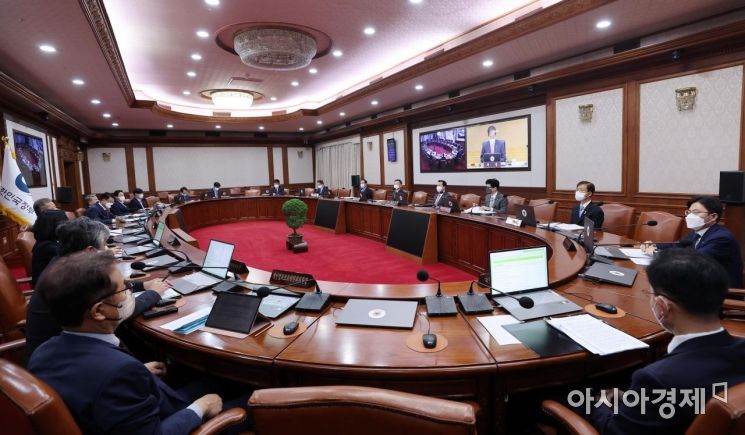 On the 31st, at the Government Seoul Office in Jongno-gu, Seoul, Cabinet members listened to Prime Minister Han Duck-soo's remarks during the Cabinet meeting held via video conference with the Sejong Office. Photo by Kim Hyun-min kimhyun81@
[Asia Economy Reporter Kim Bong-su] A legal foundation has been established to enable the designation and promotion of space industry clusters, thereby activating private-led space development.
The Ministry of Science and ICT announced on the 7th that the amendment to the Space Development Promotion Act, containing these provisions, has passed the Cabinet meeting. The amendment primarily includes expanding space development infrastructure and increasing its accessibility. To intensively foster the space industry, space industry clusters will be designated in consultation with local governments and others, and space development infrastructure owned by public institutions will be opened and made available for private sector use.
A contract system will be introduced for space development projects. Until now, the national space development project system has mainly involved participation in research and development (R&D) through agreements, making it difficult to guarantee profitability for companies. Going forward, contract methods that allow companies to factor in profits and other considerations will be possible. Considering the high technical difficulty, penalties for delays in contract fulfillment may be relaxed within the scope defined by enforcement ordinances (reviewing around 10% of the contract amount).
A system to designate new space technologies and promote technology transfer will also be implemented. Space technologies developed for the first time domestically will be designated as new space technologies, and products applying these new technologies will be given priority in procurement. To disseminate the outcomes of space development projects and promote technology transfer, policies regarding the management and distribution of information on achievements and technology transfer, as well as exchanges and cooperation in personnel, technology, and infrastructure, will be established and implemented.
Human resource development and startups in the space sector will also be promoted. To cultivate space specialists, policies including assessing manpower demand and supply forecasts and supporting educational programs will be established and implemented, and necessary support for promoting startups will be provided.
The Ministry of Science and ICT plans to enact related enforcement ordinances within the second half of this year. In particular, to designate space industry clusters for creating a private-led space industry ecosystem, a preliminary feasibility study report, including target area selection and detailed project planning, will be prepared by August.
Minister Lee Jong-ho of the Ministry of Science and ICT stated, “With the passage of this amendment to the Space Development Promotion Act, a legal foundation has been established to secure competitiveness in the space industry, which is a future growth engine. We will make every effort to ensure follow-up support such as project planning and to foster an ecosystem that does not fall behind in the NewSpace era.”
© The Asia Business Daily(www.asiae.co.kr). All rights reserved.
![From Bar Hostess to Organ Seller to High Society... The Grotesque Con of a "Human Counterfeit" [Slate]](https://cwcontent.asiae.co.kr/asiaresize/183/2026021902243444107_1771435474.jpg)
















