Global Fuel Price Surge Expected to Continue in the Second Half
 On the 7th, the Cargo Solidarity Union launched a general strike demanding the abolition of the sunset clause on safe freight rates and an increase in transportation fees due to high oil prices, at the Inland Container Depot (ICD) in Uiwang-si, Gyeonggi Province. Photo by Moon Honam munonam@
[Asia Economy Reporter Oh Hyung-gil] Concerns are growing that diesel prices, which triggered the indefinite general strike by the Cargo Solidarity Union, will continue their soaring trend in the second half of the year. Not only does the Russia-Ukraine conflict, which caused oil inflation, show no signs of calming down, but the scenario of explosive demand increase due to the COVID-19 endemic is becoming a reality.
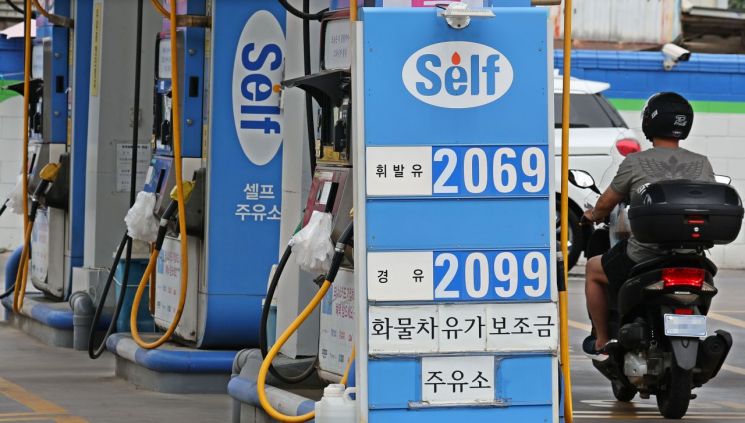
According to Korea National Oil Corporation's Opinet on the 7th, the average diesel retail price at gas stations nationwide recorded 2,025.2 KRW per liter, up 1.3 KRW from the previous day. At a gas station in Yongsan, Seoul, diesel prices have risen to 2,990 KRW, signaling an unprecedented breakthrough of the 3,000 KRW mark.
Diesel prices have been on the rise for over a month since the 3rd of last month, surpassing gasoline prices, causing cost burdens for freight transport and diesel vehicle drivers.
The problem is that this situation is not limited to South Korea alone. The international diesel price (based on 0.001% sulfur content) was $166.4 per barrel in the first week of June, up $16.8 from the previous week. Compared to $92.4 at the beginning of the year, this represents an increase of over 80%, leading to a shortage of inventory.
Diesel prices in the United States and Europe have also surged, spreading shockwaves globally. The average retail diesel price in the U.S. has risen more than 55% this year, recording a larger increase than the rise in international crude oil prices (35% based on WTI). In Europe, where diesel vehicles are relatively common, wholesale diesel prices have increased by 88% over the past year.
The global surge in diesel prices is primarily attributed to the Russia-Ukraine conflict. Russian diesel has accounted for 14% of Europe's total diesel consumption, and sanctions banning Russian crude oil imports have driven up international prices.
In particular, refiners increasing jet fuel production this year has been identified as another cause of the diesel price surge. Jet fuel, a type of kerosene, has a boiling point similar to diesel and is produced using the same facilities, allowing production volumes to be adjusted.
During the COVID-19 period, jet fuel production was reduced, but as the pandemic showed signs of easing, jet fuel production was significantly increased. The International Energy Agency (IEA) pointed out that the sharp rise in diesel prices compared to gasoline is due to refiners increasing jet fuel production as air travel demand recovered, which reduced diesel production.
Domestic refiners are also increasing jet fuel production instead of diesel. From January to April, domestic jet fuel production was 35.26 million barrels, up 31% compared to the same period last year, while diesel production increased by only 8.5% to 115.74 million barrels.
© The Asia Business Daily(www.asiae.co.kr). All rights reserved.


















