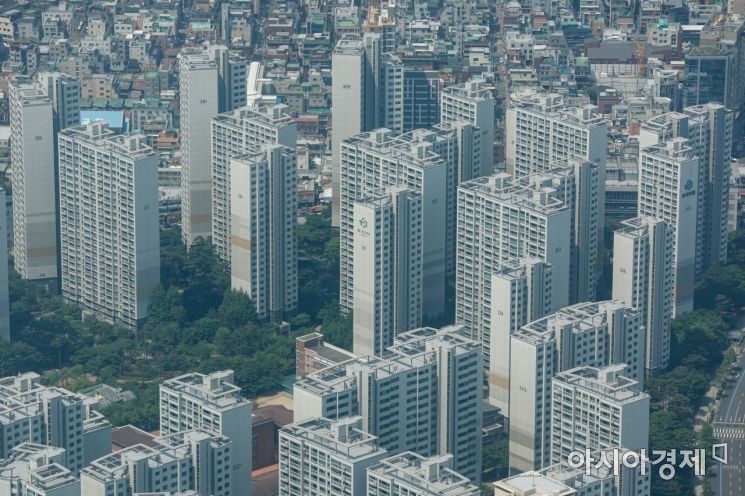
 On the 17th, a view of apartments from Lotte World Tower Seoul Sky in Songpa-gu, Seoul. The Korea Real Estate Board announced that the actual transaction price index for apartment sales in Seoul in March was 175.1, up 1.4 points from the previous month (173.7). This marks the first time in five months since October last year, when the Seoul apartment sales actual transaction price index recorded 180.0, that the index has turned upward again. Photo by Jinhyung Kang aymsdream@
[Asia Economy Reporter Myunghwan Lee] Amid recent sluggish stock markets, a warning has emerged that REITs (Real Estate Investment Trusts), which are gaining attention as a hedge against high inflation, may also face risks from high interest rates. Securities firms advised selective investment, noting that if the trend of raising the base interest rate continues, the expected returns on REITs could decline.
According to the securities industry on the 5th, as of the end of April, there are 326 domestic REITs with estimated assets under management of about 79 trillion 600 billion KRW. Among them, 20 REITs are listed on the stock market as of the end of last month, with a market capitalization of approximately 8.6 trillion KRW.
REITs are real estate indirect investment vehicles structured as joint-stock companies that pool funds from multiple investors and borrow loans to invest in real estate, returning rental income and capital gains to investors.
Among stock investors, listed REITs traded like stocks on the stock market are popular. Their advantages include low price volatility and stable dividend payments, making them recently recognized as a tool to hedge against inflation risks. This is because it is easier to pass on inflation to rents.
Korea Investment & Securities analyzed the annual dividend yields of seven REITs listed on the KOSPI: ESR Kendall Square REIT (3.8%), Lotte REIT (5.2%), SK REIT (3.8%), Shinhan Alpha REIT (5.1%), D&D Platform REIT (5.2%), NH All One REIT (4.7%), and Aegis Residence REIT (4.8%).
Researcher Kyungtae Kang of Korea Investment & Securities explained, "REITs have a dividend payout ratio exceeding 100%, playing a role in defending against recent inflation, but if the interest rate hike trend continues, returns will decrease."
Since REITs distribute more than 90% of their distributable earnings to investors, they need to form lending syndicates to raise funds for real estate investments. Therefore, loan interest may increase due to rising borrowing costs, which could exceed the increase in income from inflation. The collateral loan interest rates for 16 domestic REITs are estimated to be below the mid-2% range. The outstanding borrowings and bond issuance balance of these 16 listed REITs amount to about 8.7071 trillion KRW, with 63.2% maturing by 2024.
Korea Investment & Securities, despite concerns over rising interest expenses from borrowing, expects REITs investing in office assets such as Shinhan Alpha REIT, D&D Platform REIT, NH All One REIT, Aegis Residence REIT, and SK REIT to generate relatively stable returns in the second half of the year, considering steady office demand. The average monthly rent for Seoul offices in Q1 this year reached a record high of 102,592 KRW per pyeong.
The securities industry also advised selective investment as the global REIT index turned downward in the first half due to inflation and concerns over economic slowdown from the U.S. Federal Reserve's tightening. Researcher Sangyoung Bae of Daishin Securities said, "U.S. REITs are expected to rebound in the third quarter, but the extent is expected to be limited," adding, "If concerns over a hard landing or recession materialize, the rise in real asset values will slow or turn slightly negative."
Daishin Securities suggested that in the second half, alternative investments in the global REIT market include residential assets expected to shift to rental demand, IT assets with low economic sensitivity, and lodging and resort assets with growth momentum due to the endemic transition of COVID-19.
© The Asia Business Daily(www.asiae.co.kr). All rights reserved.

















