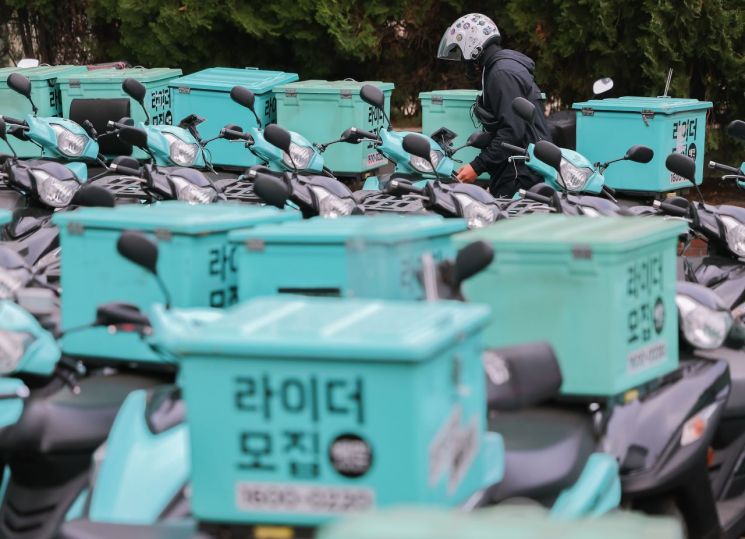
 On April 12th, delivery scooters were parked in front of a Baemin Riders center in downtown Seoul. [Image source=Yonhap News]
[Asia Economy Reporter Hwang Sumi] The number of users of the three major delivery apps has decreased by more than one million over the past month. This is attributed to soaring delivery fees and increased outdoor activities following the full lifting of social distancing measures.
According to the big data analysis platform Mobile Index on the 3rd, the monthly active users (MAU) of the three delivery apps last month totaled 32,092,451. This represents a decrease of about 3.4% compared to April's MAU (33,216,220). The decline is even more significant compared to March (35,320,008), before social distancing was lifted.
Specifically, Baedal Minjok's MAU in May was recorded at 19,938,717, down about 250,000 from the previous month. Yogiyo, which once secured 9.05 million MAU, also saw a decrease of around 300,000 during the same period, recording 7.65 million users. Coupang Eats experienced an even more pronounced user drop. Its May MAU was 4.5 million, down more than 560,000 from the previous month.
Various analyses have emerged regarding the recent slowdown in the rapidly growing delivery market since the COVID-19 pandemic.
The industry first pointed to seasonal factors as the cause. The period from March to May, with warmer weather, has traditionally been an off-season for delivery due to increased outdoor activities.
Additionally, the recent easing of social distancing measures has led to increased outings and dining out, temporarily reducing delivery demand. In fact, an analysis of credit card payment data for restaurants and pubs by BC Card's New Finance Research Institute showed that restaurant sales focused on delivery services decreased by 12% between April 18 and 30, when operating hours and capacity restrictions were fully lifted. Restaurants operating both delivery and offline services saw a 4% decline in sales.
Accordingly, the industry stated that it is necessary to observe whether the downward trend continues through the summer, but expressed hopeful forecasts that delivery demand will recover to previous levels after May and June.
However, the views of self-employed business owners and consumers differed. It was analyzed that soaring delivery fees prompted some users to leave. In fact, perceived delivery costs by users have roughly doubled over the past year, as Baemin and Coupang Eats raised delivery fees and commission rates earlier this year.
Franchise chicken delivery fees increased from around 2,000 to 3,000 won to as much as 5,000 won. Along with the increased delivery fee burden, food menu prices also rose accordingly. Furthermore, as delivery commissions shifted from a fixed-rate system to a percentage-based system, self-employed business owners faced increased cost burdens as food prices rose. Consequently, a "departure from delivery apps" phenomenon is emerging among those who cannot endure the high fees and delivery charges.
Meanwhile, a survey found that consumers consider an appropriate delivery fee to be around 1,600 won when using food delivery services. According to a report titled "Survey on Inclusiveness and Sustainability in the Food Service Sector," released by the Korea Rural Economic Institute on the 22nd of last month, the average appropriate delivery fee cited by respondents when ordering 20,000 won worth of food was 1,618 won.
© The Asia Business Daily(www.asiae.co.kr). All rights reserved.
![Clutching a Stolen Dior Bag, Saying "I Hate Being Poor but Real"... The Grotesque Con of a "Human Knockoff" [Slate]](https://cwcontent.asiae.co.kr/asiaresize/183/2026021902243444107_1771435474.jpg)
















