[Asia Economy Reporter Lim Hye-seon] The second round of 5G frequency allocation by telecom companies has officially begun. LG Uplus has been allocated the 20 MHz bandwidth of 5G frequency it had long dreamed of as a key project. The auction for the 40 MHz bandwidth (3.70~3.74 GHz, two 20 MHz bands) requested by SK Telecom requires considerable time to prepare detailed allocation plans, so it has been decided to proceed later, continuing the controversy.
LG Uplus Secures Additional 5G Frequency
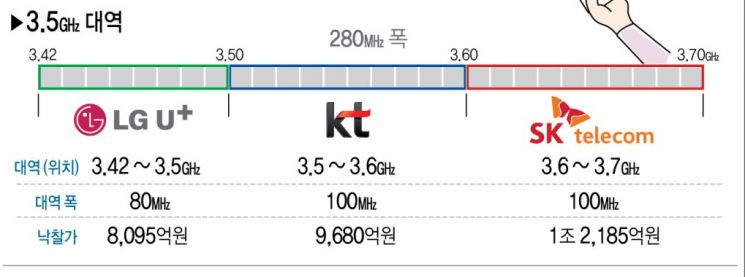
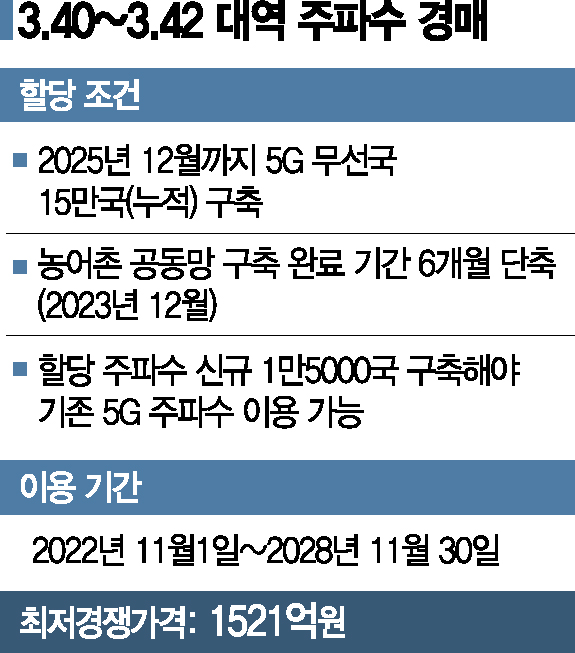
On the 3rd, the Ministry of Science and ICT announced it would hold an auction for the 3.40~3.42 GHz band frequency. Although it is an auction, LG Uplus is the only company that can actually use this band, making a sole bid highly likely. Since it is an adjacent band frequency, LG Uplus can provide services by combining it with its existing 80 MHz band (3.42~3.50 GHz) without additional investment. SKT and KT face difficulties participating in the auction because even if they win, additional investment costs are required. As it proceeds as a sole bid, the Ministry of Science and ICT set conditions. LG Uplus must build 15 million new 5G base stations to use the frequency allocated from the existing 5G base stations. The minimum competitive price was set at a total of 152.1 billion KRW.
The frequency usage period is from the allocation date (November 1) until the existing 5G frequency usage end date of November 30, 2028. In the past, SKT paid 1.2185 trillion KRW for a 100 MHz bandwidth from 3.60~3.70 GHz, and KT paid 968 billion KRW for a 100 MHz bandwidth from 3.50~3.60 GHz. LG Uplus acquired the 80 MHz band (3.42~3.50 GHz) for 809.5 billion KRW. Through this auction, LG Uplus can obtain a total of 100 MHz of 5G frequency by adding 20 MHz to the previously won 80 MHz band for a total of 961.6 billion KRW. Among the three major telecom companies, it secured the same capacity frequency at the lowest price. This has led competitors to accuse LG Uplus of using tricks to acquire frequencies cheaply.
Competitors SKT and KT Express ‘Regret’
In July last year, when it was concluded that the reserved remaining band from 2018 could be utilized, LG Uplus requested frequency allocation. The Ministry of Science and ICT formed a research team and announced plans to allocate frequencies in December, but the schedule was delayed due to opposition from competitors and SKT’s request for additional allocation of part of the 3.7 GHz band 300 MHz bandwidth (3.7~3.72 GHz, 20 MHz). LG Uplus stated, "We will do our best to secure additional frequencies according to the government’s allocation announcement schedule," adding, "If we secure additional frequencies through this allocation, we will strive to improve user benefits through active 5G investment and quality enhancement."
SKT said, "We are concerned that this does not comply with the principles and standards of frequency supply," and added, "We hope frequency supply will be made so that related frequencies can be used simultaneously, considering public benefit, domestic telecom equipment growth, and balanced development of the telecom ecosystem." KT also expressed regret, saying, "We agree with the policy intent but regret that there are no restrictions on usage time or region."
Will the 5G Communication Quality Evaluation Rankings Change?
If LG Uplus secures the frequency in this auction, the rankings in next year’s 5G communication quality evaluation may change. This is because there is a technological gap between the Huawei equipment (64TRX) used by LG Uplus and the domestic equipment used by competitors. The commercialization of domestic equipment competing against Huawei is expected in the first half of next year. Last year’s 5G download speed evaluation rankings were SKT, KT, and LG Uplus in that order.
Hong Jin-bae, Network Policy Officer, said, "Domestic manufacturers have developed technology and export similar performance to the U.S., so the introduction for domestic use will occur through competition," adding, "The frequency allocation competition could have a positive impact on small and medium-sized enterprises."
© The Asia Business Daily(www.asiae.co.kr). All rights reserved.


















