
[Asia Economy Reporter Kang Nahum] The aftermath of Google's mandatory in-app payment policy is proving to be significant. Content and app developers, as well as platforms, are actively preparing promotional strategies for 'web payments' that allow them to maintain existing prices. Meanwhile, consumer groups and companies both domestically and internationally are showing movements to confront Google through complaints and lawsuits.
According to the industry on the 3rd, with the mandatory in-app payment policies by Google and Apple starting this month, price increases for content have become inevitable. Companies listed on app markets are currently considering how to encourage users to use web payments. Since web payments do not incur commission fees associated with in-app payments, it is possible to maintain existing prices.
Previously, before Naver Webtoon’s mandatory in-app payment enforcement, they introduced an 'automatic recharge system' to enhance the convenience of web payments for users. This system automatically recharges usage rights on a set date each month or automatically recharges when the number of usage rights (cookies) falls below a certain threshold. Although the cookie (voucher) price was raised from the original 100 won to 120 won, once registered, users can continue to use the service at the original cookie price through this system.
Kakao also raised the price of KakaoTalk Emoticon Plus from the original 4,900 won per month to 5,900 won per month but informed users that "on the web, you can subscribe at a price of 3,900 won per month." Emoticon Plus is a subscription service that allows unlimited use of emoticons for a fixed monthly fee.
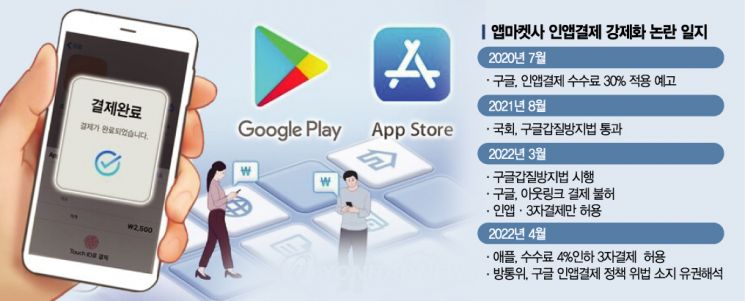
However, since the mandatory in-app payment policy began on the 1st, such promotional methods have become practically difficult. In Google's case, they threatened to delete apps that provide 'outlinks' leading to web payments and prohibited the use of expressions that guide or encourage web payments.
An industry insider said, "Even if there are ways to use content at cheaper prices, it has become difficult to explain this within the app due to Google's policy," adding, "We are currently looking for effective ways to promote the advantages of web payments."
Meanwhile, movements to confront Google are intensifying. The consumer group Consumer Sovereignty Citizens' Assembly plans to submit a complaint to the Gangnam Police Station against Google today. They claim that Google blatantly violated the enforcement decree prepared by the Korea Communications Commission, which incorporated industry opinions, ignoring the legislative intent of the Google Gapjil Prevention Act (an amendment to the Telecommunications Business Act). Prior to this, domestic publishers and authors also filed civil lawsuits against Google's mandatory in-app payment policy.
Not only in Korea but also overseas, litigation against Google is in full swing. Recently, Match Group filed an antitrust lawsuit against Google and succeeded in excluding about 10 apps they operate, including Tinder, Hinge, and OkCupid, from Google's in-app payment regulations.
Additionally, Spotify, Epic Games, 36 U.S. states along with Washington D.C., and the Netherlands Consumer Competition Claims Foundation are engaged in lawsuits against Apple and Google over mandatory in-app payments.
As Google's mandatory in-app payment policy emerges as a global issue, opinions calling for international cooperation are also being raised. A representative from the Korea Internet Corporations Association said, "Governments, parliaments, app developers, and consumers around the world are responding to app market operators' mandatory in-app payment policies in various ways," adding, "Since the mandatory in-app payment policy of app market operators is not an issue limited to a specific country, it is necessary to strengthen international cooperation."
© The Asia Business Daily(www.asiae.co.kr). All rights reserved.
![Clutching a Stolen Dior Bag, Saying "I Hate Being Poor but Real"... The Grotesque Con of a "Human Knockoff" [Slate]](https://cwcontent.asiae.co.kr/asiaresize/183/2026021902243444107_1771435474.jpg)

















