All About Senior Public Official Appointments Analyzed by a Former Blue House Reporter
Comprehensive Coverage of the Presidential Personnel System's Scope, Operating Principles, and Cases
[Asia Economy Kim Yoon-jin, Intern Reporter] It is no exaggeration to say that the success or failure of presidential leadership depends on personnel appointments. The number of positions influenced by the president exceeds 18,000. Even counting only the positions where the president legally exercises direct appointment authority, there are more than 300. These include the Chief Justice and 13 Supreme Court Justices, 3 Constitutional Court Justices, 3 Central Election Commissioners, about 140 political positions such as ministers and vice ministers of the executive branch, and around 150 executives of public institutions. The five-year national administration, and consequently the lives of the people during those five years, change depending on whom the president appoints.
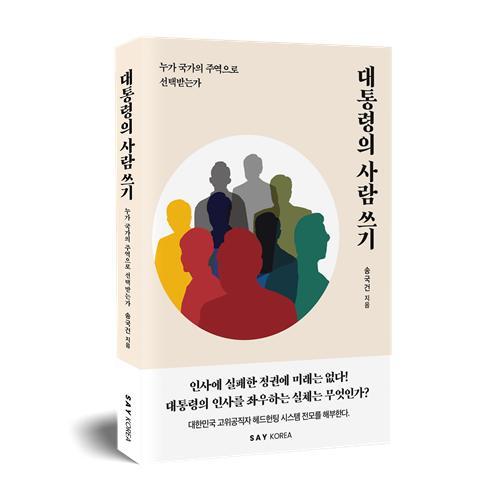
Using People by the President (Song Guk-geon, Se Korea) explains how high-ranking public official appointments directly affect the fate of the nation. The author, who earned the title of "the longest-serving reporter with access to the Blue House" by covering the Blue House for about ten years from the Roh Tae-woo administration through the Roh Moo-hyun administration, analyzes the high-ranking public official appointment systems of past administrations.
The basic principle of corporate personnel management is to evaluate work ability. However, presidential appointments are different. In addition to the individual's ability and expertise, various factors must be considered to meet the diverse demands of society as a whole. Considerations include balancing the appointee's regional origin and alma mater, political orientation, background, internal organizational reputation, and more. Care for marginalized groups is also necessary. The author describes the exercise of presidential appointment authority as "close to a political-engineering comprehensive art" in this regard.
There is a system for presidential appointments. When a personnel need arises, the Presidential Secretariat’s Chief Secretary for Personnel identifies candidates through the national talent database, unofficial confidential materials, or recommendations from the administration’s circle. After personnel verification, the candidates are discussed in a personnel consultation body chaired by the Chief Secretary, and once the consultation body approves, the president officially appoints them.
However, the author points out that the "system personnel" that should be the premise of exercising appointment authority was often replaced by "non-system personnel." Non-system appointments such as patronage appointments by power brokers within the administration, political appointments based on political judgment, rewarding those who contributed to the regime’s establishment, and unofficial power brokers who reduce ministers to figureheads caused malfunctions in the normal personnel system and led to confusion in personnel verification every time a new government was launched. This book uncovers the true face of the personnel war, described as a "battlefield between the system and power brokers," by administration.
The book also contains a blueprint for the initial cabinet formation of the Yoon Suk-yeol administration. The Yoon administration promised to abolish the Civil Affairs Office, signaling changes to the existing presidential personnel system. The author analyzes the scope, operating principles, and cases of presidential appointments diachronically, predicting how the new government’s experiment will be conducted and what types of figures will become the main actors of the new administration.
Using People by the President | Written by Song Guk-geon | Se Korea | 304 pages | 18,000 KRW
© The Asia Business Daily(www.asiae.co.kr). All rights reserved.

















