"Delay in Delivery Could Be Used as a Pretext for Breach of Contract by Overseas Buyers"
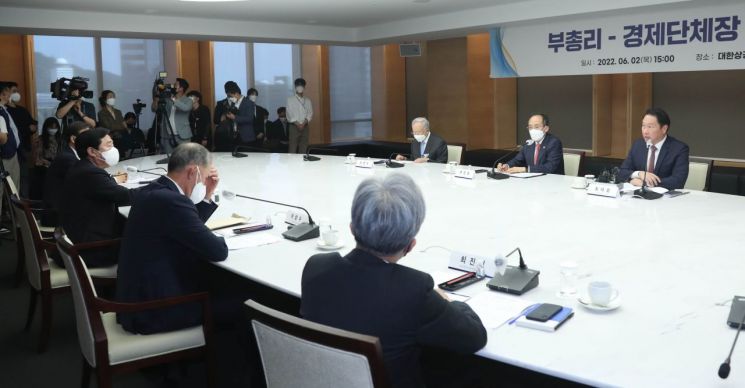 Chairman Chey Tae-won of the Korea Chamber of Commerce and Industry (top row, right) delivering a greeting at the meeting between Deputy Prime Minister for Economy Choo Kyung-ho and the heads of six economic organizations held on the afternoon of the 2nd at the Korea Chamber of Commerce and Industry building in Jung-gu, Seoul. (Photo by Korea Chamber of Commerce and Industry)
[Asia Economy Reporter Moon Chaeseok] The Korea Chamber of Commerce and Industry, the Federation of Korean Industries, the Korea Employers Federation, the Korea International Trade Association, the Korea Federation of Small and Medium Business, and the Korea Federation of Medium-sized Enterprises expressed their concerns and regrets regarding the Cargo Solidarity's declaration of an indefinite collective transportation refusal in a joint statement released on the 2nd.
These organizations stated, "Many companies are experiencing a triple hardship of supply chain crises, rising raw material prices, and increased logistics costs, while transportation difficulties have intensified due to the Russia-Ukraine conflict and the Shanghai lockdown in China," adding, "The Cargo Solidarity's refusal of land transportation will impose a greater burden on companies." They further pointed out, "Delays in delivery caused by transportation disruptions lead to contract breaches with overseas buyers, resulting not only in compensation claims but also in damage to companies' external credibility," emphasizing, "The damage to companies is difficult to estimate even arithmetically."
Referring to the government's adjustment of the base amount for diesel fuel price-linked subsidies starting from the 1st to alleviate the difficulties faced by truck drivers, these organizations proposed resolving the issue through dialogue among stakeholders rather than collective transportation refusal. They also pledged, "In line with the launch of the new government, companies plan to focus more than 80% of their investment plans domestically to stimulate domestic demand and create quality jobs," promising, "We will contribute to economic growth and the improvement of citizens' lives."
Prior to the joint statement by the economic organizations, the Korea Employers Federation separately released its 'Management's Position on the Cargo Solidarity's Collective Transportation Refusal,' criticizing the Cargo Solidarity's general strike plan as "an unjustified collective action aimed at enforcing unilateral demands by holding the economy and logistics hostage." The Federation also stated, "This collective transportation refusal by the Cargo Solidarity may constitute an 'unjustified refusal of transportation' prohibited under the Truck Transportation Business Act, thus carrying a high risk of illegality," and demanded, "The government should issue an order to commence work, and if the Cargo Solidarity refuses this or engages in illegal actions such as obstructing transportation or violence, strict measures should be taken according to law and principles."
© The Asia Business Daily(www.asiae.co.kr). All rights reserved.

















