April Monthly Rent Transactions Surpass Jeonse... Highest Share of Seoul Apartment Purchases by Under 30s This Year
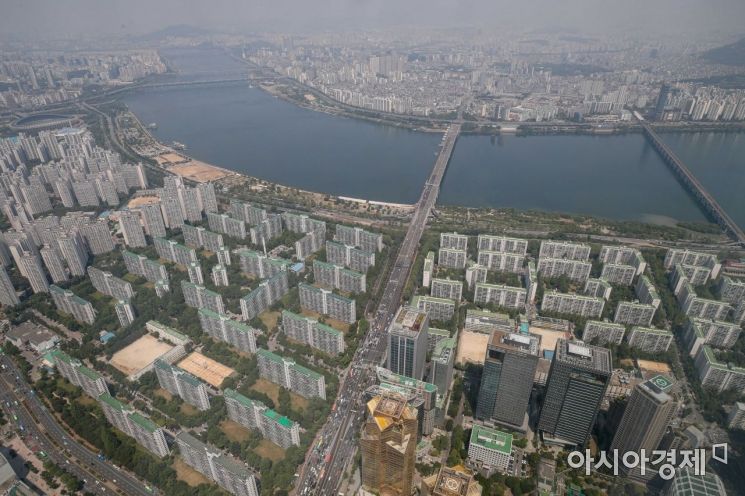 On the 17th, a view of apartments from Lotte World Tower Seoul Sky in Songpa-gu, Seoul. The Korea Real Estate Board announced that the actual transaction price index for apartment sales in Seoul in March was 175.1, up 1.4 points from the previous month (173.7). This marks the first time in five months since recording 180.0 in October last year that the Seoul apartment sales actual transaction price index has turned upward again. Photo by Jinhyung Kang aymsdream@
[Asia Economy Reporter Kim Min-young] Due to the implementation of the Lease Protection Act 2 (right to request contract renewal, rent ceiling system), which caused a sharp rise in jeonse prices, combined with loan regulations and interest rate hikes, the phenomenon of "jeonse turning into monthly rent" is accelerating, leading to an increase in the proportion of apartment purchases by the 2030 generation in Seoul. Recently, as jeonse listings have decreased mainly in Seoul and the metropolitan area and the financial burden has increased due to interest rate hikes, more young people seem to prefer securing their own homes, even if small in size.
According to the Ministry of Land, Infrastructure and Transport on the 4th, the total number of monthly rent and jeonse transactions nationwide in April was 258,118, of which monthly rent transactions accounted for 130,295 (50.4%), surpassing jeonse transactions (128,023). This is the first time since the government began compiling related statistics in 2011 that monthly rent transactions have exceeded 50% of the lease market and surpassed jeonse transactions.
Based on cumulative transactions from January to April this year, the proportion of monthly rent in lease transactions was 48.7%, up 6.5 percentage points from 42.2% during the same period last year. Compared to the five-year average of 41.6%, the monthly rent proportion was 7.1 percentage points higher.
Monthly rent prices are also soaring. According to the Korea Real Estate Board, the average monthly rent price for apartments in Seoul in April was 1,254,000 KRW, the highest ever recorded. Similarly, the nationwide average monthly rent price in April was 816,000 KRW, also at an all-time high. The May Seoul Monthly Rent Index (KB Real Estate) reached 102.3, the highest since 2016. With recent rapid inflation increasing living expenses, the rise in monthly rent prices is further burdening the household budgets of ordinary citizens.
As the monthly rent and jeonse market becomes unstable, the proportion of apartment purchases by the 2030 generation in Seoul is also increasing. According to the Korea Real Estate Board’s apartment sales statistics by buyer age group, as of the 2nd, the number of apartment sales in Seoul in April was 1,624 (based on the reporting date), of which 687 apartments (42.3%) were purchased by those aged 30 or younger. Both the number and proportion of apartment purchases by those aged 30 or younger in Seoul last month were the highest since the beginning of this year. It is also the highest in seven months since September last year.
The proportion of apartment purchases by those aged 30 or younger in Seoul began to increase significantly in August 2020 (40.4%), when housing prices surged. At that time, the purchase proportion of the 2030 generation first exceeded 40%, peaked at 44.1% in September last year, and then declined. In particular, this proportion dropped to 36.0% in February this year but changed after the presidential election ended in March. The proportion of apartment purchases by those aged 30 or younger in Seoul rose to 40.7% in March, up 4.7 percentage points from 36.0% in February, recovering to the 40% range again, and the increase expanded further last month.
Following the presidential election, expectations for the new government’s real estate deregulation policies have somewhat revived apartment transactions in Seoul, and as apartment prices rose in some areas, the 2030 generation appears to have resumed purchasing. Additionally, the recent decrease in jeonse listings and the rise in jeonse prices, causing instability in the monthly rent and jeonse market, also influenced this purchasing trend.
However, it is unlikely that the buying trend among young people aged 30 or younger will lead to a buying frenzy like last year. This is because the burden of purchasing homes has increased for the 2030 generation, who lack financial capacity due to loan regulations, interest rate hikes, and rising pre-sale prices. Although the government recently announced plans to lower loan barriers for young people, forecasts suggest that mortgage interest rates could reach 7% per annum, making it difficult for demand to increase significantly through aggressive home buying.
© The Asia Business Daily(www.asiae.co.kr). All rights reserved.
![Clutching a Stolen Dior Bag, Saying "I Hate Being Poor but Real"... The Grotesque Con of a "Human Knockoff" [Slate]](https://cwcontent.asiae.co.kr/asiaresize/183/2026021902243444107_1771435474.jpg)











