Kim Eun-hye of the People Power Party Expected to Lead
The Only Metropolitan Area to Experience a Reversal
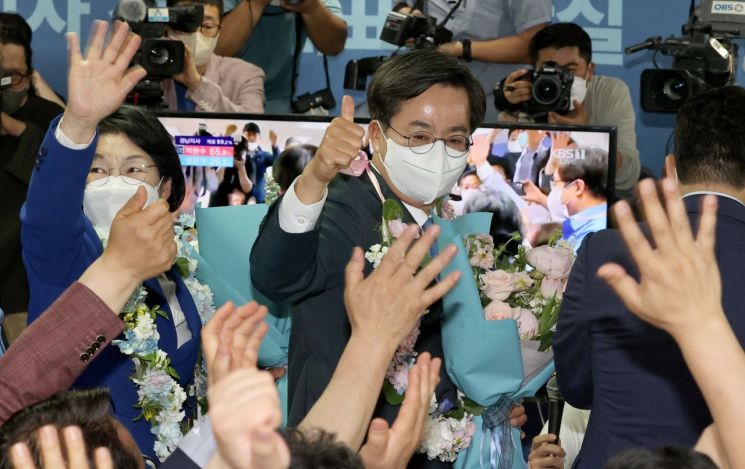 Kim Dong-yeon, the Democratic Party candidate for Governor of Gyeonggi Province, cheers as his victory becomes certain on the morning of the 2nd at the campaign office in Paldal-gu, Suwon-si, Gyeonggi-do. (Photo by Yonhap News)
[Asia Economy Reporter Geum Bo-ryeong] Kim Dong-yeon, the Democratic Party of Korea candidate for Governor of Gyeonggi Province, won by an ultra-close margin of 0.1 percentage points, overturning the exit poll predictions of the three major broadcasters (KBS, MBC, SBS) for the June 1 nationwide local elections. While the exit polls accurately predicted close races within 1 percentage point in other regions and even in the last presidential election, Gyeonggi Province was an exception this time.
According to the local election exit poll announced on the 1st by the Joint Broadcasting Prediction Survey Committee (KEP), formed by the three broadcasters and the Korea Broadcasting Association, among the 17 metropolitan mayoral elections, the People Power Party led in 10 areas, the Democratic Party in 4, and 3 were considered competitive.
The competitive areas were Gyeonggi, Daejeon, and Sejong. Although an extremely close contest was expected, the prediction was that the People Power Party candidate would win by a narrow margin. Specifically, for the Gyeonggi Province Governor race, Kim Eun-hye of the People Power Party was projected at 49.4%, and Kim Dong-yeon at 48.8%, showing less than a 1 percentage point difference. Kim Eun-hye maintained a lead until around 5 a.m. on the 2nd, but Kim Dong-yeon overtook her around 5:30 a.m., and by about 7 a.m., his victory was confirmed, reversing the exit poll forecast.
Since the Gyeonggi race showed a tight contest in pre-election opinion polls, it is analyzed that accurate predictions were difficult even in the exit polls. Additionally, while exit polls have the advantage of high response accuracy by directly surveying voters as they leave the polling stations, Gyeonggi has over 5.8 million voters, making it challenging to gauge public sentiment accurately. The exit poll conducted by the three broadcasters surveyed approximately 104,378 people across 17 cities and provinces, which is insufficient considering the number of voters in Gyeonggi alone.
The significant variation in candidate support by region is also cited as a reason for the discrepancy in exit poll results. Um Kyung-young, director of the Era Spirit Research Institute, explained, "In Gyeonggi Province, areas like Suwon have many Democratic Party supporters, while places like Yongin have many People Power Party supporters, resulting in regional vote concentration that can cause confusion in exit polls. This is also why some pre-election polls showed Kim Eun-hye leading, while others showed Kim Dong-yeon ahead."
This exit poll was conducted by the three broadcasters commissioning Korea Research, Hankook Research, and Ipsos, surveying 631 polling stations nationwide from 6 a.m. to 6 p.m. the previous day. The margin of error at a 95% confidence level ranges from ±1.6 to 3.4 percentage points by city and province.
© The Asia Business Daily(www.asiae.co.kr). All rights reserved.

![Clutching a Stolen Dior Bag, Saying "I Hate Being Poor but Real"... The Grotesque Con of a "Human Knockoff" [Slate]](https://cwcontent.asiae.co.kr/asiaresize/183/2026021902243444107_1771435474.jpg)














