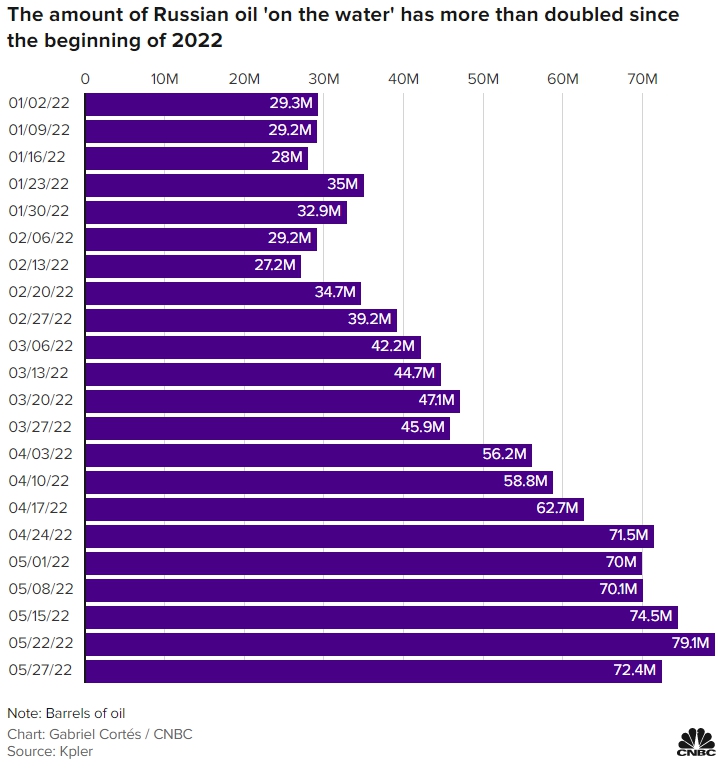
[Asia Economy Reporter Park Byung-hee] An analysis has revealed that the volume of Russian crude oil "floating on the water" is approaching nearly 80 million barrels. This volume accounts for Russian crude oil loaded on tankers that are either in transit somewhere or simply sitting on tankers. Before Russia's invasion of Ukraine, this volume was around 30 million barrels. The sharp increase in the volume floating on the water over the past few months is attributed to the Western sanctions imposed after Russia's invasion of Ukraine, which blocked sales channels, causing a surge in Russian crude oil loaded on tankers but unsold.
According to CNBC, Bloomberg, and other sources, commodity information firm Kpler estimated that as of the 27th of last month, the volume of Russian crude oil floating on the water was 72.4 million barrels, slightly down from 79.1 million barrels the previous week. This volume was only 34.7 million barrels on February 20, just before Russia invaded Ukraine.
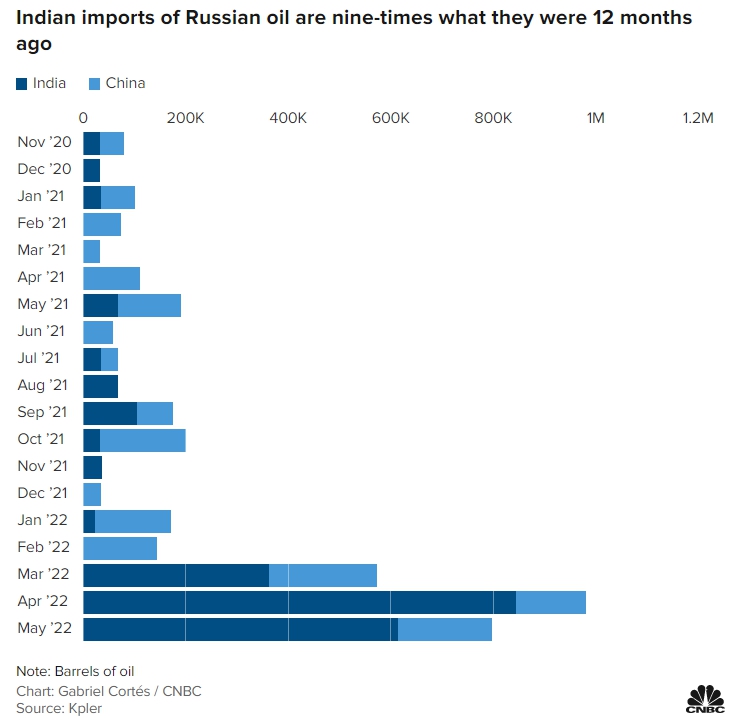
Kpler analyzed that the volume of Russian crude oil heading to India and China has increased to unprecedented levels. The combined monthly volume of Russian crude oil imported by China and India did not exceed 200,000 barrels before the outbreak of the Ukraine war.
However, imports rose to 573,300 barrels in March and surged again to a record high of 970,600 barrels in September. Although there was a slight decrease in May, imports remained at 798,000 barrels, about four times the level before the Ukraine war.
China imported 362,100, 833,800, and 614,700 barrels of Russian crude oil in March, April, and May, respectively. Before Russia's invasion of Ukraine, China's imports of Russian crude oil this year were minimal, with only 23,700 barrels in January and no imports in February.
India imported 147,200 barrels and 143,800 barrels in January and February, respectively. After the invasion of Ukraine, imports rose sharply to 2,112,000 barrels in March. In April and May, India imported 136,800 barrels and 183,300 barrels, respectively.
Kpler explained that in April, Russia sold more crude oil to Asia than to Europe for the first time. Furthermore, in May, the gap between sales volumes to Asia and Europe widened.
As Russian crude oil headed to China and India instead of Europe, the number of ships passing through the Suez Canal in May increased by 47% compared to the same period last year. When transporting crude oil from Russia's western ports to Asia instead of Europe, ships must undertake longer voyages, typically taking about two months one way to reach China. Wolf Research explained that the longer distance traveled through the Suez Canal adds another inflationary factor to oil prices.
However, even though India and China have significantly increased their imports of Russian crude oil, this is far from enough to compensate for the reduction in exports to Europe, leading to a surge in crude oil stored on tankers.
Following the European Union (EU) 27 member states' decision on the 30th of last month to partially ban imports of Russian crude oil, it is expected to become even more difficult for Russia to sell its crude oil. The EU agreed not to impose sanctions on crude oil imported via pipelines but to ban imports of crude oil transported by sea. The Druzhba pipeline, which runs from Russia through Belarus to Poland, Germany, Hungary, Slovakia, and the Czech Republic, supplies about one-third of the crude oil the EU buys from Russia and was excluded from the sanctions. Charles Michel, President of the European Council, explained that two-thirds of Russian crude oil imported by the EU will be subject to sanctions.
© The Asia Business Daily(www.asiae.co.kr). All rights reserved.


















