"Abe's Export Restrictions on Korea Have Failed": Japanese Media Criticisms Continue
No Impact on Korea, Only Increasing Losses for Japan
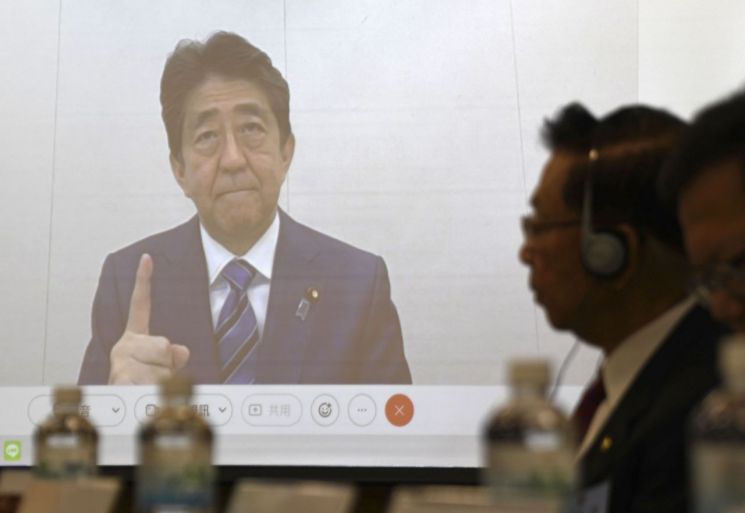 Former Japanese Prime Minister Shinzo Abe is giving an online lecture to participants of a forum hosted by Taiwan's National Policy Research Institute in Taipei on December 1 last year.
 [Image source=Yonhap News]
[Asia Economy Intern Reporter Kim Nayeon] Local media continue to criticize the export restrictions on South Korea decided during former Prime Minister Shinzo Abe's administration, stating that they have not succeeded.
Recently, Japan's Asahi Shimbun pointed out that "sanctions driven by temporary hostility cause adverse effects" amid the Japanese government's ongoing economic sanctions against Russia, citing the restrictions on South Korea as an example.
The newspaper reported that after the South Korean Supreme Court's ruling on compensation for forced labor victims, Korea-Japan relations deteriorated between 2018 and 2019, and reminded readers that the Abe administration at the time decided on semiconductor material export restrictions against South Korea as retaliation.
At that time, the Abe administration required government approval every time Japanese companies exported three items?photoresist, high-purity hydrogen fluoride, and fluorinated polyimide?to South Korea. The Japanese Ministry of Economy, Trade and Industry removed South Korea from the export screening preferential country list (white list), and this measure has continued to this day.
The results of the export restrictions differed from the Japanese government's expectations. According to data announced by South Korea's Ministry of Trade, Industry and Energy at the end of February, Japan's dependency on 100 essential materials for Korean manufacturing decreased from 30.9% in 2019 to 24.9% in 2021.
Also, among the three items subject to export restrictions, imports of hydrogen fluoride decreased by 66%, from $36.3 million in 2019 to $12.5 million in 2021. Dependency on Japanese photoresist halved, and fluorinated polyimide was zero.
Regarding this, Asahi Shimbun evaluated that South Korea, under government leadership, successfully blocked Abe's attack and succeeded in "de-Japanization."
Asahi Shimbun pointed out, "(South Korea) imports a large amount through third countries from Japanese companies," adding, "This can be seen as a difficult measure agreed upon by Korean companies seeking high-quality and affordable Japanese materials and Japanese companies that would suffer losses if they lost the Korean market."
Earlier, Nihon Keizai Shimbun (Nikkei) also published a column stating, "It is necessary to clarify that Japan's export restrictions on Korean semiconductor materials have failed."
Nikkei attributed significance to the Abe administration's measure, saying it was a high-leverage sanction that could block about 50 billion yen (4.8 billion KRW) of Japanese semiconductor material exports and potentially impact the entire Korean semiconductor industry worth 15 trillion yen (145.45 trillion KRW), but pointed out that the actual damage to South Korea was not significant.
It also explained that Japan originally did not have the concept of "applying pressure to other countries through economic means," and strongly criticized that above all, giving South Korea a moral superiority was a shameful dark chapter in Japan's trade policy.
A South Korean Foreign Ministry official stated, "The Japanese government's export restrictions encouraged Japanese companies to enter the Korean market," and added, "I think the export restrictions are rather measures against economic security."
© The Asia Business Daily(www.asiae.co.kr). All rights reserved.
![Clutching a Stolen Dior Bag, Saying "I Hate Being Poor but Real"... The Grotesque Con of a "Human Knockoff" [Slate]](https://cwcontent.asiae.co.kr/asiaresize/183/2026021902243444107_1771435474.jpg)











