Reasons for Political Neutrality
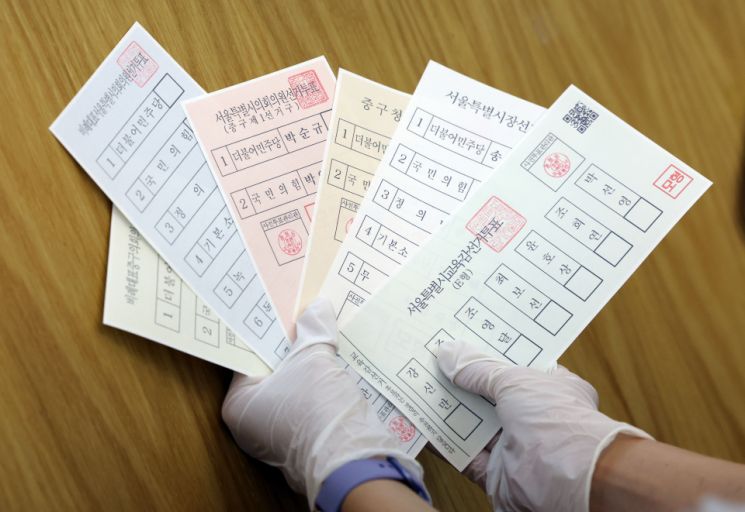 On the afternoon of the 26th, staff members conduct a final rehearsal and inspection of early voting at the early voting station set up at Jungnim-dong Community Center in Jung-gu, Seoul. Photo by Yonhap News
[Asia Economy Reporter Na Ye-eun] The 8th nationwide simultaneous local elections are just one day away. Among the total seven ballots voters receive, the 'Superintendent of Education election' ballot lists only the candidates' names horizontally, without any party affiliation or symbols.
According to the current election law, anyone intending to run for superintendent of education must not hold any party membership from one year before the candidate registration application begins. Therefore, candidates for superintendent of education do not display party names or symbols on ballots or promotional materials, citing 'political neutrality' as the reason.
At one time, symbols were displayed in the superintendent of education elections, but since the 2010 election, symbols were removed following criticism that symbols reminded voters of political parties.
After the removal of symbols, the perception that candidates listed first on the ballot had an advantage proved true. In the 2010 election, among the 16 elected superintendents of education, 6 were candidates whose names appeared first on the ballot.
Ultimately, the arrangement of candidates in the superintendent of education election changed from vertical to horizontal, and a 'rotational arrangement' method was implemented, varying the order of names in each basic council electoral district. This means that ballots for the superintendent of education election are printed differently for each electoral district.
However, many superintendent candidates reveal their political colors through colors or slogans to appeal for voter support. In this Seoul Metropolitan Superintendent of Education election, three candidates used red in their campaigns, one candidate used green, and another candidate adopted blue as their symbolic color.
Despite candidates striving to differentiate themselves from others, criticism that the superintendent of education election is a 'blind election' continues. The incumbent superintendent has a relative advantage. Since voters choose based on names alone, well-known names and incumbents are more likely to receive voter support.
Meanwhile, it was found that superintendent candidates spent more election funds than metropolitan and provincial governor candidates in the local elections four years ago. Because there are no parties involved, voter interest is low, which leads to higher election costs. Most of these costs must be raised directly by the candidates through support committees or publication commemorative events.
© The Asia Business Daily(www.asiae.co.kr). All rights reserved.
![Clutching a Stolen Dior Bag, Saying "I Hate Being Poor but Real"... The Grotesque Con of a "Human Knockoff" [Slate]](https://cwcontent.asiae.co.kr/asiaresize/183/2026021902243444107_1771435474.jpg)
















