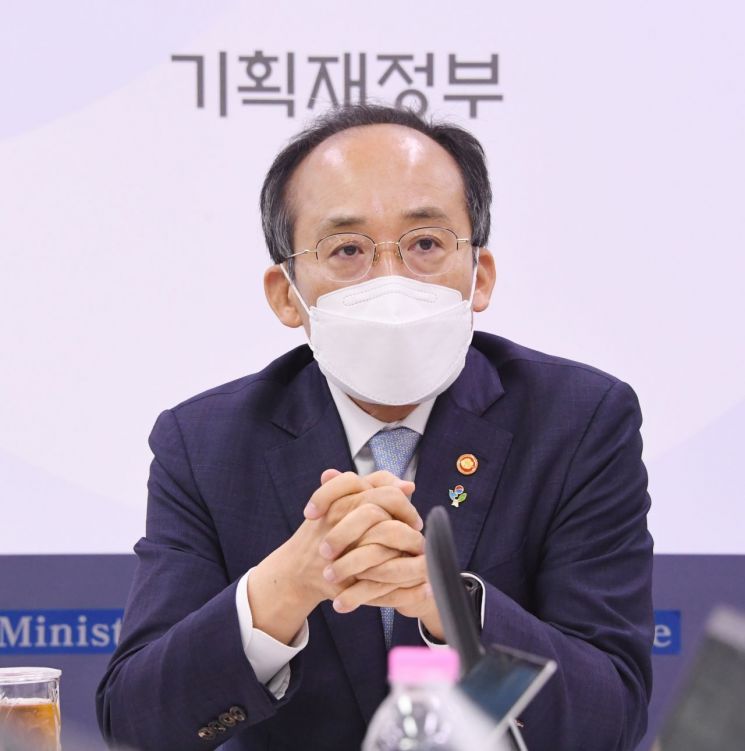
[Asia Economy Sejong=Reporter Kim Hyewon] Deputy Prime Minister and Minister of Economy and Finance Choo Kyung-ho stated on the 31st, "Until now, the committee responsible for tax revenue forecasting has been centered around the Director of the Tax Policy Bureau and internal Ministry of Economy and Finance staff, but we now intend to appoint a private expert as the chairperson."
Deputy Prime Minister Choo made these remarks during a meeting with reporters at the Sejong Government Complex regarding measures to reduce errors in tax revenue forecasting.
The government has faced criticism both domestically and internationally for excessive tax revenue forecast errors this year as well as last year, while preparing the second supplementary budget (supplementary budget) of 62 trillion won based on excess tax revenue of 53.3 trillion won.
Deputy Prime Minister Choo said, "I have taken on the responsibility of leading the Ministry of Economy and Finance, including the parts where errors were made in the past," adding, "I humbly accept the criticism from the public, media, and National Assembly regarding the inaccuracies in tax revenue forecasting and feel a strong sense of responsibility."
He added, "We will reform the tax revenue forecasting process to increase the participation of private experts," and said, "We will collaborate with various specialized institutions such as the Korea Institute of Public Finance, Korea Development Institute (KDI), and the National Tax Service, and it would be good if experts from the National Assembly Budget Office also coordinate with us."
He emphasized, "Even if we gather collective wisdom and expertise, there is no guarantee that the results will be 100% accurate, so there may be errors after the fact, but we must minimize the margin of error."
When asked about the direction of reforming inheritance and gift tax (Sangjeungse) and lowering corporate tax, Deputy Prime Minister Choo replied, "We are focusing on reviewing corporate tax and Sangjeungse as measures to reduce the burden on corporate investment and citizens, and we will introduce them once the review is complete."
Regarding criticism that the livelihood stabilization measures announced the previous day could be seen as a 'tax cut for the wealthy,' he explained, "On one hand, there are necessary parts for corporate investment and economic revitalization, and on the other hand, there is the factor of price instability," adding, "We are in the process of finding policy measures with an appropriate combination at a manageable level."
Deputy Prime Minister Choo said, "If there are support measures such as tax reductions, there is an effect of reducing tax revenue," and added, "We will look at the overall tax revenue flow, the expected economic effects, short-term and mid-to-long-term effects together to find the right combination of which tax items need rate adjustments."
© The Asia Business Daily(www.asiae.co.kr). All rights reserved.
![Clutching a Stolen Dior Bag, Saying "I Hate Being Poor but Real"... The Grotesque Con of a "Human Knockoff" [Slate]](https://cwcontent.asiae.co.kr/asiaresize/183/2026021902243444107_1771435474.jpg)











