"When Families with Developmental Disabilities Stand on the Edge of Death, the State Was Not There"
Care Responsibilities and Financial Hardship... Tragedies Continue in Families with Developmental Disabilities
Disability Parents' Group: "Support Deinstitutionalization and Independence for People with Developmental Disabilities"
Although the 'Developmental Disabilities Act' Passed in the National Assembly, It Lacks Specificity
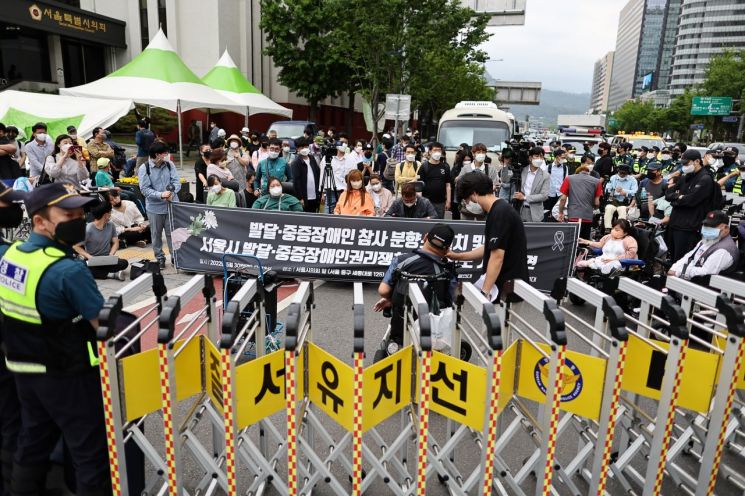 On the afternoon of the 30th, a press conference titled "Installation of a Memorial Altar for the Developmental and Severe Disabled Disaster Victims and Declaration of a Sit-in Protest for the Rights of Developmental and Severe Disabled People in Seoul" was held in front of the Seoul Metropolitan Council, hosted by the Seoul Coalition for the Elimination of Discrimination against Disabled People and others. [Image source=Yonhap News]
[Asia Economy Reporter Park Hyun-joo] Cases of extreme choices by families with developmental disabilities, unable to overcome the harsh realities of severe financial hardship and caregiving burdens, are increasing. Disability organizations have been appealing for improvements in the reality where the lack of disability support services and policies results in caregiving burdens being entirely passed on to caregivers, in order to break this tragic cycle.
Cases of families with children with developmental disabilities making extreme choices together continue to occur. On the 23rd, in Seongdong-gu, Seoul, a mother in her 40s and her 6-year-old son with developmental disabilities died after jumping from an apartment together. On the same day, in Yeonsu-gu, Incheon, a woman in her 60s, Ms. A, gave a large amount of sleeping pills to her daughter in her 30s with severe disabilities and then attempted an extreme choice herself, but only the daughter died. As Ms. A entered the court for a detention hearing, she shed tears saying, "I'm sorry. I couldn't live with you." It was reported that her daughter was recently diagnosed with stage 1 colon cancer.
The tragedies in families with developmental disabilities are not limited to these cases. On March 2nd last month, incidents where biological mothers caused the deaths of their children with developmental disabilities occurred in Suwon and Siheung, Gyeonggi Province, respectively. Both families were single-parent households receiving basic living subsidies and suffering from severe financial hardship. Since 2020, there have been nine such tragedies in families with developmental disabilities in Seoul alone.
The Seoul Disability Discrimination Abolition Solidarity and the Seoul Parents of Disabled Persons Solidarity recently set up a memorial altar in front of the Seoul Metropolitan Council to mourn the deceased disabled families and began a sit-in protest urging the passage of the ordinance supporting deinstitutionalization of persons with disabilities. They demand that the ordinance related to deinstitutionalization of persons with disabilities be passed promptly to prevent ongoing tragedies involving people with developmental disabilities. The memorial altar will be open until July 10, the 49th day memorial of the family with developmental disabilities who died on the 23rd.
On this day, Lee Hyung-sook, chairperson of the Seoul Disabled Independent Living Center Council, said, "Seoul City announced a press release last March stating it would enact an ordinance to support deinstitutionalization of persons with disabilities," adding, "If that ordinance had been enacted last year, people with developmental disabilities would not have been killed like this this year." The National Parents of Disabled Persons Solidarity also strongly urged the government’s responsibility, saying, "When they stood on the cliff of death, the state was not by their side. If the government had paid a little more attention to guaranteeing the rights of people with severe developmental disabilities, it could have given hope to people with disabilities and their families not to choose death."
 Members of the National Parents' Association for the Disabled sat after setting up a "Memorial Altar for People with Developmental Disabilities and Their Families" at the Samgakji Station platform in Seoul on the morning of the 26th. [Image source=Yonhap News]
Disability organizations criticize that the responsibility for caregiving is entirely shifted to families. Especially for people with developmental disabilities who need others' help in daily life, it is pointed out that support services and policies are grossly insufficient in a situation where caregivers with jobs find it difficult to provide 24-hour care for family members with disabilities.
The National Parents of Disabled Persons Solidarity argues that since over 80% of people with developmental disabilities need others' help in daily life, the burden of caregiving should be shared by the state and local communities. However, according to the Ministry of Health and Welfare, as of the end of last year, there were 255,207 people with developmental disabilities, of whom only 68,807 (26.9%) received activity support services.
Accordingly, on the 29th, the National Assembly passed an amendment to the "Act on the Rights Guarantee and Support for Persons with Developmental Disabilities," which provides integrated care services to people with the most severe developmental disabilities. From two years after the law is promulgated, 17 developmental disability support centers nationwide will provide integrated care services to people with the most severe developmental disabilities. However, Yoon Jin-cheol, secretary-general of the National Parents of Disabled Persons Solidarity, welcomed the intent of the law but criticized the lack of specifics, saying, "It is not at all clear how much budget will be allocated for the law."
The absence of a definition for "most severe developmental disabilities" in the law and the fact that the amended provisions will be implemented two years after promulgation are also disappointing for families with disabilities. Secretary-General Yoon explained, "Under the Disability Welfare Act, all people with developmental disabilities are considered severely disabled, and 'most severe disability' is not a legal term, so a legal definition for 'most severe developmental disabilities' is needed first," adding, "Separating only the most severe for support without any existing support system for developmental disabilities could cause confusion in the welfare service delivery system."
On the same day, the amendment to the "Act on Support for Activities of Persons with Disabilities" was also passed. Accordingly, from next year, people under 65 with elderly diseases (such as dementia and cerebrovascular diseases) who have disabilities will be able to apply for activity support benefits. As of last year, there were 25,368 registered disabled persons under 65 with elderly diseases, and the Ministry of Health and Welfare estimates that about 2,700 of them will additionally use activity support benefits along with long-term care after the amendment is implemented.
※ If you need expert help for difficult concerns such as depression, you can contact the suicide prevention hotline ☎1577-0199, suicide prevention counseling phone ☎1393, mental health counseling phone ☎1577-0199, Hope Phone ☎129, Lifeline ☎1588-9191, Youth Phone ☎1388, or the youth mobile counseling app 'There is a Dog to Listen' available on KakaoTalk and other platforms for 24-hour counseling.
© The Asia Business Daily(www.asiae.co.kr). All rights reserved.


















