Pipeline Sanctions Accounting for 35% Put on Hold
EU Commission President "90% Import Ban by Year-End"
[Asia Economy Reporter Hyunwoo Lee] The European Union (EU) announced that it has agreed on an embargo on Russian oil transported by tanker ships. However, it failed to impose sanctions on pipeline imports, which account for more than 30% of total imports, sparking expected backlash. The EU Commission plans to block more than 90% of imports by the end of the year, but strong opposition from Eastern European countries including Hungary suggests that controversies over the sanctions will continue for a long time.
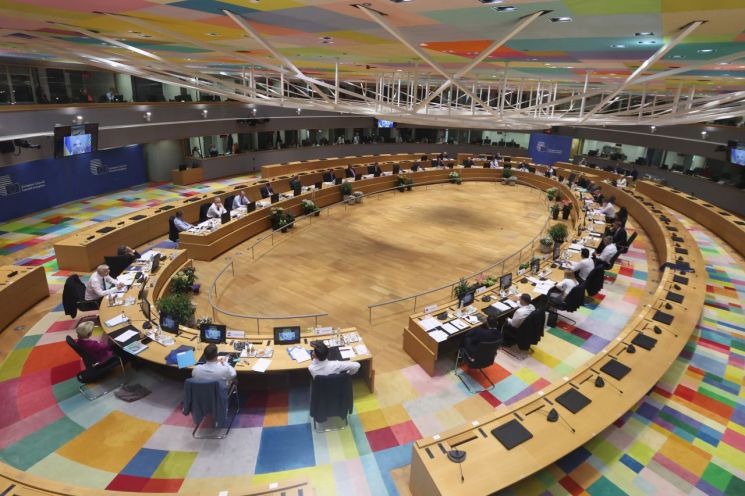
According to Euronews on the 30th (local time), the EU agreed on an embargo on Russian oil imported to Europe via maritime transport at the EU summit held in Brussels, Belgium that day. Charles Michel, President of the European Council, tweeted immediately after the summit, "This agreement will allow us to ban two-thirds of Russian crude oil imports," adding, "It will restrict a huge source of money that funds Russia's weapons expenses."
According to Eurostat, the EU's statistical office, about 65% of Russian oil imports come via maritime routes, while 35% come through pipelines. Despite the embargo on maritime-transported oil, the 35% share of oil imported through pipelines is excluded from the sanctions and is expected to continue as before.
The sixth round of EU sanctions against Russia, initially planned to block 100% of imports, ended up as a partial embargo due to fierce opposition from Eastern European countries centered on Hungary. Most Eastern European countries import Russian oil through pipelines, including the Druzhba pipeline heading from Russia to Hungary, leading to strong resistance. According to CNN, Hungary imports 86% of its total oil through pipelines connected to Russia. The Czech Republic (97%) and Slovakia (100%) have even higher proportions than Hungary.
At the summit that day, Hungarian Prime Minister Viktor Orb?n strongly opposed a complete embargo on Russian oil, citing his country's dependence on Russian energy immediately after the meeting. The EU reportedly could not even set a grace period for pipeline sanctions in order to reach an agreement on the partial embargo. This is expected to increase debates over the effectiveness of the sixth round of sanctions against Russia.
The EU Commission stated that it will increase the proportion of Russian oil subject to sanctions in the future, but concerns are growing that controversies will expand. Ursula von der Leyen, President of the European Commission, indicated the expansion of the embargo through a tweet, saying, "We will reduce about 90% of oil imports from Russia to the EU by the end of the year."
Meanwhile, along with the partial embargo on Russian oil, the EU announced plans to add Russia's largest bank, Sberbank, and three Russian state broadcasters to the list of sanctions in the sixth package of sanctions against Russia, as well as to pursue additional sanctions including broad measures against those responsible for war crimes in Ukraine.
© The Asia Business Daily(www.asiae.co.kr). All rights reserved.
![Clutching a Stolen Dior Bag, Saying "I Hate Being Poor but Real"... The Grotesque Con of a "Human Knockoff" [Slate]](https://cwcontent.asiae.co.kr/asiaresize/183/2026021902243444107_1771435474.jpg)
















