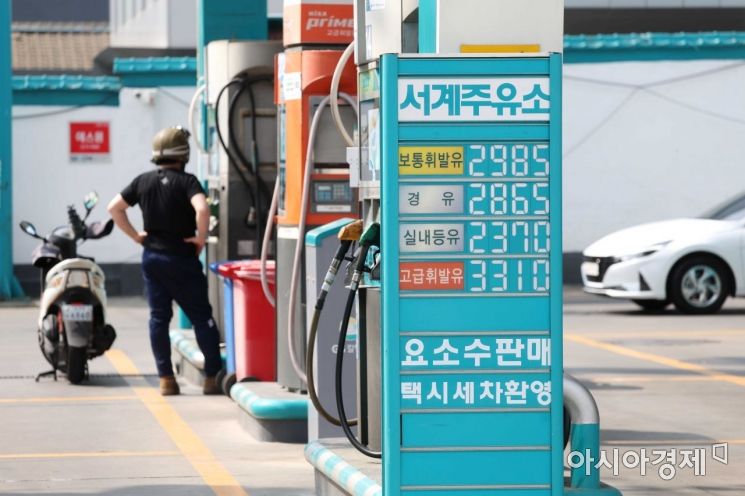
 On the 25th, amid the sharp rise in international oil prices, fuel prices such as gasoline and diesel continue to soar domestically, with fuel price information displayed at a gas station in Seoul. According to the Korea National Oil Corporation's oil price information system Opinet, the average price of diesel sold at gas stations nationwide the previous day was 2,000.93 KRW per liter. This is the first time since April 2008, when nationwide sales price statistics began to be compiled, that diesel prices have exceeded 2,000 KRW. Photo by Mun Ho-nam munonam@
[Asia Economy Reporter Hwang Junho] Attention is focused on whether a solution to calm soaring international oil prices will emerge at the regular meeting of the Organization of the Petroleum Exporting Countries (OPEC) and OPEC+, which includes Russia, scheduled for the 2nd of next month. However, domestic securities firms are forecasting that significant changes are unlikely.
Kim So-yeon, a researcher at Daishin Securities, predicted on the 30th, "It seems highly likely that the existing agreement to increase oil production by 432,000 b/d per month will be maintained at this meeting as well."
Although the burden on energy-importing countries has increased, leading to heightened pressure on OPEC+ through meetings such as the G7 Energy and Environment Ministers' meeting, it is expected that reaching an agreement on increasing production will be difficult.
Due to Hungary's opposition, the sixth round of sanctions against Russia, including a complete ban on imports of Russian petroleum products, has not yet been adopted, but attempts to impose an oil embargo on Russia are still ongoing in the European Union and elsewhere. Additional crude oil supply measures are needed to sustain these efforts.
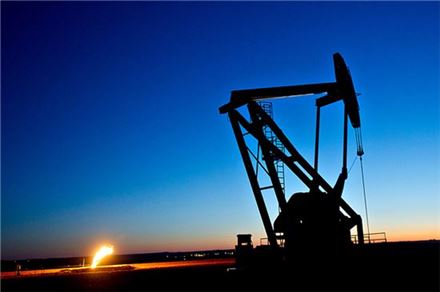 Photo by AP News
Researcher Kim presented several reasons why an agreement on production increases may not be reached at this meeting.
OPEC+ is earning substantial revenue due to soaring oil prices caused by the Russia-Ukraine war. According to the IMF, the average expected fiscal breakeven oil price for the Middle East and North Africa region in 2022 is $95 per barrel. If this level is maintained, a fiscal surplus is possible. Within OPEC, Saudi Arabia and the United Arab Emirates (UAE) have fiscal breakeven oil prices of $79 and $76 per barrel respectively, so at current oil price levels, they can expect fiscal surpluses.
Diplomatic relations among OPEC, the United States, and Russia are also expected to be obstacles. Unlike former President Donald Trump, U.S. President Joe Biden has criticized Saudi Arabia's human rights issues (the 2018 assassination of a Saudi dissident journalist and recent executions) and its involvement in the Yemen civil war. He has not engaged in direct diplomacy with MBS. Saudi Arabia is dissatisfied with these changes in U.S. political and diplomatic stances, as well as with the resolution of the Iran nuclear deal. On the other hand, given that the war has increased OPEC's influence, it appears Saudi Arabia wants to maintain cooperative relations with Russia.
OPEC's spare production capacity is also decreasing. This means that the actual amount of crude oil OPEC can increase is limited. Currently, OPEC's spare production capacity is about 5.2 million barrels, which is 900,000 barrels more than Russia's 2021 crude oil export volume of 4.3 million barrels. However, considering that this 5.2 million barrels includes Iran's spare production capacity of 1.3 million barrels, which is not being exported, it is expected that even if OPEC wants to, there will be limits to increasing crude oil supply.
Accordingly, Kim's analysis is that "it will be difficult for OPEC to act as a solution to the crude oil supply disruptions caused by the Russia-Ukraine war."
© The Asia Business Daily(www.asiae.co.kr). All rights reserved.

















