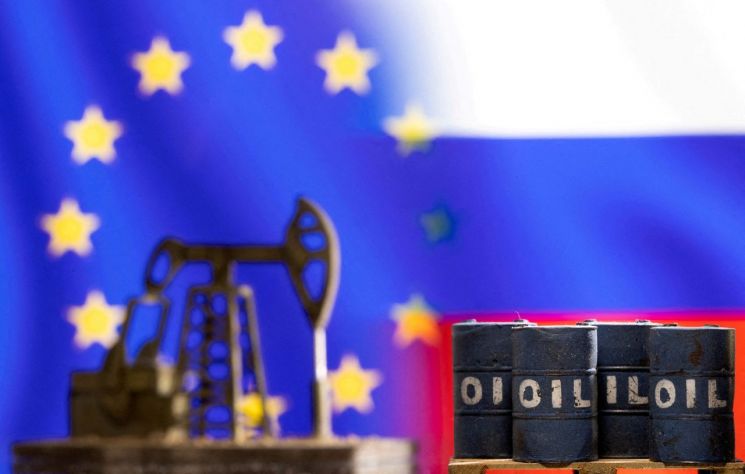
[Asia Economy Reporter Hyunwoo Lee] As the European Union (EU) has once again failed to agree on a ban on Russian oil, concerns are growing that divisions among member states will deepen. If the special summit meeting starting on the 30th also fails to reach an agreement, there are fears that cracks will appear in the sanctions against Russia that have been implemented so far.
According to CNN on the 29th (local time), Robert Habeck, Germany's Vice Chancellor and Minister for Economic Affairs and Climate Action, said at a press conference, "Since Russia's invasion of Ukraine, we have seen what Europe can achieve when united. But that unity is already beginning to break down. I hope it will continue at the EU summit starting on the 30th."
This statement is interpreted as pointing to the failure once again to reach an agreement on the ban on Russian oil by the EU delegations ahead of the special EU summit held over two days from the 30th to the 31st in Brussels, Belgium. On that day, EU diplomats made a final attempt to coordinate opinions before the summit, but it is reported that the effort ultimately failed due to strong opposition from Hungary.
According to the Associated Press, to secure Hungary's compromise, the EU proposed excluding the Druzhba pipeline, Hungary's main import route for Russian oil, from the sanctions and granting a significant grace period. However, Hungary ultimately opposed the proposal, causing the agreement to collapse. Along with Hungary, the Czech Republic, Slovakia, and Bulgaria have also maintained their opposition.
Ahead of the EU summit, Hungarian Prime Minister Viktor Orb?n sent a letter to the EU stating, "Let us not discuss the ban on Russian oil at this summit," arguing that "if the leaders discuss it without a solution, internal divisions will be highlighted and only counterproductive results will occur."
Meanwhile, Hungary's dependence on Russian crude oil is estimated to be around 64%. The Hungarian government claims that achieving economic independence from Russian oil will require 15 to 18 billion euros (approximately 20 to 24 trillion won) in the medium to long term and insists that EU support is necessary.
© The Asia Business Daily(www.asiae.co.kr). All rights reserved.

















