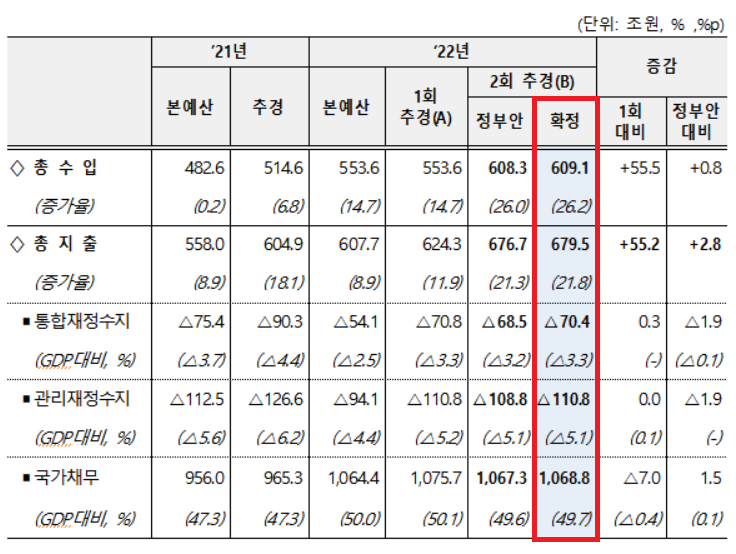
[Asia Economy Sejong=Reporter Son Seon-hee] An additional supplementary budget (supplementary budget) worth a total of 62 trillion won has been finalized. This is an increase of 2.6 trillion won from the government proposal (59.4 trillion won), making it the largest single supplementary budget in history.
On the 29th, the Ministry of Economy and Finance announced through a press release immediately after the National Assembly plenary session passed the bill that the supplementary budget had been finalized as such. Of the total 62 trillion won, excluding the statutory local transfer expenditure (23 trillion won), the central government’s general expenditure amounts to 39 trillion won. Of this, 28.7 trillion won will be allocated to loss compensation for small business owners and support for vulnerable groups, 7.1 trillion won for strengthening quarantine measures, 2.2 trillion won for livelihood and price stabilization, and 1 trillion won for reinforcing contingency funds.
Compared to the initial government proposal, support for small business owners and vulnerable groups increased by 1.3 trillion won. Medium-sized enterprises with annual sales of 3 billion won or less were included as loss compensation targets, and medium-sized enterprises with annual sales between 3 billion and 5 billion won experiencing sales declines were included as recipients of loss compensation payments ranging from 6 million to 10 million won. Financial support, including new and refinancing loans, was expanded to 2.3 trillion won, with an additional 180 billion won allocated for interest and other financial reinforcements. The issuance amount of local love gift certificates to support sales increases for small business owners and self-employed persons was also increased by 100 billion won to a total of 2.5 trillion won.
The emergency employment stabilization fund for special types of workers and freelancers, as well as the activity support fund for low-income cultural artists, was doubled from the original government proposal of 1 million won to 2 million won. Income stabilization funds for taxi and bus drivers were also raised from 2 million won to 3 million won.
The quarantine budget was increased by 1.1 trillion won to support additional medical expenses for confirmed cases after the stabilization phase (one month) and to reinforce quarantine costs such as bed operations in the second half of the year.
The supplementary budget for livelihood and price stabilization was increased by 200 billion won. The national subsidy rate for fertilizer price increases was expanded from 10% to 30%, and a temporary fuel tax-linked subsidy (55 won/liter) for fishermen will be provided for five months.
Total expenditure under this supplementary budget was finalized at 679.5 trillion won, an increase of 55.2 trillion won from the first supplementary budget (624.3 trillion won). The amount of national debt repayment was reduced by 1.5 trillion won from the government’s original plan of 9 trillion won to 7.5 trillion won. The managed fiscal balance is -110.8 trillion won, which is -5.1% of the Gross Domestic Product (GDP). National debt is estimated at 1,068.8 trillion won, or 49.7% of GDP.
The government plans to hold a Cabinet meeting on the morning of the 30th to present and approve the supplementary budget announcement and allocation plan.
Loss compensation payments will begin on the 30th, the date of the Cabinet meeting resolution, using the existing transmission system. Regarding loss compensation, the Loss Compensation Deliberation Committee will be held at the end of this month to decide the compensation standards for the first quarter, and applications and payments will begin next month.
Applications for employment and income stabilization funds for vulnerable groups such as special types of workers will be accepted until next month. Payments will begin in June for special types of workers, freelancers, and corporate taxi and bus drivers, and in July for cultural artists. Emergency livelihood stabilization funds for low-income households (prepaid cards) will have recipients confirmed in June and payments will start in July. Recipients will be confirmed using existing social security benefit eligibility information without a separate application process.
The Ministry of Economy and Finance stated, "Considering the difficulties faced by the livelihood sector, we will do our utmost to ensure that major projects such as loss compensation payments, small business loss compensation, and emergency employment stabilization funds are paid as quickly as possible."
© The Asia Business Daily(www.asiae.co.kr). All rights reserved.
![Clutching a Stolen Dior Bag, Saying "I Hate Being Poor but Real"... The Grotesque Con of a "Human Knockoff" [Slate]](https://cwcontent.asiae.co.kr/asiaresize/183/2026021902243444107_1771435474.jpg)
















