KAIST Research Team
[Asia Economy Reporter Kim Bong-su] Unlike existing slow and heavy robotic arms (prosthetic limbs), a 'shape memory alloy artificial muscle' that can move lightly and quickly has been developed.
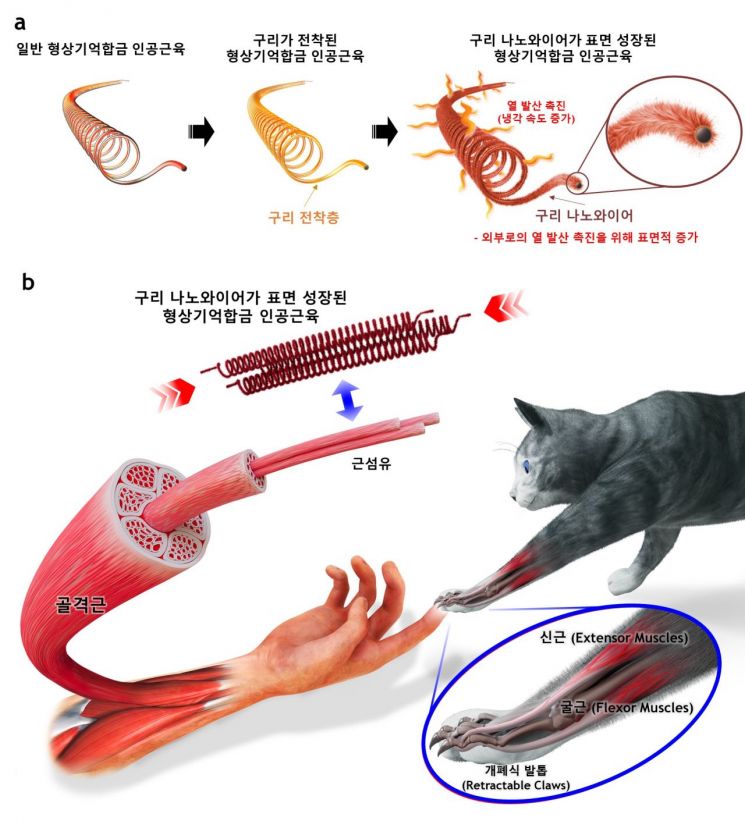
On the 29th, according to the National Research Foundation of Korea, Professor Oil Kwon's research team at KAIST developed a 'shape memory alloy artificial muscle' that can generate force like the skeletal muscles of humans and animals by using a spring-shaped shape memory alloy actuator that is more than twice as fast as the existing driving speed. They also succeeded in creating wearable prosthetic limbs and biomimetic robotics inspired by the unique claw structure of cats.
Existing shape memory alloys had the limitation of being too slow in speed when used as artificial muscles due to significantly slower cooling speeds compared to heating. The research team, inspired by attaching pointed heat sinks to surfaces to quickly lower the temperature of general electronic components or chips, uniformly grew pointed copper nanowires on the surface of the spring-shaped shape memory alloy. By doing this, they increased the surface area of the shape memory alloy and promoted heat transfer to the outside, successfully accelerating the cooling of the shape memory alloy. The artificial muscle developed by the research team showed a driving speed more than twice as fast as that of general shape memory alloys, enabling the development of prosthetic limbs that can bend and straighten fingers at speeds similar to actual hands.
The research team also focused on the similarity of the developed artificial muscle to animal skeletal muscles and applied the faster driving artificial muscle to biomimetic robotics. They implemented biomimetic retractable claws inspired by the feature of cats that reveal and hide their retractable claws as needed to control friction with the ground. It is expected to help walking robots maintain balance and walk stably by using claws when walking on rough terrains such as uneven roads, replacing the simple rubber attached to the soles of existing walking robots.
The research team explained, "By enabling artificial muscles to move at speeds similar to actual muscle movements, it is expected to provide a clue for the application of artificial muscles in various fields such as future robots, wearable muscles, human augmentation suits, and assistive robots."
The results of this study were selected as the cover paper of the international academic journal Advanced Functional Materials on the 2nd of this month.
© The Asia Business Daily(www.asiae.co.kr). All rights reserved.
![Clutching a Stolen Dior Bag, Saying "I Hate Being Poor but Real"... The Grotesque Con of a "Human Knockoff" [Slate]](https://cwcontent.asiae.co.kr/asiaresize/183/2026021902243444107_1771435474.jpg)
















