Borrowers with 'Yeongkkeul' and 'Bittoo' Expected to Feel Heavy Burden
Cold Shower for Housing Market... Will the 'Transaction Cliff' Continue?
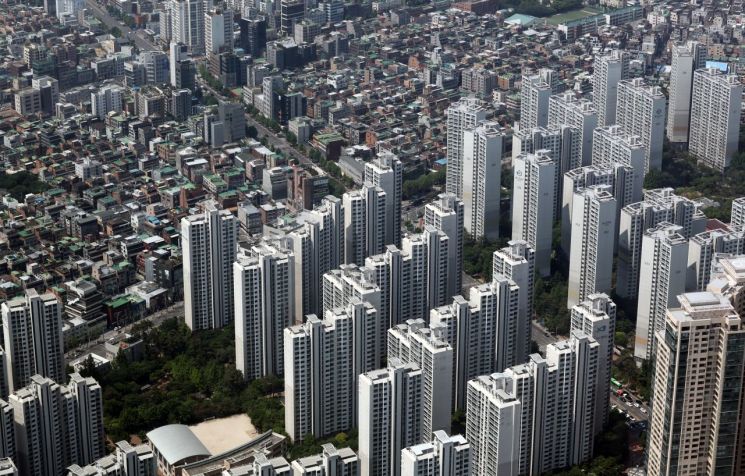
[Asia Economy Intern Reporter Kim Se-eun] Concerns are being raised that the base interest rate hike will become a 'negative factor' for the real estate market.
In particular, the burden on borrowers in their 20s and 30s who engaged in so-called 'Yeongkkeul (pulling together all their soul)' and 'debt investment' is expected to increase as house prices surged.
The Financial Monetary Policy Committee of the Bank of Korea recently raised the base interest rate five times by 0.25%p each over the past nine months, totaling a 1.25%p increase.
As of March this year, 76.5% of the total household loans from deposit banks correspond to variable interest rate loans.
Moreover, since most jeonse (long-term deposit lease) loans are also variable interest rate loans, the interest repayment burden on borrowers is expected to increase as well.
As interest rates rise and the burden of loan interest increases, the housing sales market is also expected to shrink.
Although there had been a steady recovery due to expectations of deregulation after the presidential election, the interest rate hike could act as a significant negative factor.
In fact, the number of apartment sales in Seoul recorded 4,064 cases in August last year, then declined for seven consecutive months to 814 cases by February this year. However, in March, when the presidential election was held, it increased to 1,437 cases, turning to an upward trend. The increase expanded further in April, recording 1,714 cases.
However, as of the 26th, the total number of sales cases this month was confirmed to be 704. This raises concerns that the phenomenon of a 'transaction cliff' might be repeating.
The problem is that the base interest rate may rise several more times in the future.
Experts believe that to respond to the global inflation phenomenon and the rapid base interest rate hikes in the United States, the domestic base interest rate must be raised to at least 2.25% per annum.
© The Asia Business Daily(www.asiae.co.kr). All rights reserved.
![Clutching a Stolen Dior Bag, Saying "I Hate Being Poor but Real"... The Grotesque Con of a "Human Knockoff" [Slate]](https://cwcontent.asiae.co.kr/asiaresize/183/2026021902243444107_1771435474.jpg)
















