Monkeypox, a 'Spillover' Species Causing Cross-Infection Between Humans and Wildlife
European Centre for Disease Prevention and Control Warns "Potential to Become Endemic in Europe"
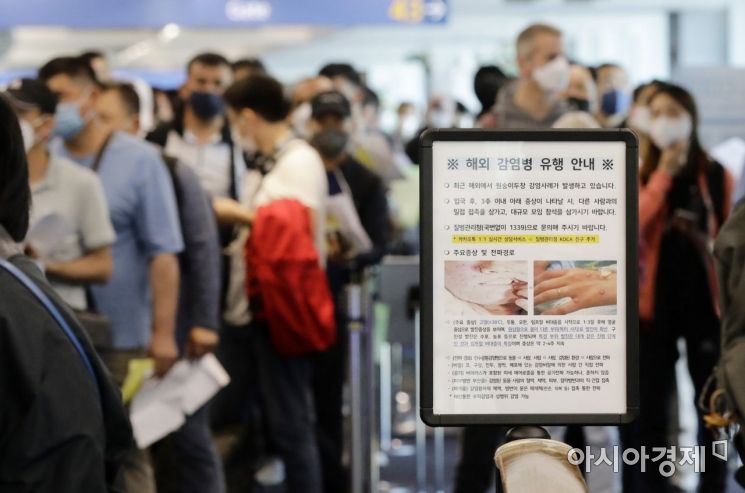 On the 27th, passengers arriving on a flight from Europe at Incheon International Airport Terminal 1 are waiting to undergo quarantine for overseas infectious diseases such as monkeypox. Photo by Mun Ho-nam munonam@
[Asia Economy Intern Reporter Kim Se-eun] As monkeypox infections surge worldwide, experts have expressed concerns that the spread of viruses crossing continents will become more frequent.
Monkeypox is a virus that existed previously, but this situation is drawing particular attention because the virus has been detected outside its usual endemic regions.
About three weeks ago, the monkeypox virus was first identified by the UK health authorities, not in Africa. Since then, additional cases of infection have been confirmed worldwide.
According to the international scientific journal Nature, approximately 400 confirmed or suspected cases have been reported in about 20 non-African countries, including the UK, Spain, Portugal, Canada, and the United States.
Examining the infection patterns, cases have been found simultaneously in multiple individual population groups within several countries.
Infectious disease experts have suggested that given the rapid spread of monkeypox outside Africa, the virus could become endemic in Europe by using pets as hosts.
The European Centre for Disease Prevention and Control (ECDC) stated that it is theoretically possible for the virus to transfer from humans to animals, and if a 'spillover' crossing the species barrier occurs, the virus could establish itself in Europe, raising concerns that monkeypox could become a zoonotic endemic disease.
Furthermore, experts predict that such cross-continental viral outbreaks will become more frequent.
In fact, a research team led by Assistant Research Professor Colin Carlson at Georgetown University in the United States reported in the scientific journal Nature that "by predicting the geographic distribution shifts of about 3,000 mammal species due to climate change and identifying future viral sharing hotspots, under a 2-degree warming scenario, at least 15,000 new interspecies viral sharing events are expected to occur over the next 50 years."
Additionally, Nature recently published an article titled "Want to prevent pandemics? Stop spillover," stating that "spillover likely triggered all viral pandemics since the early 20th century," and analysis of diseases over the past four decades indicates that environmental changes could increase the probability of pandemics several times over the coming decades.
Meanwhile, as the first monkeypox infection case has emerged in Latin America, Sylvie Briand, Director of the Global Infectious Hazard Preparedness at the World Health Organization (WHO), said during a briefing held on the 27th (local time) in Geneva, Switzerland, "Monkeypox is not a disease the general public should worry about. It is not like COVID-19."
She added, "If countries respond quickly by early identification and isolation of infected individuals and close contacts, it can be easily contained."
However, she cautioned, "We are still in the very early stages of this outbreak," and "more cases will emerge." She further explained, "We do not know if what we are currently seeing is just the tip of the iceberg."
For now, WHO advises targeted vaccination limited to infected individuals and close contacts rather than mass vaccination against monkeypox.
Moreover, some countries are actively securing vaccines due to the spread of monkeypox.
Currently, Germany and others are purchasing and stockpiling smallpox vaccines. The U.S. Centers for Disease Control and Prevention (CDC) announced that receiving a smallpox vaccine within four days after exposure to the monkeypox virus can prevent disease onset.
In Thailand, it is known that decades-old frozen smallpox vaccines are being evaluated for their effectiveness in preventing monkeypox.
In South Korea, health authorities possess about 35 million doses of first- and second-generation 'smallpox' vaccines combined.
Considering cross-immune responses, these vaccines are expected to be highly effective against monkeypox; however, due to concerns about severe adverse reactions, pregnant women, nursing mothers, and immunocompromised patients cannot be vaccinated.
Severe adverse reactions have been improved starting from third-generation smallpox vaccines, but only countries like the United States and Canada have stockpiled them on a large scale.
So far, no cases of monkeypox infection have been confirmed among Koreans.
The Ministry of Foreign Affairs stated, "We are closely monitoring the spread of monkeypox worldwide," and "there have been no reported cases of infection among our citizens at overseas diplomatic missions."
However, as a preventive measure, the Ministry is sending safety notices via text messages to citizens traveling to 18 countries where the virus has been detected.
© The Asia Business Daily(www.asiae.co.kr). All rights reserved.

















