Prices Justify Big Step
Economic Conditions Fuel Recession Concerns
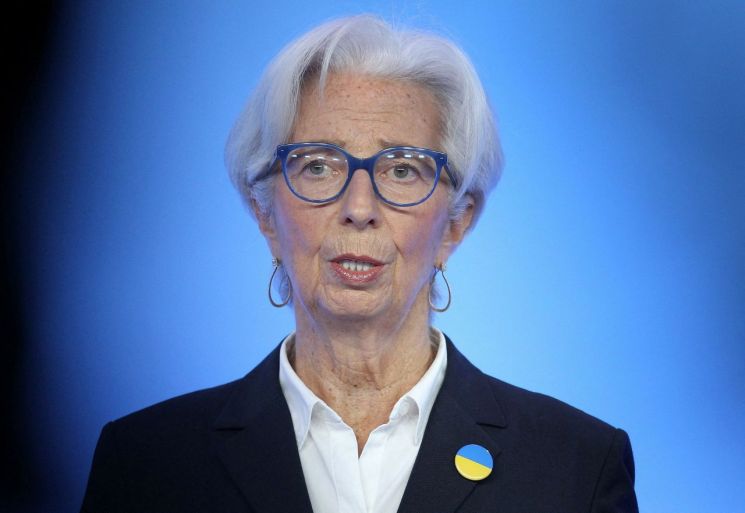
[Asia Economy Reporter Hwang Yoon-joo] Shinhan Financial Investment forecasts that the Eurozone will start raising its key interest rate from July. However, unlike the United States, it is expected to be difficult to implement a big step rate hike.
On the 28th, Min-young Park, a researcher at Shinhan Financial Investment, stated, "At the June European Central Bank (ECB) meeting, the end of the Asset Purchase Program (APP) was announced, and a key interest rate hike is expected from the July ECB meeting."
If the ECB raises the key interest rate, it will be the first rate hike in 11 years since July 2011. The ECB meetings in the second half of the year are scheduled for July, September, October, and December.
Researcher Park said, "The market expects consecutive hikes at the four meetings," adding, "Based on futures rates, there is some reflection of the possibility of a big step (raising the rate by 50 basis points at once) hike in September." President Lagarde's remark that the ECB must exit negative interest rates by the end of the third quarter also supports consecutive hikes.
However, it was analyzed that aggressive tightening like in the U.S. would not be easy to digest. This is based on the judgment that there are differences in policy responses after COVID-19. Comparing the total asset changes of central banks and the cumulative fiscal deficits of governments based on nominal GDP just before COVID-19, the overall support scale was similar. However, the U.S. focused on fiscal policy, while the Eurozone relied on monetary policy as the liquidity support channel.
Researcher Park diagnosed, "Monetary policy is fast but indirect, while fiscal policy is slow but directly affects the economy," adding, "Artificial economic lockdowns during the COVID-19 spread reduced the effectiveness of monetary policy, which supports liquidity to the real economy through indirect channels." The U.S. defended against the decline in the money multiplier through fiscal policy, but the Eurozone's monetary creation capacity weakened due to delayed fiscal policy support.
Researcher Park pointed out, "This difference in money flow connects to the labor market, where the U.S. is experiencing steep wage growth, whereas the Eurozone continues to have low wage growth."
The difference in employment costs leads to differences in private consumption recovery. Based on real retail sales, the U.S. expanded by 11% this year compared to just before COVID-19, while the Eurozone only expanded by 3%. The problem is that despite the differentiation between the U.S. and the Eurozone, inflationary pressures are the same. As of April, the year-on-year increase in headline consumer prices differs by less than 1 percentage point.
Researcher Park said, "It seems unlikely that the ECB will ignore inflation and focus on economic recovery, claiming that core inflationary pressure is relatively weak," adding, "Core consumer prices continue to rise, and energy price stability in the Eurozone is unlikely in the short term."
He noted, "The Eurozone is a net energy-importing region, and its dependence on Russian energy is particularly high," adding, "With the Ukraine crisis expanding sanctions on Russian energy, securing energy resources has become important, and inflationary pressure is likely to intensify."
Researcher Park diagnosed, "However, a big step rate hike is expected to stimulate concerns about Eurozone growth slowdown and recession."
He continued, "Compared to the U.S., the Eurozone has lower employment cost pressures and sluggish real consumption recovery," adding, "Various research institutions estimate that the Eurozone's potential growth rate will be below +1.4% until 2030."
© The Asia Business Daily(www.asiae.co.kr). All rights reserved.

















