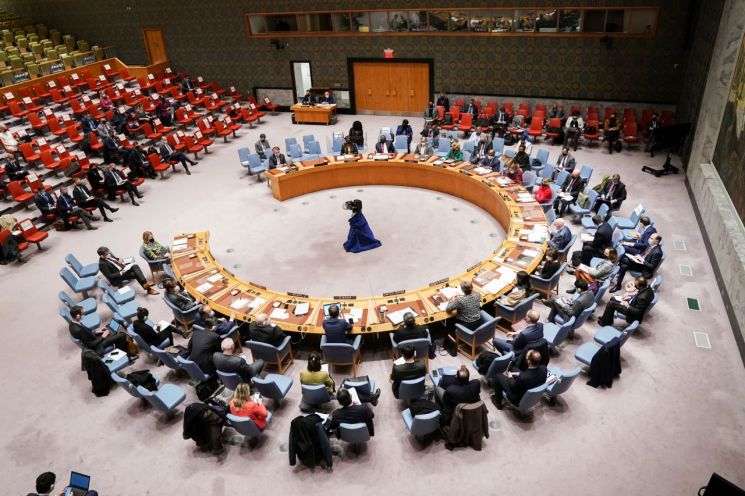
[Asia Economy New York=Special Correspondent Joselgina] The United Nations Security Council (UNSC) failed on the 26th (local time) to adopt additional sanctions against North Korea led by the United States. This was due to vetoes from permanent members China and Russia, as expected.
The Security Council held a meeting at the UN Headquarters in New York and put to a vote a resolution that included reducing the cap on North Korea's oil imports. The vote result was 13 in favor and 2 against, surpassing the approval threshold of 9 votes. However, the two opposing votes came from permanent members China and Russia, causing the resolution to ultimately fail to pass the Security Council. For a resolution to be adopted, at least 9 of the 15 Security Council members must vote in favor, and none of the 5 permanent members can exercise a veto.
This resolution was pushed as a response to North Korea's multiple ballistic missile tests this year, including intercontinental ballistic missiles (ICBMs). The UNSC North Korea resolution 2397's "oil trigger" clause, which mandates automatic discussion of strengthening oil supply sanctions if North Korea launches an ICBM, served as the basis for pursuing these sanctions.
The United States, which led the resolution, drafted a new resolution on March 24th immediately after North Korea launched an ICBM, proposing to halve crude oil and refined oil exports to North Korea, and has been discussing it with Security Council members. On the 25th, when President Joe Biden was returning from his trip to Japan and South Korea, North Korea launched three ballistic missiles including an ICBM, prompting the U.S. to immediately push for a vote on the resolution. The U.S. holds the Security Council presidency in May.
The resolution put to a vote on this day aimed to reduce North Korea's crude oil import cap from the existing 4 million barrels to 3 million barrels, and the refined oil import cap from 500,000 barrels to 375,000 barrels. It is reported that the U.S. reduced the amount of cuts from the original draft to secure more votes in favor. Sanctions on exports of mineral fuels, mineral oils, watches and parts were also included. Additionally, the resolution included adding to the asset freeze list the hacking group Lazarus, known to be behind North Korea, Chosun Namgang Trading Company, Haegumgang Trading Company, and Kim Su-il, the Vietnam representative of the Ministry of Military Industry leading ballistic missile development.
This Security Council meeting was the first vote on North Korea sanctions since the unanimous adoption of UNSC Resolution 2397 on December 22, 2017. Last month, the UN General Assembly unanimously adopted a resolution stating that if a permanent member of the Security Council exercises a veto, the General Assembly should discuss the issue, so China and Russia are expected to provide explanations regarding this matter in the future. However, this resolution is not legally binding.
© The Asia Business Daily(www.asiae.co.kr). All rights reserved.
![Clutching a Stolen Dior Bag, Saying "I Hate Being Poor but Real"... The Grotesque Con of a "Human Knockoff" [Slate]](https://cwcontent.asiae.co.kr/asiaresize/183/2026021902243444107_1771435474.jpg)
















