[Asia Economy New York=Special Correspondent Joselgina] "Under Chinese President Xi Jinping, the Chinese Communist Party has become more repressive domestically and more aggressive overseas."
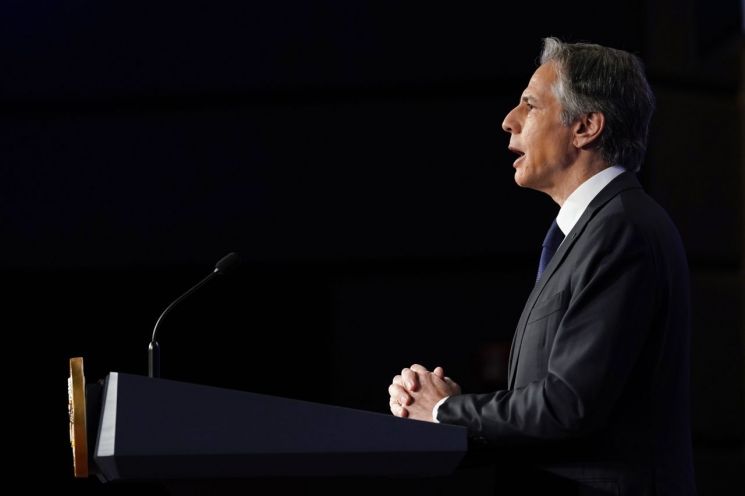
On the 26th (local time), U.S. Secretary of State Tony Blinken criticized China for undermining the very laws and principles from which it has benefited the most on the international stage. He also announced plans to change the strategic environment in response.
According to the State Department, Blinken's China strategy speech delivered at George Washington University is regarded as the first comprehensive public China strategy since the Biden administration took office. Originally, Blinken was scheduled to give the speech earlier this month but postponed it due to a COVID-19 diagnosis.
On this day, Blinken emphasized that even as Russia's invasion of Ukraine continues, "the United States will remain focused on China, the most serious long-term challenge to the international order."
He stated, "China is the only country with the intent and the economic, diplomatic, military, and technological power to reshape the international order," expressing concern that "Beijing's vision will take us away from the universal values that have underpinned much of the world's progress over the past 75 years." He also described China as "one of the most complex and important relationships the United States has ever had in history."
Blinken clarified, "We are not seeking conflict or a new Cold War. On the contrary, we have decided to avoid both," explaining that the goal is not to contain or halt China's role as a major power. Rather, the focus is on maintaining peace and security by upholding the laws of the international community and protecting the planet, not blocking China's economic growth or changing its political system.
He also raised strong criticism of China. "China's transformation was made possible by the stability and opportunities provided by the international order. Undoubtedly, no country on Earth has benefited more from this than China," he said, "but China is undermining, not strengthening, the laws, agreements, principles, and institutions that made this success possible." He pointed out that under Xi's leadership, the Chinese Communist Party has become "more repressive and more aggressive," citing blatant military ambitions in the South China Sea. He also warned about China’s apparent support for Russia, which invaded Ukraine.
Blinken stressed the necessity of diplomacy, saying, "Diplomacy is essential at times like these," and expressed readiness to expand direct communication with China, hoping that such engagement will occur.
However, Blinken emphasized, "We cannot rely solely on the expectation that China will change course," and pledged to "change the strategic environment around China to advance a vision for a free and inclusive international system." He noted that President Biden views the next decade as decisive and summarized the Biden administration’s China strategy with three words: "investment, alliances, competition." He also pledged to strengthen America’s strengths in competitiveness, innovation, and democracy.
At the event, Blinken reaffirmed the existing position on Taiwan, stating that the U.S. adheres to the "One China" policy and does not support Taiwan independence. He said, "Our policy has not changed. What has changed is that China is becoming increasingly coercive toward Taiwan, severing Taiwan’s relations with countries around the world and blocking its participation in international organizations," holding China accountable.
Additionally, Blinken called on China to cooperate regarding North Korea, which continues its nuclear missile provocations. The State Department plans to establish a "China House" to coordinate and implement related policies.
© The Asia Business Daily(www.asiae.co.kr). All rights reserved.
![Clutching a Stolen Dior Bag, Saying "I Hate Being Poor but Real"... The Grotesque Con of a "Human Knockoff" [Slate]](https://cwcontent.asiae.co.kr/asiaresize/183/2026021902243444107_1771435474.jpg)
















