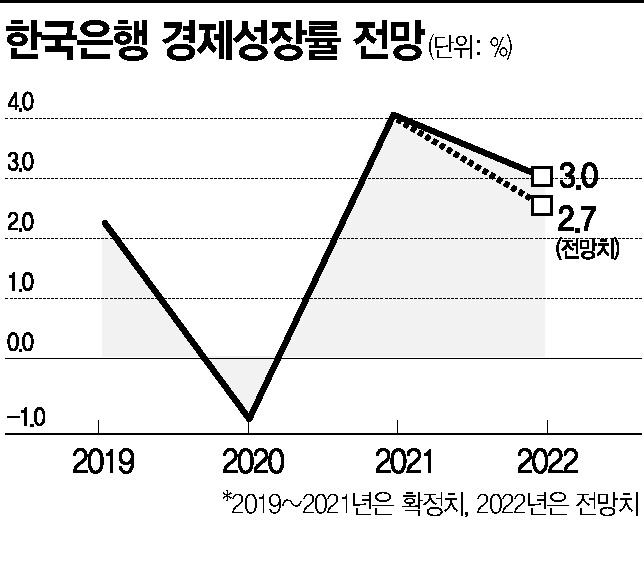
[Asia Economy Reporter Seo So-jeong] The Bank of Korea has downgraded South Korea's economic growth forecast for this year from the previous 3.0% to 2.7%, citing worsening external conditions such as China's lockdown measures and the Ukraine crisis. The consumer price inflation forecast for this year was raised by 1.4 percentage points to 4.5% compared to the previous projection.
In the revised economic outlook announced on the 26th, the Bank of Korea stated, "Although worsening external conditions such as China's lockdown measures and the Ukraine crisis will act as downward factors, the domestic economy is expected to continue its recovery thanks to the easing of quarantine measures."
Private consumption is expected to continue its recovery supported by the lifting of social distancing and improved income conditions. The Bank of Korea anticipated a rapid recovery in face-to-face service consumption and overseas consumption, along with a continued increase in goods consumption. Although household burdens due to rising prices and interest rates are expected to gradually increase, government support policies such as supplementary budgets and the purchasing power accumulated by households after the COVID-19 crisis are expected to support consumption recovery.
Construction investment is expected to remain sluggish for the time being due to rising raw material prices but is projected to show a gradual improvement in the second half of the year. Merchandise exports are expected to gradually slow down due to weakened growth in major countries and China's lockdown measures.
Regarding the contribution of expenditure components to growth, domestic demand contribution is expected to show a significant positive figure this year and next, following last year, while export contribution is expected to shrink compared to last year.
The number of employed persons is expected to gradually recover, mainly in face-to-face service industries, supported by the easing of quarantine measures, with increases of 580,000 and 120,000 persons expected this year and next year, respectively.
The consumer price inflation rate is projected at 4.5% this year and 2.9% next year. The 4.5% figure is 1.4 percentage points higher than the previous forecast of 3.1% announced in February and is the highest forecast in 13 years and 10 months since July 2008 (4.8%).
The Bank of Korea expects inflationary pressures to significantly increase beyond previous projections due to rising raw material prices, intensified supply disruptions, and the lifting of social distancing. Core inflation (excluding food and energy) is forecast at 3.2% this year and 2.6% next year.
Bank of Korea Governor Lee Chang-yong emphasized at a press conference following the Monetary Policy Board meeting, "The Statistics Korea will announce the May inflation rate in early June, and according to the Bank of Korea's estimate, it is expected to exceed 5%," adding, "We will focus on inflation in conducting monetary policy over the coming months." Governor Lee also stated, "Even if oil prices fall, international grain prices tend to remain high for a considerable period once they rise, so consumer price inflation is expected to remain at 3-4% until early next year."
The current account balance is expected to shrink compared to last year, mainly due to merchandise and service balances. The current account surplus forecast was sharply reduced from $70 billion to $50 billion. The current account surplus-to-GDP ratio is expected to remain around 3% both this year and next year.
© The Asia Business Daily(www.asiae.co.kr). All rights reserved.
![Clutching a Stolen Dior Bag, Saying "I Hate Being Poor but Real"... The Grotesque Con of a "Human Knockoff" [Slate]](https://cwcontent.asiae.co.kr/asiaresize/183/2026021902243444107_1771435474.jpg)
















