First Presentation of 'Judgment Criteria' for Wage Peak System Effectiveness... Individual Case Judgments Expected to Vary
Labor Sector "Encouraging Union-Level Actions to Nullify and Abolish Wage Peak System"
[Asia Economy Reporter Heo Kyung-jun] The Supreme Court has ruled that the "wage peak system," which reduces workers' wages upon reaching a certain age, is invalid. This ruling is the first to establish criteria for judging the effectiveness of the wage peak system that maintains the retirement age while reducing the wages of workers above a certain age for a specific period before retirement.
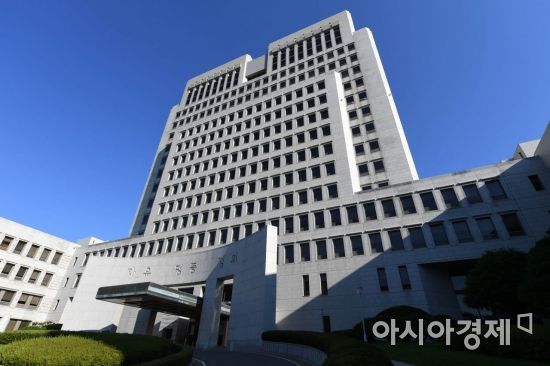
The Supreme Court's First Division (Presiding Justice Noh Tae-ak) on the 26th upheld the lower court's ruling that the wage peak system constitutes age discrimination in the wage lawsuit appeal filed by retiree A against Research Institute B.
The Supreme Court found it difficult to justify the purpose of the wage peak system, introduced to alleviate labor costs and improve management performance, as a valid reason for wage reduction measures targeting only employees aged 55 and older. Additionally, the fact that workers suffered a significant sudden wage decrease and that appropriate targeted measures were not devised was also a basis for ruling the wage peak system invalid.
However, the court stated that the effectiveness of the wage peak system may be judged differently depending on individual cases. Whether the wage peak system currently implemented by companies, such as the retirement age maintenance type, or the recognition of the wage peak system's effectiveness in cases pending in lower courts will depend on factors such as ▲the legitimacy and necessity of the introduction purpose ▲the extent and duration of the actual wage reduction ▲the appropriateness of the targeted measures ▲and whether the reduced funds were used for the intended purpose.
Labor unions' demands for the abolition of the wage peak system are expected to intensify. The two major unions, the Korean Confederation of Trade Unions and the Federation of Korean Trade Unions, have been demanding the extension of the retirement age to 65 and the abolition of the wage peak system, which is currently set at 60.
In a statement released after the ruling, the Federation of Korean Trade Unions said, "Although it has been more than five years since its introduction, the effect of increasing youth employment at workplaces where it was introduced has been minimal, and as a result, only workers' wages have been reduced." It added, "In the financial sector and public institutions, the reduction of skilled practical personnel has increased the workload intensity for workers in those fields, leading to accumulated dissatisfaction and serious organizational conflicts due to labor cost regulations, meaning the original purpose has not been realized."
It continued, "The wage peak system, which reduces wages based on age as it currently operates, should not continue," and stated, "We will encourage labor unions to invalidate and abolish the wage peak system through on-site guidelines and other measures."
Some interpret this ruling as a "standard wage season 2." The core issue in the standard wage lawsuit is whether to include regular bonuses in the standard wage. Most workplaces have lost these lawsuits, bearing the burden of having to pay standard wages all at once.
Since the standard wage serves as the basis for calculating overtime and holiday work allowances and retirement pay, future wage cost increases are inevitable. This will inevitably be a significant burden for manufacturing companies such as shipbuilding and automobile industries, where workers have long working hours. In December last year, the Supreme Court ruled in favor of workers at Hyundai Heavy Industries, a shipbuilding affiliate of Korea Shipbuilding & Offshore Engineering, who filed a lawsuit against the employer to include bonuses in the standard wage and claim the difference in statutory allowances and retirement pay. Following that ruling, Korea Shipbuilding & Offshore Engineering set aside a provision of 687.2 billion KRW in the fourth quarter of last year for its three shipbuilding affiliates combined.
© The Asia Business Daily(www.asiae.co.kr). All rights reserved.
![Clutching a Stolen Dior Bag, Saying "I Hate Being Poor but Real"... The Grotesque Con of a "Human Knockoff" [Slate]](https://cwcontent.asiae.co.kr/asiaresize/183/2026021902243444107_1771435474.jpg)
















