[Asia Economy Reporter Tae-min Ryu] As the online commerce market expands due to the impact of COVID-19, the logistics center real estate market is gaining attention as an investment product. With the spread of non-face-to-face culture driving demand, the annual investment transaction volume has surpassed 7 trillion won, marking an all-time high.
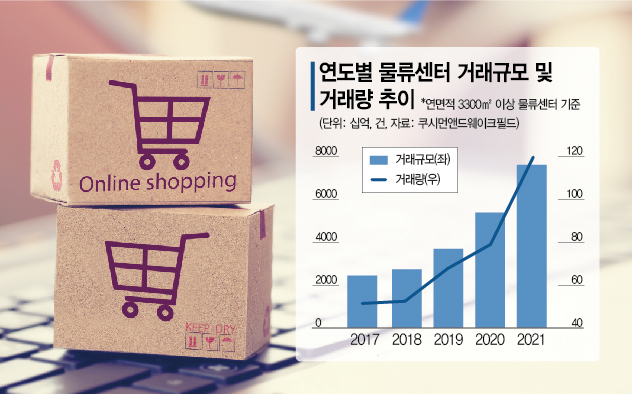
According to the 2022 Logistics Report published on the 26th by global real estate consulting firm Cushman & Wakefield, the total transaction amount of logistics-related real estate nationwide with a total floor area of 3,300㎡ or more reached 7.76 trillion won last year. This is an increase of 3.992 trillion won (105%) compared to 3.768 trillion won in 2019, before the COVID-19 pandemic, more than doubling in two years. Compared to four years ago in 2017 (2.494 trillion won), the transaction market size increased by a staggering 5.266 trillion won (211%).
The increase in transaction volume is also remarkable. The total number of transactions nationwide for logistics-related real estate with a total floor area of 3,300㎡ or more was only 50 to 60 cases from 2017 to 2019, but jumped to 80 cases in 2020 and 120 cases last year. In particular, by region, 95 transactions occurred in the Seoul metropolitan area and 25 in non-metropolitan areas last year, showing a concentration in the metropolitan area.
As demand surged, supply also increased. The cumulative supply area of logistics centers in the metropolitan area was about 21.63 million ㎡ last year. This has steadily increased from 13.67 million ㎡ in 2017 to 15.44 million ㎡, 17.56 million ㎡, and 19.23 million ㎡ in subsequent years.
The number of logistics-related permits and approvals has also steadily increased. According to Real Estate R114, the annual number of permits for logistics warehouse operators was only 157 in 2019 but rose sharply to 255 in 2020 and 224 in 2021 after the outbreak of COVID-19.
Online Shopping Demand Surges... REITs and Fractional Investment Also Attract Interest
This upward trend is attributed to the normalization of non-face-to-face culture due to the spread of COVID-19. As the e-commerce market rapidly grows, the demand for logistics warehouses needed for storing goods and related loading, unloading, and sorting operations has increased quickly. In particular, demand has concentrated in the Seoul metropolitan area, which offers relatively superior consumer accessibility and transportation convenience compared to provincial areas. In fact, more than half of the 224 permits issued last year, 148 cases, were located in the metropolitan area.
The market size of REITs (Real Estate Investment Trusts) investing in logistics centers is also expanding. ‘ESR Kendall Square REIT,’ listed in December 2020, is the largest logistics center REIT in Korea, with assets worth 2.3 trillion won and a market capitalization of 1.5 trillion won. Lotte Group’s asset securitization channel, Lotte REITs, is also growing rapidly, achieving an asset size of 2.3 trillion won within two years of its establishment.
Additionally, the ‘real estate fractional investment’ market, a method of dividing buildings into small shares for investment similar to stock investment, has recently entered the logistics center sector. Korea’s first real estate digital revenue securities (DABS) exchange, Kasa, announced on the 24th that it will publicly offer the ‘TE Logistics Center’ located in Cheonan next month.
© The Asia Business Daily(www.asiae.co.kr). All rights reserved.

















