Saemaeul Geumgo Employee "Used Living Expenses"
Civil Enforcement Impossible Without Assets
Penalties Vary Depending on Repayment Status
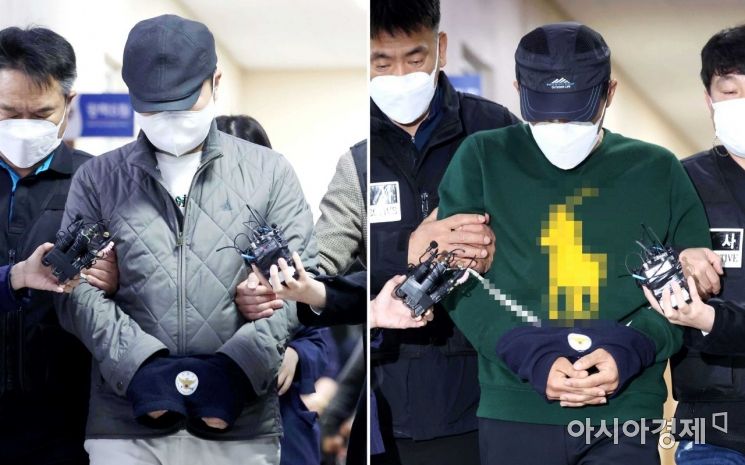 Employee A (left) and his younger brother B, who are accused of embezzling approximately 61.4 billion won over six years at Woori Bank, are being transferred to the prosecution at Namdaemun Police Station in Jung-gu, Seoul on the 6th. Photo by Moon Honam munonam@
[Asia Economy Reporters Jang Sehee and Oh Gyumin] A common factor in recent embezzlement cases is the embezzlers' statements that "the money has all been spent." In reality, if the embezzler lacks the ability to repay, recovering the damages is difficult.
On the 26th, the Songpa Police Station in Seoul booked and is investigating Mr. A, a man in his 50s and an employee at the Saemaeul Geumgo headquarters in Songpa-gu, Seoul, on charges of embezzlement under the Act on the Aggravated Punishment of Specific Economic Crimes. He is accused of embezzling about 4 billion KRW from customer deposits over approximately 16 years. Of the damages, 1.1 billion KRW has not yet been repaid to the company. Ultimately, the Saemaeul Geumgo Central Association decided to cover all the damages at the company level. He stated during the police investigation that he used part of the embezzled funds for living expenses.
An employee of Woori Bank also embezzled company funds amounting to about 60 billion KRW, but the police applied for seizure and confiscation preservation only for about 6.6 billion KRW. A police official said, "Under criminal law, the investigative agency can only apply for seizure and confiscation preservation when assets are found." Although civil lawsuits can continue, even if a favorable judgment is obtained, if there are no assets, the money cannot be recovered.
What about the severity of their punishments? Legal circles agree that the level of punishment varies depending on the state of damage repayment and whether there is an agreement with the victim. For example, the Jeonju District Court last month sentenced a 30-year-old public official, Mr. A, who embezzled about 800 million KRW of public funds last year, to three years in prison. The court stated, "Considering that most of the amount has not yet been repaid, a severe punishment corresponding to the defendant's culpability is necessary." On the other hand, the Daegu District Court on the 17th sentenced Mr. B, who embezzled 67 million KRW of public funds, to six months in prison with a two-year probation. The court explained the sentencing by considering "the full repayment of the damages and the absence of prior criminal records."
Attorney Kim Kwangjoong of Han-gyeol Law Firm said, "Whether repayment has been made is the most important factor in sentencing," adding, "If the embezzled money has all been spent, a heavier punishment will be imposed." Under criminal law, embezzlement is punishable by up to five years in prison or a fine of up to 15 million KRW. Occupational embezzlement carries a heavier sentence of up to ten years in prison or a fine of up to 30 million KRW. If the amount gained exceeds 500 million KRW, the sentence is imprisonment for three years or more, and if it exceeds 5 billion KRW, aggravated punishment applies with life imprisonment or imprisonment for five years or more.
Strengthening internal management and preventing embezzlement accidents are also important. Attorney Hong Kyungho of Hwawoo Law Firm said, "In embezzlement cases, even if it goes to civil court, if the other party lacks the ability to pay, enforcement itself is impossible," adding, "Companies should strengthen internal controls twofold or threefold to prevent crimes such as embezzlement from occurring in advance." Researcher Seung Jaehyun of the Korea Institute of Criminal Justice Policy said, "In financial crimes, if post-event self-compensation is impossible, there is no way to prevent it, so prevention is paramount," and added, "It should not be seen as a mere isolated incident at one place; the entire company's accounting system should be thoroughly reviewed."
© The Asia Business Daily(www.asiae.co.kr). All rights reserved.

















