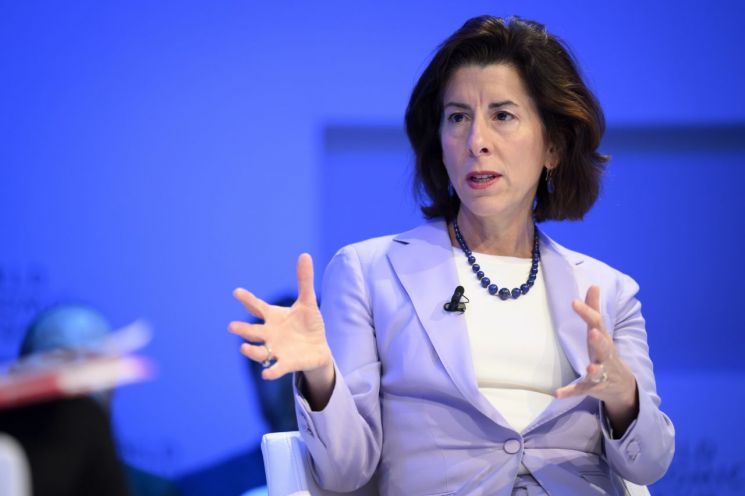
[Asia Economy Reporter Jeong Hyunjin] Gina Raimondo, U.S. Secretary of Commerce, who accompanied President Joe Biden on his Asia tour and pledged to strengthen semiconductor cooperation with South Korea and Japan, emphasized that the direction should be to build semiconductor production facilities directly in the United States rather than 'friendshoring.'
Secretary Raimondo said this during an interview with U.S. economic broadcaster CNBC on the 25th (local time) while attending the World Economic Forum (WEF, Davos Forum) in Davos, Switzerland, calling it "a tremendous national security issue." Friendshoring is a concept proposed last month by U.S. Treasury Secretary Janet Yellen, which aims to strengthen economic cooperation such as global supply chains among countries that share core values and principles.
Raimondo's remarks are notable as they came immediately after her visits to South Korea and Japan. On the 20th, she toured the Samsung Electronics semiconductor plant in Pyeongtaek together with President Biden. CNBC reported that at that time, Secretary Raimondo repeatedly requested the creation of a similar "massive manufacturing facility" in the United States.
Secretary Raimondo stressed that Congress must actively support legislation to establish semiconductor factories within the U.S. She mentioned Intel, Micron, and Samsung, saying, "They are growing and will build future (semiconductor) production facilities," adding, "If Congress does not act quickly, they will build production facilities in Asia or Europe instead of the U.S., and we will be at risk of losing them."
Raimondo also highlighted the high dependence of major U.S. companies such as Apple, Amazon, and Google on Taiwanese firms like TSMC, expressing concern by stating, "The U.S. purchases 70% of advanced semiconductors from Taiwan." She noted that advanced semiconductors are used in military equipment, citing that the Javelin anti-tank missile contains as many as 250 such advanced semiconductors. She said, "Do we want to buy all these semiconductors from Taiwan? That is not safe," and urged, "Pass the bill. Let's secure businesses that manufacture semiconductors in the U.S. to protect our future." When asked if a conflict between China and Taiwan could also damage the semiconductor industry, she replied, "It would be a completely terrifying and unbearable situation."
The Biden administration is focusing on building semiconductor supply chains. The share of U.S. semiconductor production facilities worldwide dropped sharply from about 40% in 1990 to 12% in 2020. The global semiconductor supply shortage caused by the COVID-19 pandemic impacted key U.S. industries such as automobile manufacturing. To counter China, the U.S. is strengthening semiconductor supply chain cooperation with allies like South Korea and Japan.
© The Asia Business Daily(www.asiae.co.kr). All rights reserved.

















