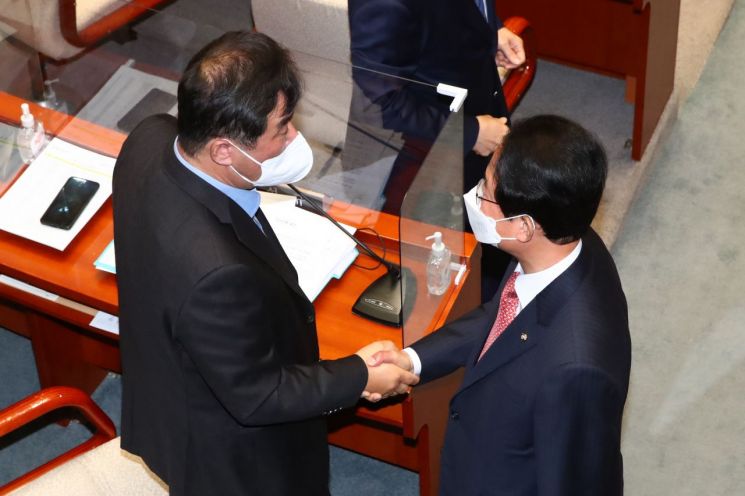
 Ryu Seong-geol, the secretary of the People Power Party (right), and Maeng Seong-gyu, the secretary of the Democratic Party of Korea (left), are greeting each other on the 19th at the Special Committee on Budget and Accounts held at the National Assembly. (Photo by Yonhap News)
[Asia Economy Reporter Ryu Tae-min] The ruling and opposition parties continued negotiations on the second supplementary budget bill (supplementary budget) for this year but failed to reach an agreement as they could not overcome differences on key issues, continuing from the previous day.
Ryu Seong-geol of the People Power Party and Maeng Seong-gyu of the Democratic Party, the floor leaders of the National Assembly's Special Committee on Budget and Accounts, resumed talks on the supplementary budget bill at the National Assembly on the afternoon of the 25th, but the talks broke down after about 10 minutes.
After the breakdown, Representative Maeng said, “(The People Power Party side) did not make any adjustments and brought the original draft as it was, so additional adjustments seem necessary.” Representative Ryu said, “The difference in the scale of the supplementary budget is too large,” and added, “We will continue negotiations from today until the subcommittee meeting.”
The Democratic Party side proposed 47.2 trillion won plus “+α (plus alpha)” in this negotiation. Including an 8 trillion won retroactive budget for COVID-19 loss compensation and new emergency management loans for self-employed and small business owners (3.8 trillion won), the total scale reportedly exceeded 50 trillion won.
However, the People Power Party side, citing legal deficiencies, expressed reluctance to apply loss compensation retroactively and insisted on the original draft of 36.4 trillion won (excluding local allocation tax) agreed upon with the government, resulting in a stalemate in negotiations between the ruling and opposition parties.
Representative Maeng posted on SNS, “The Democratic Party requested the Ministry of Economy and Finance to use the 9 trillion won debt repayment in this supplementary budget to expand the second compensation for loan interest conversion of 7 trillion won for damage relief for small business owners and self-employed, expand emergency management loan support, and increase debt forgiveness. However, the Ministry of Economy and Finance has not even minimally reviewed the demands for expanded support for small business loans, so the discussion could not progress.”
In response, Representative Ryu explained, “The part about restoring the spending restructuring is actually an increase compared to the government proposal. The government holds the right to consent on the increase. Since it is an increase, not a decrease, the government’s opinion is very important.”
With limited time remaining to pass the second supplementary budget bill within the May extraordinary session as originally targeted, the ruling and opposition parties decided to continue behind-the-scenes negotiations even after the meeting broke down on this day.
© The Asia Business Daily(www.asiae.co.kr). All rights reserved.
![Clutching a Stolen Dior Bag, Saying "I Hate Being Poor but Real"... The Grotesque Con of a "Human Knockoff" [Slate]](https://cwcontent.asiae.co.kr/asiaresize/183/2026021902243444107_1771435474.jpg)
















