KMA "This Summer's Temperatures Expected to Be Higher Than Average"
Growing Concerns Over the 'Silent Killer' Heatwave
Heatwaves Avoided with Air Conditioners... But What About 'Ozone'?
"Coal Power Is the Main Cause of the Climate Crisis... Urgent Energy Transition Needed"
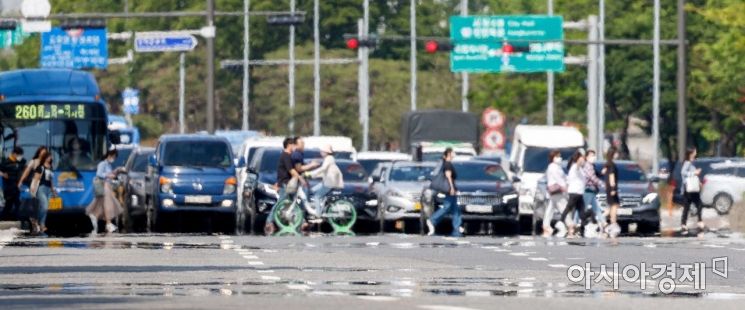 On the 24th, as the daytime temperature in Seoul rises to 30 degrees Celsius, heatwaves continue, and heat haze is rising on Yeouidaero in Seoul. Photo by Jinhyung Kang aymsdream@
[Asia Economy Reporter Yoon Seul-gi] As the hot early summer weather continues, concerns about the "silent killer" heatwave are growing amid forecasts that this summer's temperatures are likely to be higher than average. On top of this, an ozone advisory has been issued, making the climate disaster feel more immediate. Environmental groups have pointed to coal power generation as the main culprit of the climate crisis and emphasized the transition to renewable energy.
According to the Korea Meteorological Administration's recent "June to August 3-month forecast," the probability of this summer's temperatures being higher than average is high until around Chuseo (處暑, August 23), when the heat typically subsides. For June, the probability of temperatures being lower than the average temperature (21.4°C) is 20%, while the probability of temperatures being similar to or higher than average is 80%. For July and August, the probability of temperatures being higher than the average temperatures (July 24.6°C, August 25.1°C) is 50%. The probability of temperatures being similar to average is 30%, and the probability of being lower is 20%.
With the Korea Meteorological Administration forecasting temperatures above average this summer, concerns about heatwaves are rising. Heatwaves, which cause heat-related illnesses such as heatstroke and heat cramps, are the natural disaster with the highest death toll. According to Statistics Korea, from 2011 to 2019, the total number of heatwave-related deaths was 493. This figure is approximately 3.6 times higher than the combined fatalities caused by typhoons and heavy rains during the same period.
In particular, the damage in 2018, when the highest temperatures and the most heatwave days since meteorological observations began were recorded, was severe. According to the 2020 Heatwave Impact Report by the Korea Environment Institute, 4,526 heat-related illness cases occurred nationwide in 2018, with 48 deaths recorded by the heat illness surveillance system and 145 deaths recorded in the cause-of-death statistics by Statistics Korea (June to August). As the number of heatwave days increases, the incidence rate of heat-related illnesses rises, and the risk of health damage also increases.
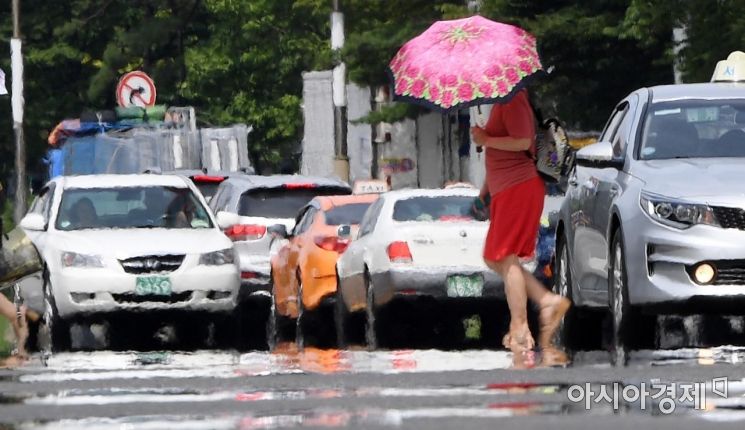 Heat haze is rising above the roadway in Yeouido, Yeongdeungpo-gu, Seoul. Photo by Hyunmin Kim kimhyun81@
The problem is that the number of heatwave days is expected to increase due to climate change. According to the Korea Meteorological Administration's forecast, the average summer temperature in Seoul in the late 21st century (2071?2100) is expected to reach 29.8°C, and the average daily maximum temperature is projected to approach a staggering 40°C. The number of heatwave days is expected to increase by 62.3 days from the 2001?2010 average of 11.1 days, totaling 73.4 days, which is about 6.6 times higher.
Meanwhile, as heatwaves pose a growing threat, Seoul has issued its first ozone advisory of the year, confronting another climate crisis. The Seoul Metropolitan Government issues an advisory when the one-hour average ozone concentration in a district exceeds 0.12 ppm. On the 23rd at 2 p.m., an ozone advisory was issued across all of Seoul except the southeastern region.
According to last year's "Seoul Ozone Advisory Issuance Status and Causes of Increase" report by the Health and Environment Research Institute, ozone concentrations have been steadily rising from 1989 to 2020 (with an annual average of 0.025 ppm in 2020). The number of ozone advisories issued in Seoul increased from a total of 3 times in 2015 to 17 times in 2016 and has remained in double digits since then.
The problem with ozone is that, unlike fine dust, it is difficult to avoid. Fine dust particles can be filtered by wearing masks, but ozone, being a gas, inevitably enters the body during outdoor activities.
Regarding this, Song Joo-hee, an activist from the Korean Federation for Environmental Movements, said, "The early arrival of summer and the increase in heatwave days are phenomena caused by the climate crisis. There are several main culprits worsening the climate crisis, but the biggest problem is greenhouse gas emissions from coal power generation. Greenhouse gases raise the Earth's temperature, creating a vicious cycle." She added, "Ultimately, to solve these problems, a transition to renewable energy is necessary."
Song emphasized, "To address the intermittency of renewable energy, expanding energy storage systems (ESS) and developing technologies to improve generation efficiency with smaller capacities require large-scale government budget allocations. Since the climate crisis is greatly influenced by coal power, transitioning to renewable energy should be prioritized."
© The Asia Business Daily(www.asiae.co.kr). All rights reserved.


















