44.6% Increase Over the Past 5 Years... Four Times the G5 Average
"Concerns Over Side Effects, Excessive Increases Should Be Avoided This Year"
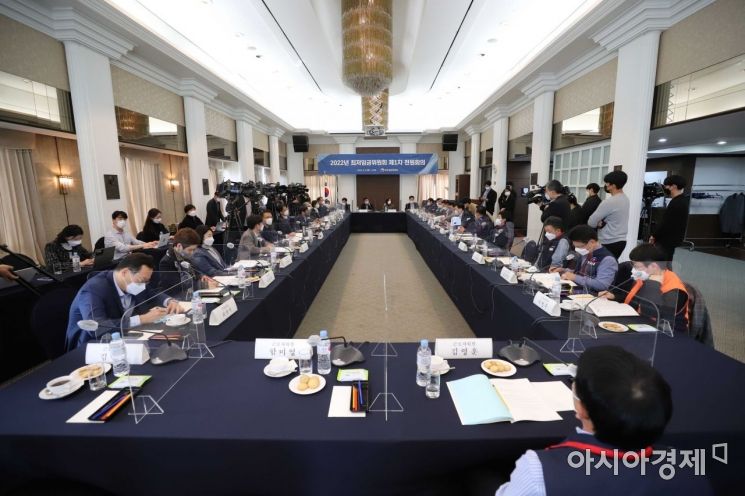 Park Junsik, Chairman of the Minimum Wage Commission, is delivering an opening remark at the Minimum Wage Commission meeting held on the 5th at the Press Center in Jung-gu, Seoul. Photo by Kang Jinhyung aymsdream@
[Asia Economy Reporter Kim Jin-ho] South Korea's minimum wage level and rate of increase have been found to be among the highest within the Organisation for Economic Co-operation and Development (OECD). As the Minimum Wage Commission begins deliberations on next year's minimum wage, suggestions have been raised to refrain from excessive hikes in order to alleviate corporate burdens and minimize various side effects.
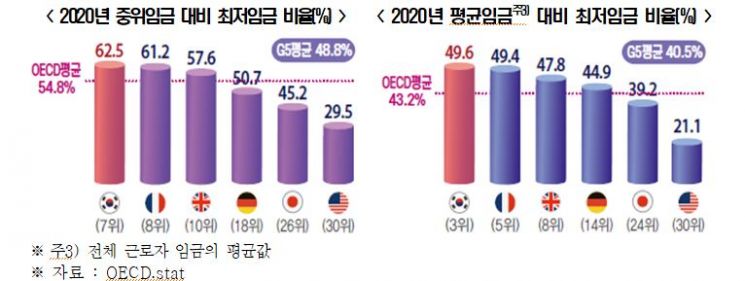
The Federation of Korean Industries (hereafter FKI) announced on the 26th that, based on an analysis of OECD statistics, South Korea's minimum wage ratio compared to the median wage was 62.5% in 2020, ranking 7th among the 30 OECD countries surveyed. South Korea's minimum wage ratio compared to the average wage was also high, at 49.6% in 2020, ranking 3rd among the 30 OECD countries surveyed.
Over the past five years (2016?2021), South Korea's minimum wage increase rate was 44.6%, which is four times the G5 average of 11.1%. Following South Korea were the UK (23.8%), Japan (13.0%), Germany (12.9%), France (6.0%), and the United States (0.0%). Due to the rapid increase in the minimum wage, the proportion of workers earning below the minimum wage appears to be higher compared to major countries.
South Korea's minimum wage underpayment rate was 15.6% in 2020, significantly higher than Japan (2.0%), the UK (1.4%), Germany (1.3%), and the US (1.2%). The FKI pointed out, "While hourly labor productivity increased by 11.5% over the past five years, the minimum wage rose by 44.6%, indicating that the minimum wage increase is very steep compared to productivity growth."
While South Korea applies a uniform minimum wage, major advanced countries such as the United States and Japan apply differentiated minimum wages considering factors like industry, region, payment capacity, productivity, and work intensity. For example, the US differentiates by region, Japan by region and industry, and the UK by age.
Unlike the G5 countries, South Korea mandates the payment of one day's weekly holiday allowance if an employee works 15 hours or more per week. The FKI explained, "South Korea is the only G5 country with a weekly holiday allowance system, and since this allowance is not included in the minimum wage calculation base, it further increases the labor cost burden on companies."
South Korea's narrow scope of minimum wage inclusion compared to major countries is also cited as a problem. In South Korea, if an employer provides lodging or meals in kind to workers, these are excluded from the minimum wage calculation base. In contrast, the US, Japan, and France include lodging and meal costs provided in kind in the minimum wage, and the UK includes lodging costs provided in kind.
Particularly in Germany, lodging and meal costs provided in kind are included in the minimum wage only for workers affected by seasonal characteristics such as agriculture and fisheries. The FKI pointed out, "In South Korea, foreign workers are often provided lodging and meals directly, and due to the narrow minimum wage inclusion scope, these workers may receive greater benefits compared to domestic workers when applying the minimum wage."
South Korea experiences intense labor-management conflicts during the minimum wage deliberation process every year. The minimum wage decision system consists of a Minimum Wage Commission with 27 members: 9 worker representatives, 9 employer representatives, and 9 public interest members, who decide the minimum wage through labor-management agreement. Meanwhile, in the US, the federal Congress decides the minimum wage, and in France, the government decides after hearing labor-management opinions. Japan, Germany, and the UK also decide minimum wages through commissions with labor-management agreements, but their labor-management relations are cooperative, often leading to smooth agreements.
The FKI explained, "Since the introduction of the minimum wage system in 1988, there have been only seven instances of agreed increase rates due to significant differences between labor and management positions. As a result, the current decision system leads to prolonged deliberation periods and effectively results in the minimum wage being decided by public interest members."
Additionally, while most G5 countries impose fines or penalties without imprisonment for minimum wage violations, South Korea imposes imprisonment of up to three years or fines up to 20 million won, which has been criticized as excessive. France imposes a fine of 1,500 euros per worker paid below the minimum wage, Japan imposes fines up to 500,000 yen, the UK fines up to 20,000 pounds, Germany fines up to 500,000 euros, and the US imposes imprisonment of up to six months or fines up to 10,000 dollars only for intentional violations.
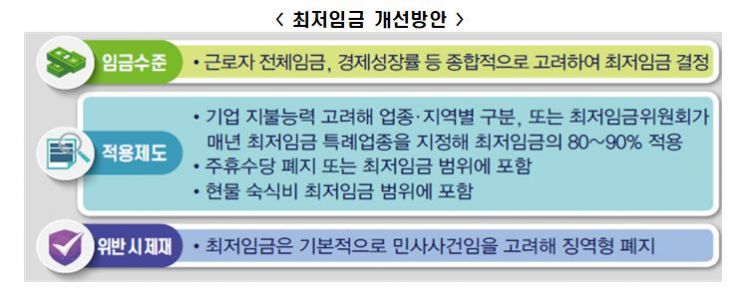
The FKI proposed improvement measures to enhance the rationality of the minimum wage, including adjusting the rate of increase by comprehensively considering economic growth rates and overall worker wage levels. They also suggested differentiated application by industry and region based on payment capacity and productivity, designation of special minimum wage industries, abolition or inclusion of weekly holiday allowance in the minimum wage base, and elimination of imprisonment penalties for violations.
Choo Kwang-ho, head of the FKI Economic Headquarters, expressed concern, saying, "The minimum wage is already at a high global level, and with persistent economic uncertainties such as high inflation, high exchange rates, and high interest rates, the difficulties faced by small and micro enterprises with weak payment capacity are expected to worsen."
© The Asia Business Daily(www.asiae.co.kr). All rights reserved.



















