As the COVID-19 pandemic transitions into an endemic, offline commercial districts that had been subdued for over two years are rapidly recovering. Not only has the floating population noticeably increased in major commercial areas of Seoul, but sales have also surged significantly.
According to a comparison of subway exit data from Seoul's public data, the number of subway exits during the 4th and 5th weeks of April, after social distancing measures were lifted, increased by 21.6% at Itaewon Station compared to the previous month. During the same period, Hongdae Entrance Station saw a 20.9% increase, and Myeongdong Station increased by 16.4%.
Consumers' card usage also surged. According to KB Kookmin Card, the average card sales in major industries increased by 60% after the full lifting of business restrictions. The number of card transactions jumped by 44% compared to before the lifting, allowing a tangible sense of commercial district recovery.
An industry insider stated, “Major commercial districts are rapidly recovering just about a month after the social distancing measures were lifted,” adding, “In particular, not only food and beverage establishments such as restaurants and cafes but also leisure service sectors like movie theaters, performance venues, and exhibition halls have seen a significant increase in sales transactions, drawing attention.”
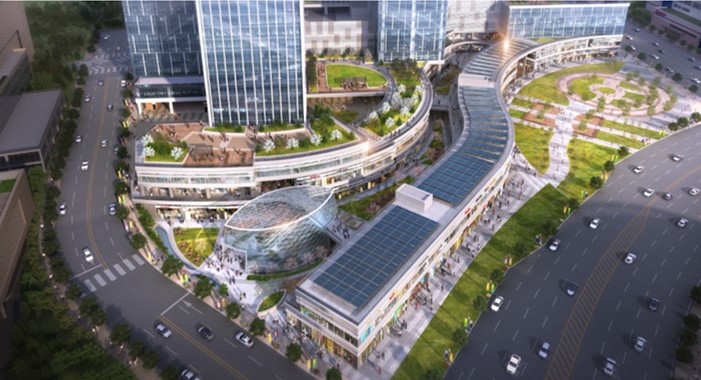
Meanwhile, a complex shopping space featuring movie theaters and exhibition halls has been introduced in the Gwangmyeong Station area, considered the center of the western metropolitan area, attracting attention. The commercial facility ‘GIDC Mall,’ supplied on the urban support facility site of the Gwangmyeong Station district, is the main highlight.
Located within the knowledge industry center ‘GIDC Gwangmyeong Station,’ with a total floor area of 269,109㎡, the commercial facility ‘GIDC Mall’ quickly completed its sales due to solid fixed demand and the attraction of differentiated anchor tenants.
The Gwangmyeong Station area, where this commercial facility is located, is inherently rich in floating population thanks to KTX, Subway Line 1, and the KTX Gwangmyeong Station City Airport Terminal. Additionally, there is fixed demand from residents of approximately 7,000 residential units already sold. Large distribution facilities such as Costco, IKEA, and Lotte Outlet have also established their presence, securing a diverse consumer base.
Furthermore, in March, the 700-bed Chung-Ang University Gwangmyeong Hospital opened, and various knowledge industry centers are being additionally developed, forming a vast commercial district encompassing residential, business, and shopping functions.
The differentiated anchor tenants attracting customers are also noteworthy. The most eye-catching feature is the permanent exhibition of the ‘Bon Da Vinci Museum,’ a media art exhibition highly praised both domestically and internationally. ‘Bon Da Vinci Museum Gwangmyeong’ showcases media art exhibitions that combine original masterpieces with IT, incorporating storytelling to convey not only the artist’s works but also the boundless stories of his life.
Additionally, the country’s largest book caf?, ‘Coffee and Library,’ has completed its move-in, and a CGV movie theater with all seats arranged as recliners is scheduled to open this month. The commercial facility ‘GIDC Mall,’ currently progressing smoothly with tenant move-ins, is being constructed on the urban support facility site of the Gwangmyeong Station district, spanning from basement level 2 to ground level 1, with a total floor area of 55,588㎡. The project’s stability is also secured through construction by Hyundai Engineering.
© The Asia Business Daily(www.asiae.co.kr). All rights reserved.

















