Short-term External Debt Ratio to Foreign Exchange Reserves at 38.2%... Up 2.6%p from Previous Quarter
[Asia Economy Sejong=Reporter Kwon Haeyoung] As demand for funding surged ahead of the U.S.'s full-scale interest rate hikes, both short-term and long-term external debt increased simultaneously in the first quarter of this year. The proportion of short-term external debt relative to foreign exchange reserves also rose, raising concerns that the maturity structure of external debt may become even shorter-term due to the ongoing global interest rate hike trend.
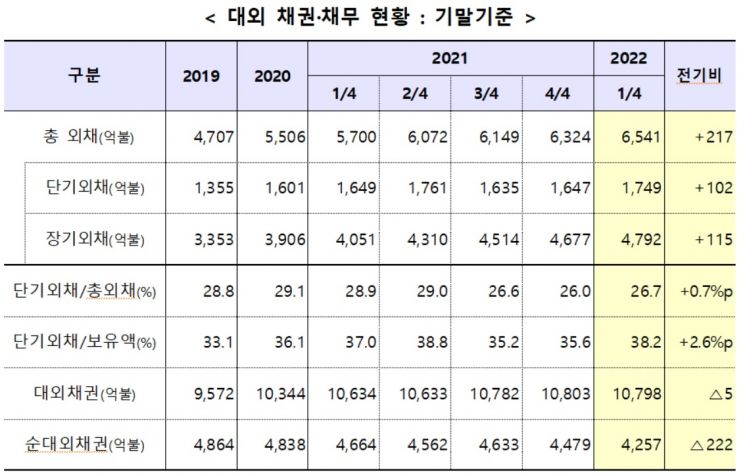
According to the "2022 Q1 External Claims and Liabilities Trends" released by the Ministry of Economy and Finance on the 25th, as of the end of March this year, external liabilities stood at $654.1 billion, an increase of $21.7 billion compared to the end of last year.
Among these, short-term external debt repayable within one year amounted to $174.9 billion, up by $10.2 billion. As a result, the share of short-term external debt in total external debt rose by 0.7 percentage points from the end of last year to 26.7%. With foreign exchange reserves decreasing and short-term external debt increasing, the ratio of short-term external debt to foreign exchange reserves also rose by 2.6 percentage points to 38.2%. This exceeds the 10-year quarterly average of 33.8%. In this regard, the Ministry explained that this level is still lower than other emerging countries such as Turkey (107.7%), Argentina (105.5%), and Malaysia (80.5%).
Long-term external debt with maturities over one year reached $479.2 billion, an increase of $11.5 billion.
Net external claims, calculated by subtracting external liabilities from external claims, were $425.7 billion, down by $22.2 billion.
A Ministry of Economy and Finance official analyzed, "Both short-term and long-term external debt increased due to pre-funding demand ahead of the U.S. Federal Reserve's interest rate hikes. Considering the possibility of increased short-term borrowing driven by expanded arbitrage incentives and the weakening incentive for foreign investors to invest in medium- to long-term Korean won bonds due to narrowing domestic-foreign interest rate differentials, the maturity structure of external debt is likely to shorten in the future."
According to the Ministry, the interest rate differential between Korea and the U.S. is expected to widen from 0.15 percentage points in Q2 to 0.35 percentage points in Q3 and 0.6 percentage points in Q4.
The Ministry official added, "We will actively discuss the issuance of long-term foreign currency bonds by public institutions and strive to supply foreign currency funds through this, which will reduce arbitrage incentives and slow the increase in short-term external debt, thereby helping to lengthen the maturity structure of external debt."
© The Asia Business Daily(www.asiae.co.kr). All rights reserved.

















