Large-scale Economic Stimulus Announced but Market Remains Lukewarm
Competitor US Strengthens Global Leadership Emphasizing Democracy
Capital Accelerates Move Away from China... Apple Also Relocates Factories
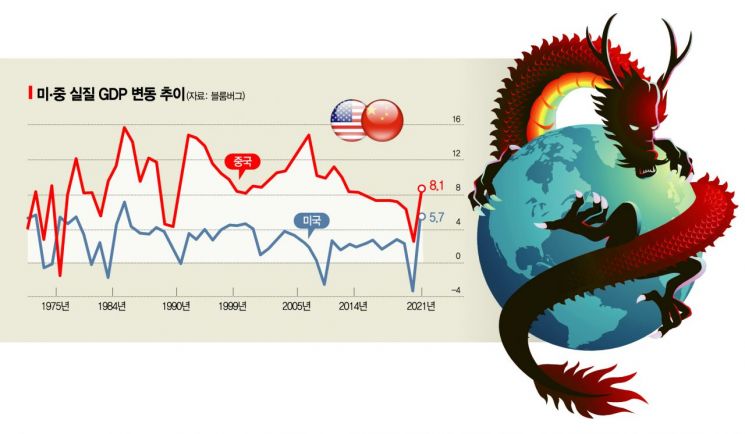
[Asia Economy Reporter Kim Hyunjung] The era when China drove the global economy based on high growth in the manufacturing sector is coming to an end. Some analysts argue that the world order reshaped after the Ukraine crisis, combined with China’s ‘Zero-COVID’ policy, has exposed the limits of the Chinese-style growth model. In particular, it is assessed that since the war, China has lost its lead in the hegemony competition with the US, showing inferiority in global influence and economic resilience.
On the 25th, synthesizing major foreign media and China’s official announcements, after China announced a ‘33-package policy’ worth 140 billion yuan (about 26.5594 trillion KRW) including tax cuts for economic stimulus on the 23rd, no financial institutions positively evaluated it or raised growth forecasts. Global investment banks (IBs) rather issued pessimistic forecasts, saying the series of processes exposed the limitations of China’s political and economic structure.
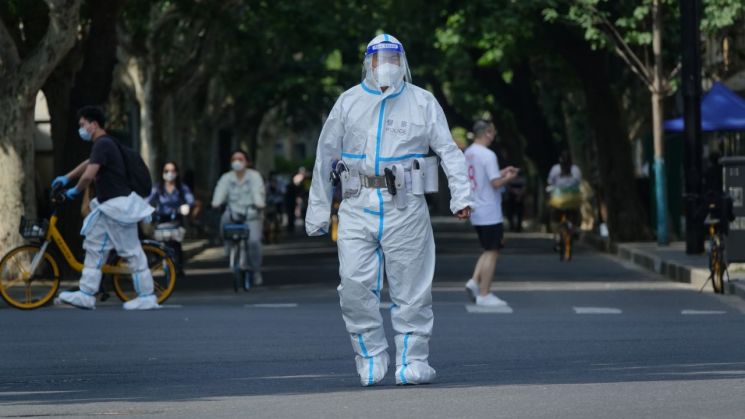
◆ Limits of Chinese-style Politics and Economy Revealed by Lockdowns = UBS lowered China’s GDP growth forecast for this year from 4.2% to 3.0% on the 23rd (local time), after the stimulus package was announced, citing “lack of clarity on lockdowns and exit strategies.” JP Morgan cut its forecast from 4.3% to 3.7%, and Bloomberg Economics lowered it from 3.6% to 2%. Most institutions including Standard Chartered (4.1%), Goldman Sachs (4%), and Citi (4.2%) predicted that the Chinese government would not reach its official growth target of 5.5%.
This judgment reflects the real estate market downturn that was already embedded before the shock of city lockdowns. The construction and real estate investment boom that drove China’s high growth rapidly cooled due to high-intensity regulations introduced by the government to curb excessive loans and speculation, as well as the Evergrande default crisis. Recently, Goldman Sachs raised its default rate forecast for Chinese real estate high-yield bonds in fiscal year 2022 from 19.0% to 31.6%.
Within China, expectations of further declines in real estate and stock markets are growing, and there is a strong mood to hold only cash. As of the end of last month, the balance of savings deposits at Chinese banks reached 109.2 trillion yuan, with deposit growth rates soaring to 7% from January to April.
Low birthrate and aging issues are also expected to make China’s structural economic rebound more difficult. As of last year, China’s birthrate hit its lowest in 43 years, and the population aged 65 and over reached 205.6 million, accounting for 14.2% of the total, entering an aged society.
The rise of the US, China’s competitor, amid global focus on war and virus response, also makes it difficult to be optimistic about the Chinese economy. US President Joe Biden said during his visit to Korea on the 21st, “Despite historic global economic difficulties, our (US) economy has proven its resilience,” adding, “There is analysis that the US economy is prepared to grow much faster than China’s economy. This is the first time in 45 years since 1976.”
President Biden particularly described the US in one word as ‘possibility’ and ‘optimism,’ indirectly referring to the democratic system. This was interpreted as emphasizing the superiority of democracy in the new Cold War framework between democracy and authoritarianism deepening after the Ukraine war.
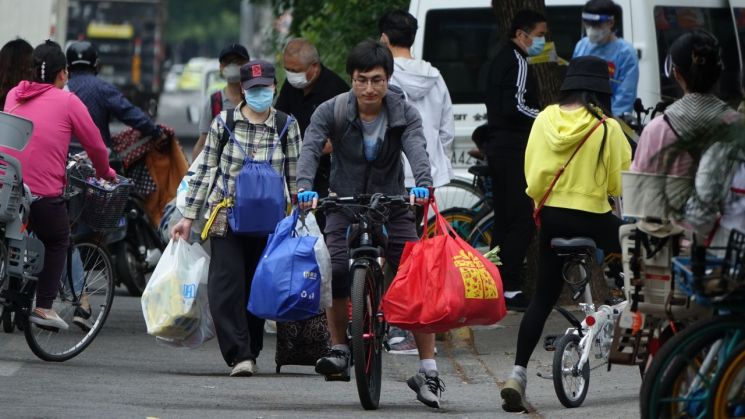
◆ The Flow of ‘Money’ Has Already Begun to Move = Capital was the quickest to notice China’s crisis and the shift in hegemony. Financial markets and global companies already seem to have concluded on China’s low growth and limitations.
Apple, regarded as a global ‘innovative company,’ is a representative example. The company, which has manufactured over 95% of its major products such as iPhones in China, is recently considering relocating some production bases to India or Southeast Asia. Last month, Apple announced that its Q2 revenue could decrease by up to $8 billion, indicating that the damage would not end there. Airbnb, the world’s largest accommodation sharing platform, also decided to cease its accommodation business in China starting this summer.
Investor withdrawal movements are also significant. According to The Economist UK, $2 trillion (about 2,549 trillion KRW) has flowed out of Chinese stocks listed in Hong Kong and New York over the past year. The Washington-based Institute of International Finance (IIF) forecasts that capital outflows invested in China will increase from $129 billion last year to $300 billion this year.
The recent emphasis on the role of Premier Li Keqiang, the ‘economic chief’ inside and outside China, is also due to this. Some see that concerns over low growth have inevitably increased the need and interest in stimulus measures, causing Premier Li to rise rapidly. Considering the current complex situation and role, there is also analysis that this could pose a new challenge to President Xi Jinping’s third term.
© The Asia Business Daily(www.asiae.co.kr). All rights reserved.
![Clutching a Stolen Dior Bag, Saying "I Hate Being Poor but Real"... The Grotesque Con of a "Human Knockoff" [Slate]](https://cwcontent.asiae.co.kr/asiaresize/183/2026021902243444107_1771435474.jpg)













