From Next Month 1st, Apps Refusing 'In-App Payment' Will Be Deleted
Final Price Increase for Content
Discussion on Effectiveness of Google Antitrust Law
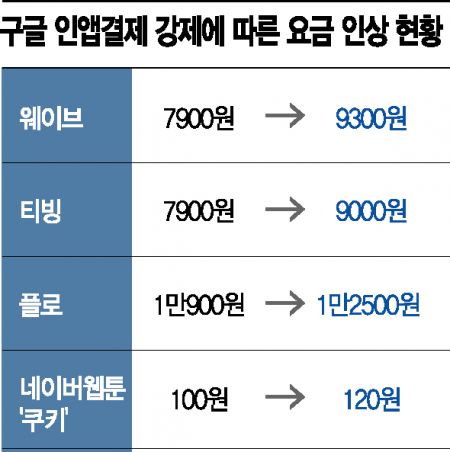
[Asia Economy Reporters Nahum Kang, Seungjin Lee] #Seunggyu Lee, a man in his 30s, is seriously considering canceling the content platform services he subscribed to. The price of the online video service (OTT) TVING has increased from 10,900 KRW to 12,500 KRW, and the music platform Melon has also announced a price hike, increasing his financial burden. The Naver Webtoon subscription, which used to cost about 10,000 KRW per month, now costs over 12,000 KRW. Lee said, "With prices already rising and my budget tightening, the increase in content prices adds to the burden," adding, "Although it’s unavoidable due to Google’s policy, I don’t understand why consumers have to pay the fees that platform companies should bear."
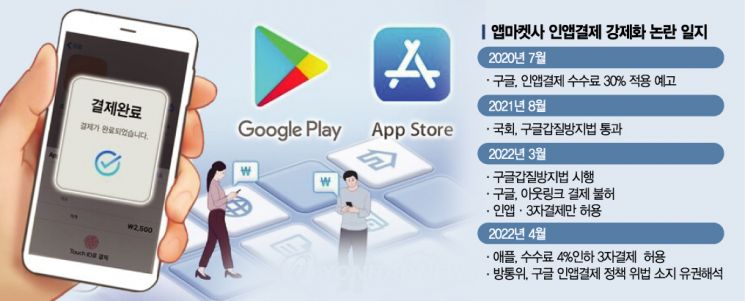
◆ 7 Days Until Google App Deletion = On the 24th, Google issued a final ultimatum to delete applications (apps) that do not comply with the in-app payment method starting next month on the 1st. Meanwhile, content companies that had postponed price hikes saying they would "wait and see the situation" have now started final price increases. Although the increased fees due to in-app payments are unavoidable, the burden on consumers is significant. Questions are also being raised about the effectiveness of the world’s first Google Fair Trade Act (an amendment to the Telecommunications Business Act).
On the 23rd, Naver Webtoon raised the price of its payment method ‘Cookie’ from 100 KRW to 120 KRW per unit, a 20% increase. Kakao Entertainment also raised its usage fee from 1,000 KRW per 1,000 cash to 1,200 KRW, a 20% increase. Earlier this month, OTT services Wave and TVING raised their subscription prices by about 15%, while music platforms FLO and VIBE increased streaming service prices by 14% and 16%, respectively. Melon is expected to announce its price hike plan within this week.
The content and publishing industries say this price increase was a predictable problem and raise concerns about the effectiveness of the so-called Google Fair Trade Act. They argue that app market operators like Google and Apple have ignored the law’s intent and circumvented the legislation, resulting in a strengthening of in-app payments instead.
◆ "Overall Contraction of the Content Industry" = On the same day, a forum was held at the National Assembly hosted by Jeon Jae-su, a member of the Democratic Party on the Political Affairs Committee, to discuss countermeasures against Google’s enforcement of the in-app payment method. Participants included the Korea Publishing Culture Association, which reported Google’s unfair practices through the Korea Communications Commission and the Fair Trade Commission, as well as the Korea Electronic Publishing Association, Korea Comics Publishing Association, Korea Web Novel Writers Association, Korea Webtoon Industry Association, and the law firm Jihyang.
Particularly, criticism regarding the effectiveness of the amendment is expected to dominate. Seo Beom-gang, president of the Korea Webtoon Industry Association attending the forum, said, "The forum will focus on discussing the effectiveness issues of the amendment," adding, "The Communications Commission tells us to report cases of damage, but this shows that the law is failing to prevent harm from occurring in the first place."
There will also be claims that Google’s enforcement of in-app payments could shrink the entire content industry. If rising fees reduce profitability, it will lead to decreased investment and eventually force small and medium-sized enterprises out of the market. Ultimately, only large companies will survive, limiting consumer choice and shrinking the market. Criticism of Google’s overall monopolistic behavior is expected to continue, with calls to increase pressure on dominant platform operators. The law firm Jihyang plans to argue that Google’s preferential use of its own points on the Play Store and the pre-installation of Google-related apps on the Android operating system (OS) are unfair practices.
© The Asia Business Daily(www.asiae.co.kr). All rights reserved.
![Clutching a Stolen Dior Bag, Saying "I Hate Being Poor but Real"... The Grotesque Con of a "Human Knockoff" [Slate]](https://cwcontent.asiae.co.kr/asiaresize/183/2026021902243444107_1771435474.jpg)

















