50% Chance of Above-Average Temperatures in July-August
Temperature Rise Induced by Tibetan High Pressure Development
Temperatures Increased by 0.5~0.7°C Over the Past Decade
Precipitation Expected to Be Above Average in June
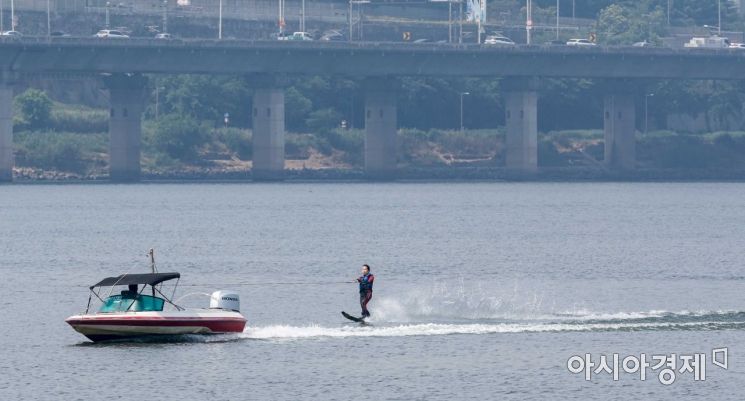 On the 23rd, as the daytime temperature in Seoul rose to 30 degrees Celsius, marking the peak of midsummer heat, a citizen is cooling off by water skiing on the Han River in Seoul. Photo by Kang Jin-hyung aymsdream@
[Asia Economy Reporter Han Jinju] This summer is expected to be hotter than average, with precipitation levels similar to the norm.
On the 24th, the Korea Meteorological Administration (KMA) announced its three-month forecast (June to August), stating that the probability of June temperatures being similar to or higher than average is 40% each, and the probability of July and August temperatures being higher than average is 50%.
The KMA analyzes three-month weather forecasts based on climate prediction models provided domestically and internationally, as well as climate monitoring factors from global oceans and the Arctic. Meteorological agencies and related organizations from 13 countries, including the U.S. and the U.K., have all predicted temperatures higher than average from June to August. The average temperatures for the reference period (1991?2020) are 21.1?21.7°C for June, 24.0?25.2°C for July, and 24.6?25.6°C for August.
June is expected to be influenced by migratory high pressure systems, while July and August will be affected by the North Pacific High, resulting in continued hot weather. Due to influences such as the Tibetan High, there is a high possibility of a hot summer. This spring, the Tibetan region experienced less snow cover than usual, which promotes the development of the Tibetan High, raising summer temperatures above average. In the summers of 1994 and 2018, strong development of the Tibetan High and North Pacific High led to record-breaking heatwaves. A KMA official explained, "Less snow cover in the Tibetan region than usual means faster snowmelt, which strengthens the Tibetan High," adding, "Last July was also hotter than average due to the influence of the Tibetan High and other factors."
Global warming trends are also a factor raising temperatures from June to August. Over the past decade, the average temperature on the Korean Peninsula has increased by 0.5°C in June, 0.6°C in July, and 0.7°C in August compared to the average. For the entire period from 1973 to 2021, increases were 1.3°C in June, 0.7°C in July, and 1.0°C in August.
The La Ni?a phenomenon (a cooling of the equatorial eastern Pacific Ocean lasting more than five months) has persisted for two consecutive years, adding variability. A KMA official stated, "Since 1950, this is the third time La Ni?a has occurred for two consecutive years. Typically, La Ni?a periods are associated with weaker heat, but recently, high temperatures have been observed even in June during La Ni?a." If Arctic sea ice is less than average, it induces a positive Arctic Oscillation, positioning high-pressure anomalies in the upper atmosphere, which raises temperatures in July and August. As of mid-May, sea ice in the Barents Sea remains near average levels.
Precipitation this summer is expected to be above average in June and near average in July and August. The probability of precipitation being similar to or above average in June is 40%, similar to or below average in July is 40%, and similar to average in August is 50%.
In June, low-pressure systems approaching from the southwest may cause concentrated rainfall in the southern regions. In July and August, low-pressure influences are expected to bring cloudy skies and periodic rain. Climate prediction models analyze that precipitation will be above average in June, below average in July, and near average in August.
A KMA official explained, "As low-pressure systems move northward in June, precipitation will increase, mainly concentrated in the southern areas," adding, "It is too early to conclude that this is due to the monsoon until the date approaches."
© The Asia Business Daily(www.asiae.co.kr). All rights reserved.
!["The Woman Who Threw Herself into the Water Clutching a Stolen Dior Bag"...A Grotesque Success Story That Shakes the Korean Psyche [Slate]](https://cwcontent.asiae.co.kr/asiaresize/183/2026021902243444107_1771435474.jpg)
















