Bloomberg: Power Supply Threatened by Heatwaves and War
India's GDP Fell 5% in 2014 Due to Power Shortages... Economic Damage Feared
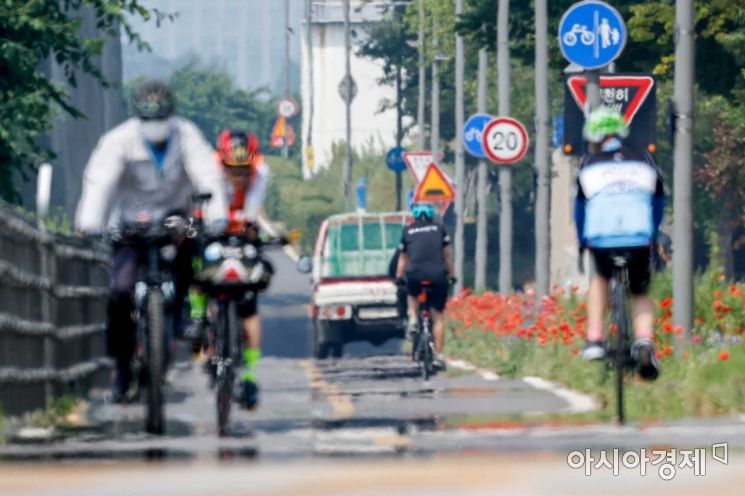 On the 23rd, as the daytime temperature in Seoul rose to 30 degrees Celsius, signaling the peak of midsummer heat, heat haze was rising on the bicycle path at Hangang Park in Seoul. Photo by Kang Jin-hyung aymsdream@
[Asia Economy Reporter Yoon Seul-gi] As the energy supply shortage becomes a reality due to the Russia-Ukraine war, coupled with heatwaves caused by climate change, there is a forecast that the world could face the worst power crisis in decades this summer.
On the 22nd (local time), Bloomberg reported that following a difficult period in the global energy market last year due to soaring oil prices and delays in the transition to renewable energy, the situation is expected to worsen this year because of heatwaves and the war.
The most severely affected areas are South Asia and Southeast Asia, where extreme heat makes air conditioning essential for survival.
It is estimated that over one billion people in countries such as India, Pakistan, Sri Lanka, and Myanmar face the risk of power outages lasting several hours at a time, and early heatwaves have already caused blackouts. According to local Indian authorities, more than 700 million people in 16 out of 28 states experience power outages lasting at least 2 hours and up to 10 hours daily.
Pakistan, Sri Lanka, and Myanmar, with populations of about 300 million, are also already experiencing nationwide blackouts.
In the United States, the transition to eco-friendly energy has been delayed due to supply chain disruptions, and at least ten states are expected to face power shortages this summer due to heatwaves. Existing thermal power plants are disappearing faster than renewable energy generation and storage facilities are being installed, and many nuclear power plants are scheduled to shut down due to aging, raising concerns about power supply shortages.
Power grid operators in California, Texas, and Indiana have warned that starting this year, if demand increases due to heatwaves, rotating power outages?where power supply is intermittently cut off by region to avoid large-scale blackouts?may become unavoidable.
China, which experienced a large-scale power crisis last year, and Japan are also facing difficult power situations. South African countries are also feared to face the worst power shortages this year.
Even Europe, which maintains relatively stable power conditions, could face blackouts in countries highly dependent on Russian natural gas, such as Greece and Hungary, if Russia stops supplying natural gas.
Bloomberg pointed out that if power supply is cut off during heatwaves, it could lead to an increase in various diseases and related deaths, as well as severe economic damage. In fact, India’s gross domestic product (GDP) decreased by 5% due to power shortages caused by heatwaves in 2014.
The bigger problem is that the global power crisis is unlikely to be resolved within a few years. Bloomberg noted concerns that heatwaves will increase due to climate change, but investments in fossil fuels are decreasing due to policies expanding eco-friendly energy, and renewable energy is not yet sufficient to cover the power shortage.
However, the media reported that increasing coal consumption due to energy shortages would create a vicious cycle of more heatwave days and worsening power shortages, so the transition to renewable energy is the most important response to climate change.
© The Asia Business Daily(www.asiae.co.kr). All rights reserved.

















