Ministry of Land, Infrastructure and Transport Minister's Press Briefing
The First System to Revise for Housing Supply: Price Ceiling on Sale
Incentives for 'Good Landlords' Amid Rental Market Instability in the Second Half of the Year
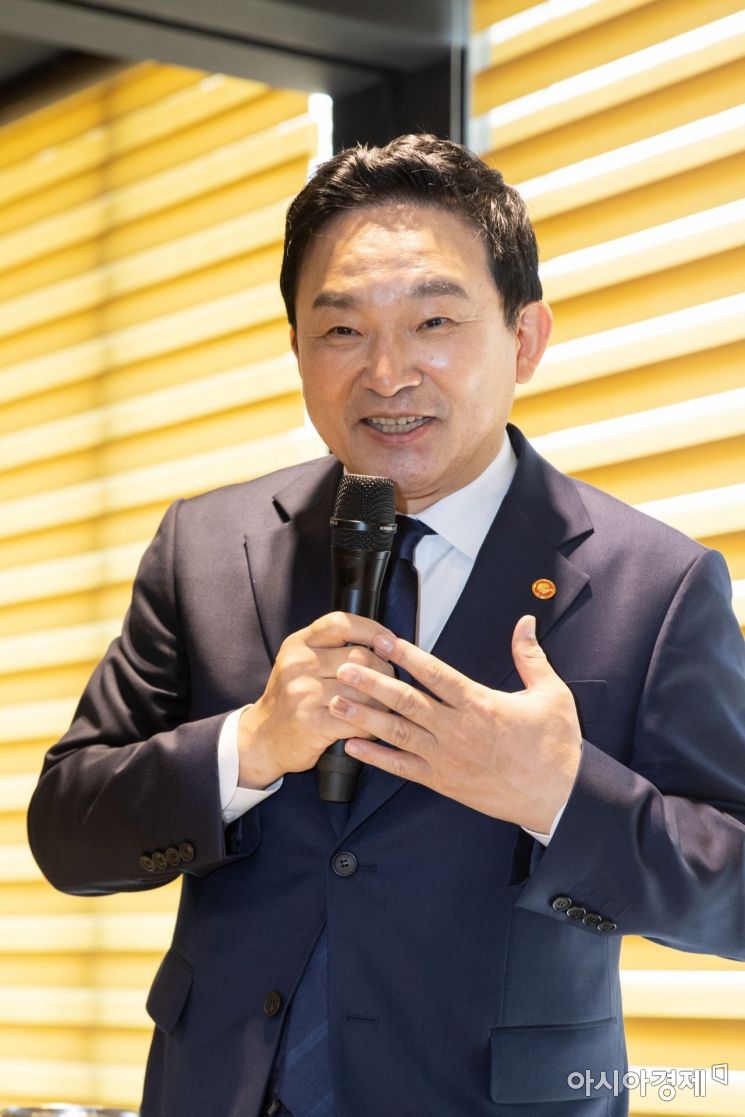 Minister of Land, Infrastructure and Transport Won Hee-ryong is speaking about the Ministry's policy direction at a press briefing held at a restaurant in Eojin-dong, Sejong City on the 23rd.
 Won Hee-ryong, Minister of Land, Infrastructure and Transport, identified the price ceiling system for pre-sale housing (Bunsangje) as the first system in need of improvement to promote housing supply and announced on the 23rd that improvement measures would be announced within June. He also stated that, as the two-year mark since the introduction of the contract renewal request right approaches and instability in the rental market is anticipated in the second half of the year, short-term measures to alleviate this will also be introduced within June.
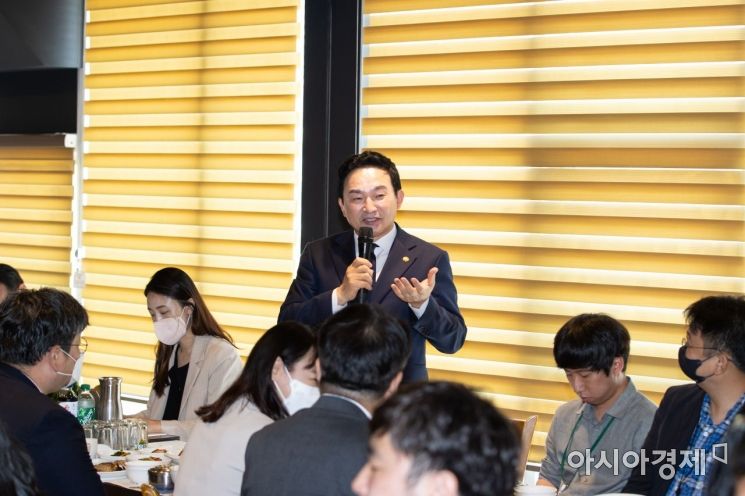
Minister Won held his first press briefing since taking office at a restaurant in Eojin-dong, Sejong City, where he responded to questions regarding future housing supply plans and measures to ease instability in the lease market.
Minister Won first emphasized the importance of rapid housing supply and stressed the need to improve the Bunsangje system for this purpose. He said, "I consider the Bunsangje the first system that needs to be revised to promote supply," adding, "We are preparing improvements by June to supplement the timing of applying the price ceiling, its contents, and rigidity so that it can be well linked with future market movements."
However, he also clarified his intention to control the extent and speed of deregulation, stating, "The Bunsangje provides housing to buyers at prices lower than market value and serves as a safety device to prevent soaring pre-sale prices." Minister Won explained, "Eliminating the Bunsangje all at once would cause significant side effects. We will approach this cautiously and aim to minimize side effects caused by rigid operation."
In addition to new supply, he pointed to multi-homeowners as a means to encourage the release of existing properties into the market. He said, "Ignoring the reasons why multi-homeowners exist and their role as housing suppliers, the previous government imposed uniform regulations, which led to significant side effects," adding, "Since multi-homeowners play a role as suppliers in the sales and rental markets, we will not overlook this and will reflect it in policy."
This suggests an intention to recognize the role and function of multi-homeowners in the market rather than demonizing them as in the previous administration, and to introduce measures accordingly. In this process, Minister Won expressed openness to considering changing the punitive taxation criteria for multi-homeowners from the number of houses to a value-based standard. He explained, "The existing number-of-houses standard exacerbated the 'smart one house' phenomenon," adding, "There is a consensus within the government that we should move to a value-based standard, and we will pursue this direction as a mid- to long-term task."
Regarding concerns about potential instability in the lease market in the second half of the year, he said that mid- to long-term improvements to the Lease 3 Laws are being considered. He diagnosed, "(The Lease 3 Laws) have many side effects such as controlling prices and rigidifying the market," but added, "Since the Democratic Party holds about 170 seats, unilaterally amending the Lease 3 Laws is not realistic." He then said, "We will approach this by dividing measures into immediate and long-term fundamental solutions."
He first diagnosed, "It is true that the rental market tends to have a low first half and high second half, with relocation demand concentrated in the second half," adding, "There is a possibility of supply-demand imbalance in the second half." He mentioned, "We are reviewing immediate institutional measures to promote the supply of rental listings," noting, "There is a tendency for listings to be locked up due to mortgage loans, the Bunsangje, and related owner-occupancy obligations." This is interpreted as an intention to relax such regulations so that these properties can enter the rental market.
In the mid- to long-term, measures to provide incentives to landlords are under consideration. Minister Won said, "There is no reason not to provide tax and financial benefits to landlords who renew contracts multiple times and lower rents to registered rental levels." He explained, "While excessive speculation will be curbed, we will avoid categorically defining and demonizing multi-homeowners."
Regarding remodeling and reconstruction of first-generation new towns, he emphasized a sequential and comprehensive approach. He said, "There are apartments built in 1977 and many places are aging daily," adding, "(Remodeling and reconstruction) will not be approached solely based on first-generation new towns."
Minister Won stressed, "We will establish and proceed with measures in a fair and orderly manner so that issues like whether only first-generation new towns receive special treatment do not arise," adding, "Seoul city will be handled separately, first-generation new towns separately, and comprehensive plans will be made according to the degree of aging, overall order, and characteristics."
© The Asia Business Daily(www.asiae.co.kr). All rights reserved.
![Clutching a Stolen Dior Bag, Saying "I Hate Being Poor but Real"... The Grotesque Con of a "Human Knockoff" [Slate]](https://cwcontent.asiae.co.kr/asiaresize/183/2026021902243444107_1771435474.jpg)












