Coffee Goes Decaf Amid Health Trends
Decaffeinated Coffee Bean Imports Up 260% in 3 Years
Industry Expands Decaf Beverage Lineup
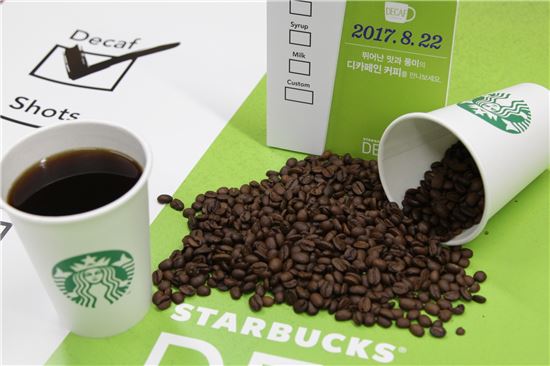 Starbucks Decaffeinated Coffee
[Asia Economy Reporter Song Seung-yoon] "I switched to a product with reduced caffeine for health reasons."
No Min-ji (34, pseudonym), an office worker living in Incheon, recently cut down her daily coffee intake from three cups to two. She began experiencing sleep disorders due to caffeine, which made her more conscious about managing her health. Ms. Noh said, "I switched to coffee with reduced caffeine content because I thought it would be better for my health than regular coffee," adding, "Once I get used to the taste, I plan to drink only decaffeinated coffee from now on."
Riding the wave of the ‘Healthy Treasure’ trend that promotes enjoyable health management, the coffee market is also seeing a surge in ‘decaf’ coffee. Since the COVID-19 pandemic, interest in health has increased, leading to the gradual expansion of the decaffeinated coffee market alongside the zero-calorie beverage market.
According to customs import-export trade statistics on the 23rd, the amount of decaffeinated coffee imported into South Korea last year was 3,664 tons, a 30.6% increase compared to the previous year (2,806 tons). Compared to 1,267 tons in 2018, three years ago, it increased by 189%. The import value also recorded $20.717 million (approximately 26.3 billion KRW) last year, up 52% from $13.62 million the previous year, and a 260% increase compared to $5.745 million in 2018. According to ‘Naver Data Lab,’ a search volume analysis service, the number of searches for decaffeinated-related keywords in the first quarter of this year more than doubled compared to the first quarter of 2019, three years ago. The industry analyzes that as interest in health increased during the COVID-19 situation, demand expanded not only among the existing main consumers such as pregnant women and teenagers but also among the general public trying to reduce caffeine intake.
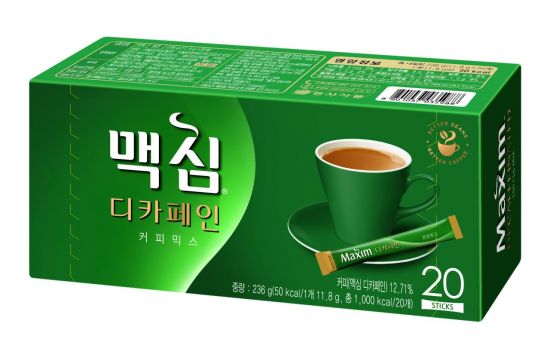
Beverage companies, including coffee specialty stores, are also expanding their decaffeinated beverage lines one after another. Starbucks, which has been selling decaffeinated coffee since 2017, and recently low-cost coffee chains like Mega Coffee have been introducing decaffeinated coffee menus one after another. SPC Paris Baguette also launched ‘Cafe Adagio Decaffein’ under its own coffee brand Cafe Adagio last month, allowing customers to choose decaffeinated beans for all coffee menus.
Dongseo Food, which holds the number one market share in instant coffee, has long secured the decaffeinated mix coffee market by launching Maxim Decaf over 20 years ago, and has been offering decaffeinated products under the ‘Kanu’ brand for several years. Not only existing mix coffee manufacturers but also coffee specialty stores such as Hollys, Tom N Toms, and Twosome Place have been releasing products using decaffeinated beans in stick-type ready-to-drink formats. Lotte Chilsung Beverage launched ‘Cantata Contrabass Decaffein Black,’ a decaffeinated coffee under the Cantata Contrabass line, last year, and Coca-Cola’s coffee brand Georgia also released ‘Georgia Craft Decaffein Oat Latte’ the same year, indicating that the liquid coffee market is also seeing an increase in decaffeinated product lines.
Professor Kim Si-wol of Konkuk University’s Department of Consumer Studies said, "Decaffeinated coffee was not a main product in the past, but it is gradually becoming mainstream in line with the recent health-oriented trend," adding, "Since consumption mainly occurs among the MZ generation (Millennials + Generation Z), the related market is expected to continue growing."
© The Asia Business Daily(www.asiae.co.kr). All rights reserved.
![Clutching a Stolen Dior Bag, Saying "I Hate Being Poor but Real"... The Grotesque Con of a "Human Knockoff" [Slate]](https://cwcontent.asiae.co.kr/asiaresize/183/2026021902243444107_1771435474.jpg)










