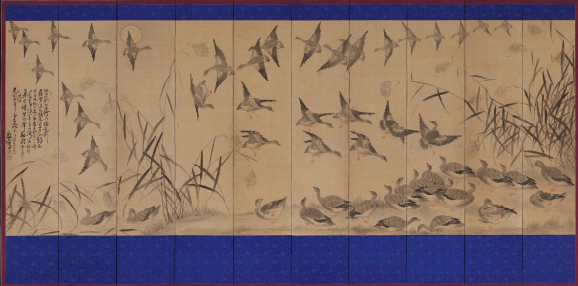
[Asia Economy Reporter Seomibeum] The Cultural Heritage Administration’s National Palace Museum has replaced the permanent exhibition artifacts to newly display large-scale royal court paintings. The artifacts on display this time include a total of six pieces: three works by modern painter Yang Gi-hoon and three folding screens of Munbangdo.
Yang Gi-hoon, a painter from Pyongyang, is well known for working in Seoul in the early 20th century and creating artworks used in the royal court. The works presented this time are three folding screens: "Gunando Folding Screen," "Maehwado Folding Screen," and "Sansuilchuldo Two-Panel Folding Screen." The "Gunando Folding Screen" is a large-scale work over 4 meters long, depicting a flock of wild geese among reed fields, presented to Emperor Gojong in 1905. The theme of “Noan (蘆雁),” depicting reeds and wild geese, is a homophone of “老安 (Noan),” meaning peace and longevity in old age. It is believed that this large folding screen was created to decorate the interior of the palace with the theme of “Noan” to wish for Emperor Gojong’s long life and health.
Yang Gi-hoon’s "Maehwado Folding Screen" is a work newly unveiled by the National Palace Museum this time. It is a six-panel folding screen vividly depicting a plum tree in full bloom, with a calligraphy inscription by Haegang (海崗) Kim Gyu-jin, a contemporary painter.
Yang Gi-hoon is known as the artist who drew the preliminary sketch for the "Maehwado Embroidered Folding Screen," which was used in the royal court. Although the "Maehwado Folding Screen" unveiled this time was not used in the royal court, it holds significant meaning as it allows viewers to observe the artist’s style in painting plum blossoms.
Additionally, to allow visitors to experience various works by Yang Gi-hoon, the "Sansuilchuldo Two-Panel Folding Screen," which depicts a landscape and sunrise side by side, is also displayed.
The National Palace Museum also presents three Munbangdo works (one four-panel folding screen and two two-panel folding screens), a theme familiar to the general public. The "Munbangdo Folding Screen" depicts subjects such as books, stationery, antiques, ceramics, flowers, and fruits, and was used to decorate the interior of the palace. These paintings encompass various rare objects and auspicious motifs, reflecting not only the intellectual and cultural tastes of the time but also secular desires such as wealth, longevity, and fertility. In particular, the "Munbangdo Four-Panel Folding Screen" is notable for its unique format, showing objects filling the space inside a raised curtain. This work stands out for its detailed depiction and decorative composition, offering a glimpse into the high quality and splendid techniques of royal court decorative paintings.
The Cultural Heritage Administration’s National Palace Museum stated, “We regularly replace the permanent exhibition artifacts so that visitors to the museum can enjoy a variety of royal relic contents. In particular, we plan to actively reveal royal court paintings that have not been frequently exhibited before, allowing visitors to experience the diverse characteristics and beauty of royal court paintings.”
© The Asia Business Daily(www.asiae.co.kr). All rights reserved.

















