Korea National Oil Corporation to Sell Harvest... Acquired for About 5 Trillion Won in 2009
MB Administration Established 'Expansion' Policy... Led to Capital Erosion
Criticism of 'Poor Acquisition' Including Harvest... Suspected Distortion of Oilfield Profitability
Moon Administration Also Classified as Non-performing Asset... Recommended Disposal of Overseas Assets Last Year
High Possibility of Not Getting Full Price... Emphasis on 'Disposal' Rather Than Price in Sale
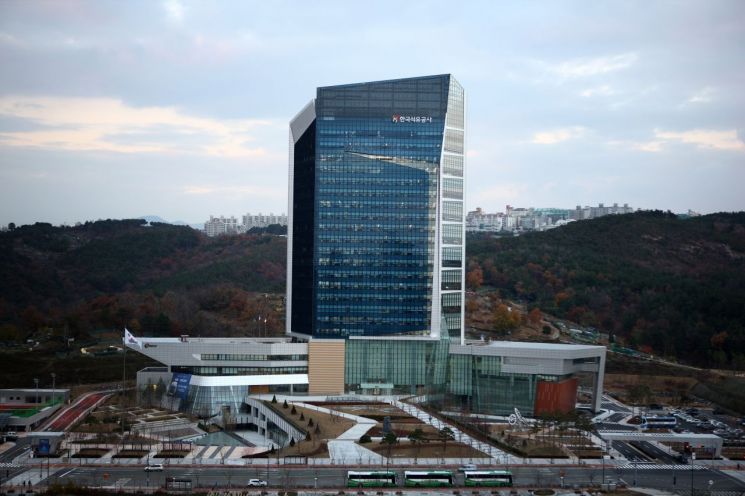
[Asia Economy Sejong=Reporter Lee Jun-hyung] Korea National Oil Corporation's decision to sell Harvest Canada, acquired in 2009, stems from the judgment that business normalization is impossible without large-scale restructuring. The debt of the Oil Corporation, which entered an emergency management system in 2018, had already exceeded the limit several years ago. The debt ratio, a representative indicator of the company's financial soundness, soared nearly fivefold in just two years, from 719% in 2017 to 3415% in 2019. Considering that the average debt ratio of public enterprises is in the 150% range, this is a significant figure. Ultimately, the Oil Corporation fell into complete capital erosion in 2020, 41 years after its founding.
The trigger for the deterioration of the Oil Corporation's financial structure began during the Lee Myung-bak administration's 'resource diplomacy.' The Oil Corporation aggressively started acquiring overseas oil fields from 2008. This was because the government had firmly set a goal in the 1st National Energy Basic Plan to raise the self-development rate of oil and gas from 4.2% in 2008 to 40% by 2030. Accordingly, the Oil Corporation established a 'scaling-up' policy and shifted its resource development strategy focus from exploration blocks to purchasing production blocks and mergers and acquisitions (M&A) of oil development companies.
The problem was that the Oil Corporation took reckless steps during the scaling-up process. There have been continuous criticisms that the Oil Corporation hastily acquired overseas projects without sufficient review, focusing excessively on external expansion. In response, Kim Dong-seop, president of the Oil Corporation, acknowledged the failure of overseas projects at last year's National Assembly audit and expressed "deep responsibility."
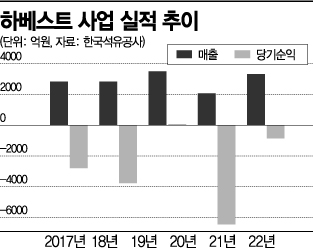
Harvest is at the center of the 'poor acquisition' controversy. The Oil Corporation is suspected of distorting the profitability of oil fields when acquiring Harvest. The Korea Institute of Geoscience and Mineral Resources pointed out that the Oil Corporation overvalued Harvest, acquiring it for more than 1 trillion KRW above the appraised market price. In fact, the water cut (the ratio of water in crude oil) of Harvest's oil fields reaches 98%. This means that 98% of Harvest's crude oil consists of water. The industry considers oil wells with a water cut exceeding 90% to have reached the end of their lifespan.
The refining subsidiary of Harvest, NARL, also became problematic. Initially, NARL was not part of the Oil Corporation's acquisition plan. However, at Harvest's request, the Oil Corporation also purchased NARL, which was not generating profits. The amount invested by the Oil Corporation for acquiring NARL was about 1.3 trillion KRW. The Oil Corporation never made a profit through NARL and eventually sold the company in 2014 for 96.4 billion KRW, less than 1% of the acquisition cost. At that time, the Oil Corporation announced that losses due to NARL amounted to about 1.5 trillion KRW.
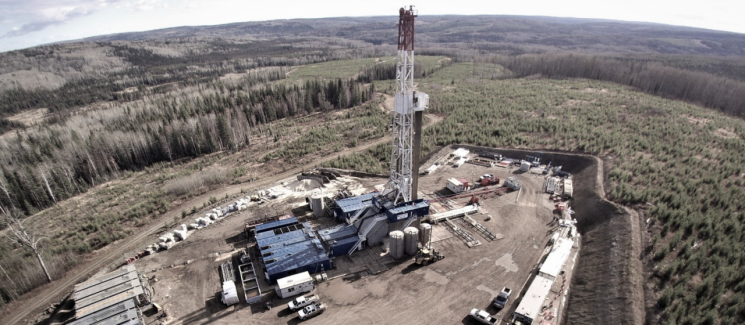 An oil field of Harvest, a Canadian oil company whose 100% stake was acquired by Korea National Oil Corporation in 2009.
 [Photo by Harvest website capture]
This is why the Moon Jae-in administration classified Harvest as a non-performing asset. The government's 'Overseas Resource Development Innovation Task Force (TF),' which was dissolved last year, recommended that the Oil Corporation dispose of non-performing assets such as Harvest. The government’s recommendation also included provisions allowing third-party intervention if overseas asset sales were not conducted in a timely manner.
However, there are expectations that the Oil Corporation may not receive a fair price. This is because the emphasis of the Harvest sale process is on 'disposal' rather than 'price.' The fact that the Oil Corporation has suffered losses of several hundred billion KRW annually since acquiring Harvest also raises concerns about a 'fire sale.' The Oil Corporation stated, "Non-performing assets must be liquidated," and added, "We will proceed with the sale aiming to receive as much value as possible."
© The Asia Business Daily(www.asiae.co.kr). All rights reserved.



















