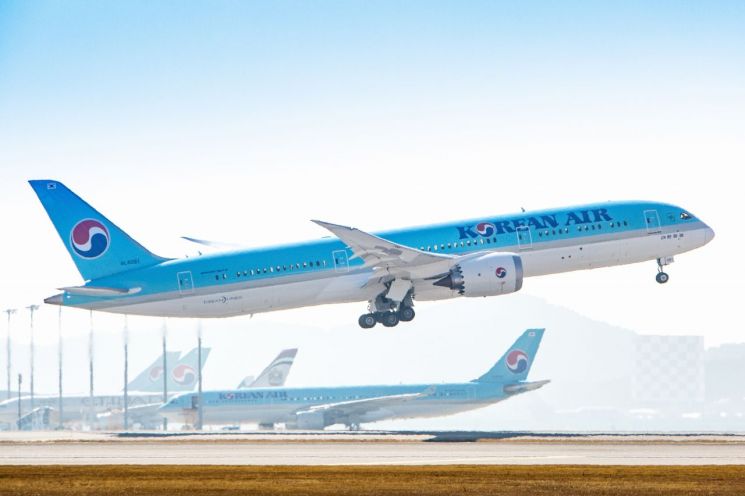
[Asia Economy Reporter Yoo Hyun-seok] Korean Air announced on the 23rd that since obtaining conditional approval from the Korea Fair Trade Commission in February this year regarding the acquisition and merger (R&D) of Asiana Airlines, it has been steadily proceeding with the corporate merger reviews by six overseas competition authorities, including those in the United States and the European Union (EU), which are essential preconditions.
In a statement released on the same day, Korean Air said, "To obtain prompt corporate merger approvals from competition authorities in each country, we are operating dedicated expert groups for each country consisting of five teams and over 100 members, steadily implementing tailored strategies."
Additionally, Korean Air has contracted with ▲ three global law firms to oversee the progress of overseas competition authorities' reviews, ▲ eight local law firms to closely respond to individual national reviews, ▲ three economic analysis firms to secure objectivity and expertise, and ▲ two country-specific advisory firms for negotiation strategy formulation and political approaches, actively responding to the demands of competition authorities in each country.
They emphasized that the reviews in major countries are also proceeding smoothly according to procedures. In the case of the United States, one month after submitting the initial notification, a vast amount of data must be submitted under the 'Second Request' regulation. The respondent can respond through one of two procedures: ▲ approval through data submission or ▲ approval through submission of a remedial action plan.
Korean Air initially planned to respond by preparing remedial measures after consulting advisors and negotiating with competition authorities following the submission of the initial notification. However, considering the recently strengthened stance of the U.S. competition authorities, it judged that simultaneously submitting the Second Request data and proposing new airlines would be advantageous for obtaining prompt approval, and is currently actively responding to the review in both directions.
Regarding the EU, pre-consultation procedures on the background and purpose of the corporate merger began with the EU competition authority (EC) in January 2021. Currently, prior to the formal submission of the notification, pre-consultation procedures are underway to submit requested data and remedial measures to shorten the overall review period.
The situation is similar in China. Since submitting the notification in January, Korean Air has actively responded to the review by submitting supplementary materials more than ten times. Korean Air explained, "Although there were reports that the notification was withdrawn and resubmitted, withdrawing and resubmitting the notification due to the expiration of the review deadline is a perfectly normal process in the Chinese authorities' review procedures."
They also explained that the key to alleviating competition restrictions, 'attracting new entrant airlines,' is progressing smoothly. Currently, competition authorities in the United States, EU, United Kingdom, and Australia require the entry of new airlines to maintain a competitive environment similar to that before the merger of Korean Air and Asiana Airlines. To this end, Korean Air's top management is directly visiting overseas locations to actively persuade competitors, with whom they had no prior cooperative relationships, to enter as new airlines.
Korean Air emphasized that the acquisition and integration of Asiana Airlines is the only alternative to enhance Korea's industrial and logistics competitiveness and increase consumer benefits. A Korean Air official explained, "The Korean aviation industry, including related industries, accounts for about 3.4% (54 trillion won) of the domestic gross domestic product (GDP). The integration of the two companies is indispensable for the survival of the Korean aviation industry and the preservation of jobs, as it is a national key industry with as many as 840,000 related jobs."
He added, "Despite the challenging situation of rising domestic-first policies in global M&A recently, Korean Air believes it is still producing positive results, albeit slowly. Going forward, Korean Air will do its utmost to actively cooperate with the requests of competition authorities in each country, secure approvals, and firmly promote the acquisition and integration of Asiana Airlines."
The reason Korean Air unusually issued a statement is interpreted as being due to the recent turnaround to profitability of Asiana Airlines, which has sparked debates about the necessity of the merger. Asiana Airlines recorded sales of 1.1466 trillion won and an operating profit of 176.9 billion won in the first quarter based on separate financial statements, thanks to the continued strong performance of its cargo business. However, Asiana Airlines' situation has not improved. Its debt ratio surged by 938.5 percentage points from 1,343.8% in 2020 to 2,282.3% in 2021. As of the first quarter of this year, the debt ratio stood at 2,217%.
© The Asia Business Daily(www.asiae.co.kr). All rights reserved.