Jasaeng Korean Medicine Hospital Spine and Joint Research Institute Research Team Led by Yeo Chang-hwan
Confirmed Inhibition of Cartilage Component Degradation by Mogwa
"Increased Potential for Using Mogwa in Degenerative Arthritis Treatment"
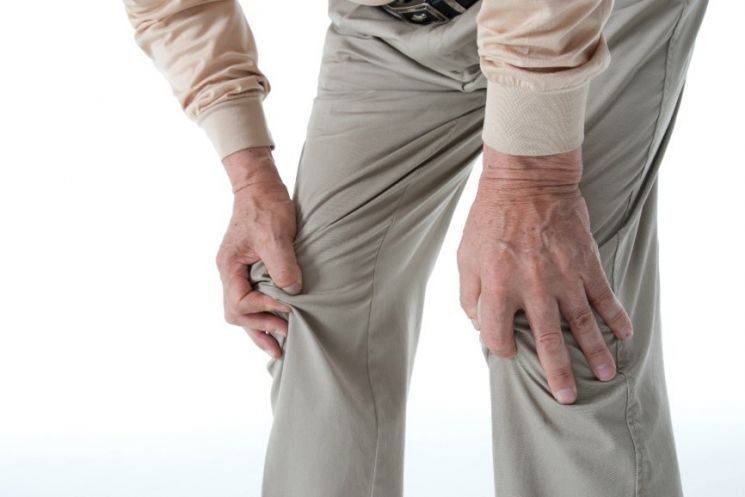 A patient with degenerative arthritis is complaining of knee pain.
 Photo by Jaseng Hospital of Korean Medicine
[Asia Economy Reporter Lee Gwan-joo] A domestic research team has published a paper in an international academic journal that for the first time elucidates the mechanism of the cartilage-protective effect of mogwa (Chinese quince).
The research team led by Researcher Yeo Chang-hwan at Jaseng Spine and Joint Research Institute announced on the 23rd that through experimental research, they confirmed that mogwa protects cartilage cells by inhibiting the degradation of cartilage components.
First, to create a cartilage loss environment similar to degenerative arthritis, the research team exposed cartilage cells to an inflammatory cytokine (IL-1β), a signaling molecule related to inflammation. They then confirmed that the expression levels of 'proteoglycan' and 'type II collagen (Col2a1)', essential components for maintaining cartilage flexibility and elasticity, decreased. The team subsequently treated the damaged components with mogwa extract at three concentrations (12.5, 25, 50 μg/ml) to observe whether recovery occurred.
As a result, the expression levels of type II collagen and proteoglycan increased in a concentration-dependent manner with mogwa extract, showing signs of cartilage structure recovery. Regarding the mechanism of mogwa's cartilage-protective action, the team interpreted that mogwa inhibited the expression of the p65 protein involved in the secretion of inflammatory substances in the body's signaling pathway (NF-kB), thereby preventing damage and degradation of key cartilage components.
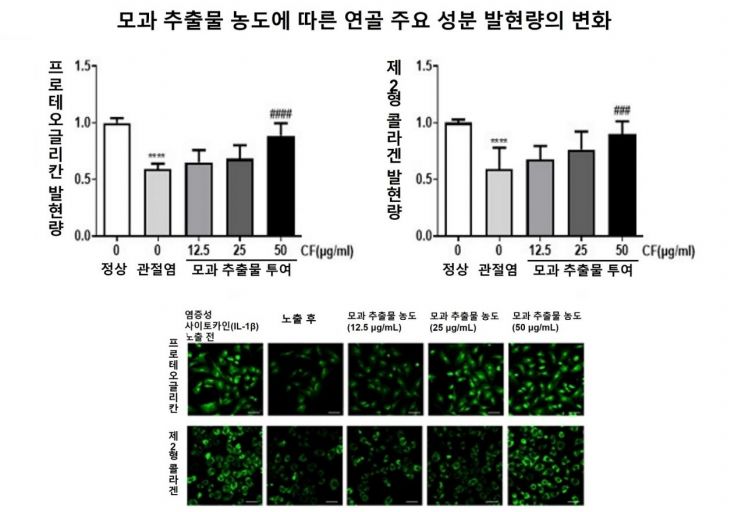 Changes in the expression levels of major cartilage components according to the concentration of quince extract.
The research team also confirmed the antioxidant effect of mogwa. Mogwa significantly reduced reactive oxygen species increased by inflammatory cytokines. Reactive oxygen species are oxidative waste products known to be a major cause of cartilage degeneration and to induce degenerative arthritis. The team confirmed that the level of reactive oxygen species generation in cartilage cells after exposure to inflammatory cytokines (11.4%) was higher than before exposure (8.4%). After treatment with mogwa extract, the generation of reactive oxygen species decreased to 8.5%, 7.1%, and 6.8% at increasing concentrations (12.5, 25, 50 μg/ml), respectively, compared to before exposure.
Researcher Yeo Chang-hwan said, “This paper is significant in that it is the first to reveal the mechanism of mogwa’s cartilage-protective effect and thereby demonstrates the therapeutic effect of Jaseng Sukjiyanggeuntang on degenerative arthritis,” adding, “Furthermore, as research on degenerative arthritis treatment is active, therapies using mogwa may be considered a viable option in the future.”
This paper was published in the April issue of the SCI(E)-level journal, International Journal of Molecular Sciences (IF=5.924).
© The Asia Business Daily(www.asiae.co.kr). All rights reserved.
![Clutching a Stolen Dior Bag, Saying "I Hate Being Poor but Real"... The Grotesque Con of a "Human Knockoff" [Slate]](https://cwcontent.asiae.co.kr/asiaresize/183/2026021902243444107_1771435474.jpg)

















