The Proportion of Single Parents Receiving Government Support is 54.4%
Over 20 Percentage Points Increase Since 2012
Childcare and Education Costs Are the Biggest Burdens for Single-Parent Families
Average Monthly Income of Single Parents is Half of Total Household Income
14.0% Experienced Job Loss or Business Closure Due to COVID-19
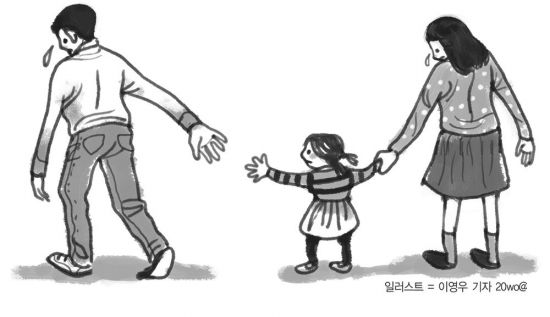
[Asia Economy Reporter Han Jinju] It was found that 72% of single-parent families have never received child support payments, and more than half of single-parent families receive government assistance.
On the 23rd, the Ministry of Gender Equality and Family announced the results of the "2021 Single-Parent Family Survey," conducted on 3,300 heads of single-parent households. According to the survey, 80.7% had either never received child support (72.1%) or had not received it recently (8.6%).
Legally, 78.7% do not have child support claims, while 21.3% have claims for regular or lump-sum payments. Among single parents without legal child support claims, only 2.6% regularly received child support payments. Among those with legal claims, only 63.8% reported regularly receiving child support, an increase of 2.7 percentage points compared to the 2018 survey. To secure child support enforcement, 9.5% reported filing claims lawsuits, and 10.5% used enforcement procedures.
More than half (54.4%) of single-parent families receive government support. The rate of receiving government support has increased compared to 2015 (41.5%) and 2018 (46.0%), and has risen by 20 percentage points since the survey began in 2012 (30.4%). This increase is due to expanded support policies, such as extending child-rearing support for children from under 14 to under 18 years old and additional child-rearing support for single-parent families receiving livelihood benefits. The scale of child-rearing support for low-income single parents increased from 75,000 in 2017 to 188,000 in 2018.
Regarding necessary systems to secure child support enforcement, "expansion of emergency child support" (44.4%) was the most cited, followed by ▲strengthening penalties for non-payers (31.5%) ▲strengthening the role of the Child Support Enforcement Agency (23.6%). The response that strengthening penalties for non-payers is urgent increased by 8.1 percentage points compared to 2015 (23.4%).
14.0% of single-parent families experienced dismissal, retirement, or business closure due to COVID-19. About half of them experienced job changes, and 25.4% reported decreased income, while 5.2% reported unemployment. They responded that policies for livelihood and child support (64.5%) and housing support such as facilities and rental housing (12.0%) are needed due to COVID-19.
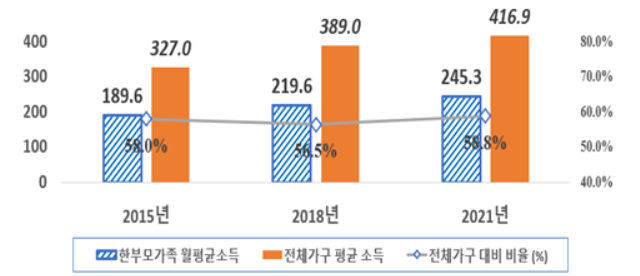
The average age of single-parent families is 43.6 years, with divorce (81.6%) being the most common status, and the average number of children is 1.5. Mother-centered households, where other generations such as grandparents live together (67.4%), account for the largest proportion, increasing by 1.9 percentage points compared to the 2018 survey. The average monthly income of single-parent families was 2,453,000 KRW, which is only 58.8% of the total household income.
More than 70% of single-parent families responded that they experience difficulties due to the burden of child support and education expenses. The difficulties felt in parenting varied by the age group of the children. Those with preschool children complained of lack of parenting and education information (65.3%) and difficulty securing caregivers (64.1%). Those with elementary school children reported difficulties in career guidance (58.1%) and parenting stress (51.5%). Those with children in middle school or older cited difficulties in career guidance (67.0%) and academic performance (59.2%) as challenges.
Care for single-parent families is mostly through facility childcare (84.0%), with only a few directly caring (9.0%) or receiving help from grandparents (5.5%). For elementary school children, half (48.4%) used after-school or care classrooms. More than half of children (57.5%) and single parents (65.6%) reported not contacting the non-custodial parent. Only 10.2% of children and 2.6% of single parents said they meet regularly.
The Ministry of Gender Equality and Family plans to establish the "1st Basic Plan for Single-Parent Family Policy," a mid- to long-term policy for single-parent families, and cooperate with related ministries to expand child support. They will also review ways to expand government support for child care services such as the Idolbom service. Various measures will be pursued to enhance the effectiveness of sanctions against non-compliant debtors to strengthen child support enforcement by non-custodial parents.
Kim Hyun-sook, Minister of Gender Equality and Family, said, "Strengthening child support to enable single-parent families to raise their children and live stably is included in the national agenda, and we will carry it out without fail." She added, "Based on the results of this survey, we will reduce the child-rearing burden of low-income single-parent families and consider various effective enforcement measures against intentional non-payment of child support debts."
© The Asia Business Daily(www.asiae.co.kr). All rights reserved.

















