Revision of Public Official Election Act... Changes in Standards Including Restrictions on Noise Regulation
Effectiveness Questioned Due to High Thresholds Despite Noise Regulation Standards
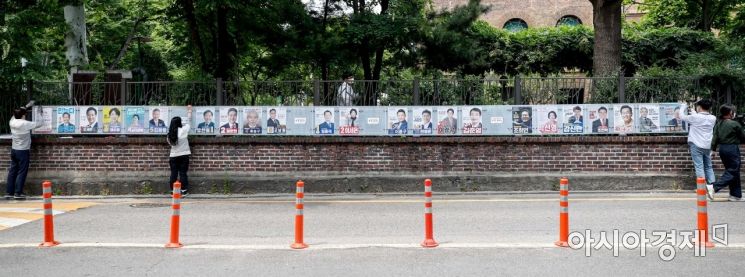 On the 19th, when the official election campaign for the June 1 local elections began, officials from the Jongno District Election Commission were posting election posters on the fence of the Artists' House in Ihwa-dong, Jongno-gu, Seoul. Photo is unrelated to specific expressions in the article. Photo by [photographer's name].
[Asia Economy Intern Reporter Kim Nayeon] As the official election campaign for the June 1 local elections begins and political parties and candidates launch full-scale rallies, voices complaining about 'noise pollution' are emerging across the country.
This election is the first to apply the revised Public Official Election Act, which limits noise during the election period, but there are criticisms that the law is ineffective because it allows noise levels up to 150dB (decibels), comparable to airplane takeoff noise.
Noise complaints have never ceased during election seasons. In January 2020, the Constitutional Court ruled that the Public Official Election Act, which did not set noise regulation standards for election campaigns, infringed on citizens' rights to live in a healthy and pleasant environment. In response, the National Assembly passed an amendment to the Public Official Election Act last December, establishing noise limits for campaign vehicles and loudspeakers. This law has been in effect since the 1st of last month.
According to the revised law, loudspeakers attached to vehicles must not exceed a rated output of 3 kW (kilowatts) and a sound pressure level of 127 decibels, and portable loudspeakers cannot exceed 30 watts output. However, for presidential and metropolitan/provincial governor elections, loudspeakers attached to candidate vehicles are allowed up to 40 kilowatts rated output and 150 decibels sound pressure level, and portable loudspeakers up to 3 kilowatts. Violations may result in fines of up to 10 million won.
Meanwhile, there are criticisms that the noise limits set by the Public Official Election Act are excessively lenient. According to the National Noise Information System, noise near railroads when trains pass is 100 decibels, car horn noise is 110 decibels, and noise generated during fighter jet takeoff and landing is 120 decibels. Since campaign vehicles can produce noise levels comparable to fighter jet takeoff and landing noise but still fall far below the enforcement threshold, the law is considered ineffective.
On the 20th, in Jeju-do, a man dissatisfied with the noise from speeches drove his car into a campaign site and was apprehended by the police, and candidate banners were damaged. The Jeju-do Election Commission reported that the man was reported to the police for violating election laws.
The man, a nearby resident, reportedly complained to the police and the election commission that the campaign was "noisy" as soon as it started, but when no significant action was taken, he committed the act.
© The Asia Business Daily(www.asiae.co.kr). All rights reserved.
![Clutching a Stolen Dior Bag, Saying "I Hate Being Poor but Real"... The Grotesque Con of a "Human Knockoff" [Slate]](https://cwcontent.asiae.co.kr/asiaresize/183/2026021902243444107_1771435474.jpg)











