"Afraid to Go Grocery Shopping," "When Will Prices Stabilize?" Common People Sigh
Soaring Food and Dining Prices, Supply Shortages and Increased Demand
Rising Meat Prices... Some Vegetables Affected by Poor Harvests
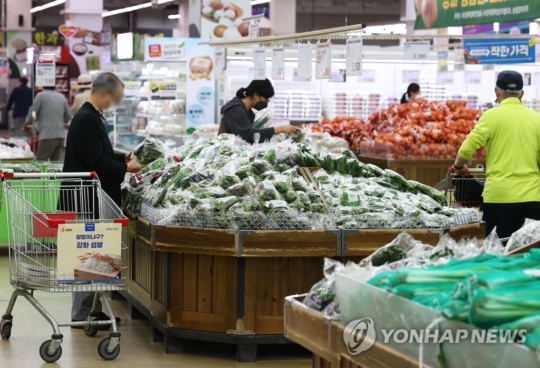
[Asia Economy Reporter Han Seung-gon] "Prices have risen so much that it's scary now." , "I hope inflation gets under control."
As prices rise across the board, the sighs of ordinary people are growing deeper. Not only food closely related to daily life but also dining-out prices continue to soar. According to Statistics Korea, consumer prices in April rose by 4.8%, the highest increase in 13 and a half years since the 2008 financial crisis. The government has begun preparing measures to stabilize prices.
Due to soaring prices, complaints such as "Everything except my salary is going up" are spreading among ordinary people. Mr. Kim, a company employee in his 40s, said, "I stopped my hobbies a long time ago," adding, "I only spend money on essentials like meals, but it's frustrating because prices keep rising." He continued, "I hope the government comes up with practical measures to control prices."
◆ "I can't even eat Samgyeopsal now" When will the price surge stop?
According to the '2022 Q1 Regional Economic Trends' announced by Statistics Korea on the 18th, nationwide prices in the first quarter of 2022 rose by 3.8% compared to the same quarter last year due to increases in petroleum products and dining-out. The quarterly increase is the largest since the 4.0% rise in Q4 2011.
Additionally, according to the Korea Rural Economic Institute, the grain import unit price index (edible grains, 171.7) for Q3 this year is expected to rise 7.4% compared to Q2 (159.9). Following an 11.3% increase in Q2 compared to Q1, the upward trend in grain import prices is expected to continue in the second half of the year.
The import price of feed grains for Q3 is also predicted to rise 6.8% compared to Q2. The import unit price index is an indicator that indexes quarterly grain import prices based on 2015 prices set at 100.
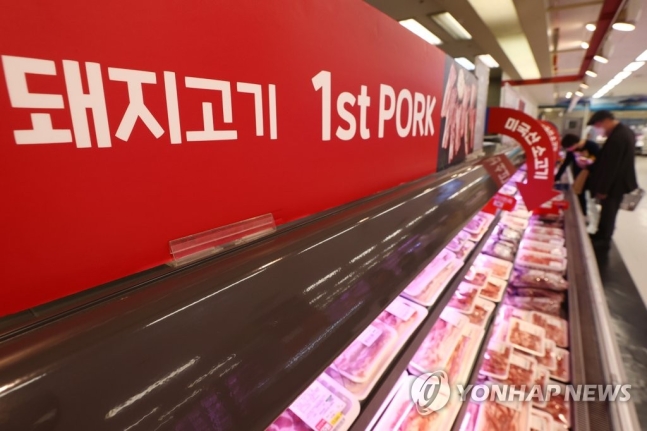 Citizens shopping at a large supermarket in downtown Seoul on the 5th of last month [Image source=Yonhap News]
The livestock situation is similar. According to statistics from the Livestock Products Quality Evaluation Service's Livestock Distribution Information as of the 18th of this month, the average consumer price of domestic pork neck per 100g was 2,661 KRW, up 18.5% from a year ago. The same amount of Samgyeopsal was 2,829 KRW, up 19.2%. Chicken prices rose 11.8% to 6,048 KRW per kilogram.
Due to the pork price increase, complaints like "I can't even eat Samgyeopsal" are emerging. Mr. Park, a company employee in his 30s, said, "Samgyeopsal is a staple menu when families dine out or eat at home," adding, "I actually hesitate a lot when choosing Samgyeopsal." Mrs. Choi, a housewife in her 40s, said, "When eating meat or chicken on weekends, I find myself wondering if there are cheaper dining options."
Imported meat prices have risen even more sharply. The price of U.S. beef (short ribs) is 40,403 KRW per 100g, up 77.8%. Australian beef is 40,385 KRW, up 81.0%, and imported Samgyeopsal prices rose 9.8% to 10,427 KRW per 100g. The industry views the rise in meat prices as a result of a combination of supply shortages and increased demand. The consumer price index in April also rose 4.8% compared to the same month last year due to the surge in international energy prices and supply chain disruptions.
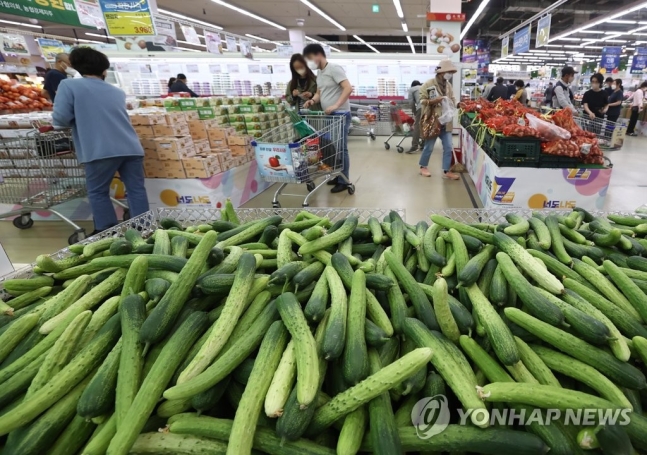
◆ Vegetable and egg prices rise, dining-out prices also on the rise... Government operates cross-ministerial task force for price stabilization
Meanwhile, prices of some vegetables have also increased. In a major supermarket, peeled garlic (300g) rose 20.1% compared to the first half of last year, and washed carrots (1kg) rose 14.4%. However, the distribution industry sees the price increase of some vegetables as mainly due to poor harvests, unlike other items.
Egg prices are also rising again. Egg prices soared in 2020 due to the highly pathogenic avian influenza (AI) outbreak but gradually stabilized from August last year. However, prices are rising again due to the sharp increase in feed costs caused by the recent rise in international grain prices.
At the same time, dining-out prices are also increasing. According to the Korea Consumer Agency's price information portal Chamgagaek, the price of cold noodles (based on Seoul) in April rose 9.5% year-on-year to an average of 10,192 KRW, surpassing 10,000 KRW for the first time. Jajangmyeon prices rose 14.1% to exceed 6,000 KRW, and Kalguksu prices rose 10.8% to surpass 8,000 KRW.
To reduce the burden of soaring food prices, the government is implementing various measures. To curb accelerating inflation as much as possible, the government is operating a cross-ministerial task force (TF) for price stabilization and is fully committed to price management. The newly established cross-ministerial price stabilization TF will be responsible for promoting short-term key tasks to stabilize prices in each ministry's jurisdiction. Additionally, the recently announced supplementary budget includes support for special feed purchase funds of 50 million KRW per farm at an interest rate of 1.8%. A total of 1.15 trillion KRW has been allocated for this purpose.
© The Asia Business Daily(www.asiae.co.kr). All rights reserved.
![Clutching a Stolen Dior Bag, Saying "I Hate Being Poor but Real"... The Grotesque Con of a "Human Knockoff" [Slate]](https://cwcontent.asiae.co.kr/asiaresize/183/2026021902243444107_1771435474.jpg)


















